

Notifications
Clear all
Joining the Renewable Heating Hub forums is completely free and only takes a minute. By registering you’ll be able to ask questions, join discussions, follow topics you’re interested in, bookmark useful threads and receive notifications when someone replies. Non-registered members also do not have access to our AI features. When choosing your username, please note that it cannot be changed later, so we recommend avoiding brand or product names. Before registering, please take a moment to read the Forum Rules & Terms of Use so we can keep the community helpful, respectful and informative for everyone. Thanks for joining!

Topic starter
21/12/2024 8:29 pm
As a GivEnergy battery and inverter owner, I was interested to discover the attached YT video interview with Paul Landregan, who is GivE's head of product development.
He describes a range of new battery and inverter products that are planned for release in 2025.
Mitsubishi Zubadan 14kW with Mixergy 210l DHW in 220m2 barn property. 24 solar panels = 9kWp with GivEnergy 5.0kW Hybrid inverter and 19kWh GivE batteries. Jaga Strada fan-assisted rads throughout. Landvac vacuum glazing/triple glazed windows.

23/12/2024 4:58 pm
Highlights which might be significant here are:
There is to be a new All-in-One inverter/battery combo, which is yet un-named.
The battery capacity is to be 13.6kW (from which we can infer that it has 16 cells, rated 280Ah),
and the inverter will be rated 12kW for input (charging) and export.
That's a major change of design.
Until now, GivEnergy's inverters have only delivered half-power for export/discharge.
There is presently no facility to operate these units in parallel, but that is being worked on.
(12kW offers 50A at mains voltages, which will be sufficient for many houses if you don't have an electric shower).
However, there will be a facility to increase the storage capacity by adding up to four DC-modules.
But note that GivEnergy have adopted a 'high-voltage' architecture. The more storage modules you have, the higher the voltage they present to the integral inverter.
The new All-in-One will have six MPPT inputs for solar panels,
each of which will be capable of operating from 90v - 600v, which roughly equates to 3-panels up to 15-panels.
That's a wider range than most other inverters.
For comparison, The Sunsynk ECCO inverters (3.3kW, 5.5kW and 16kW) have MPPT inputs operating between 150v - 425v.
Gateway-2 is a new development from Givenergy which allows in-home appliances to be activated according to If-Then-Else rules which are entered via the App.
It's up to the user to decide what gets connected, which could include:
- an existing (old style) non-Smart EV charger
- an immersion heater to use electricity from solar panels once the battery has reached a certain State of Charge (SoC)
The Gateway-2 also allows the user to define two categories of appliances which will be supplied from the All-in-One storage battery:
- Those essential devices which will supplied from the battery in the event of a power outage (internet, boiler, lights etc)
- Those devices which will be supplied from the battery whilst it still has more than 50% charge available
There will be three new 6kW, 8kW and 10kW 'high voltage' hybrid inverters.
Those three sizes define the maximum input from solar panels.
These are single-phase inverters which can connect to matching Givenergy 'high voltage' battery stacks.
Each battery stack can be 10.4kWh to 20.8kWh capacity...
... and up to four 20.8kWh stacks can be connected to a 'high voltage' hybrid inverter.
The existing 52v storage batteries are not compatible with this HV system.
The power charge/discharge available from the new HV Hybrid Inverters depends on how many battery packs are in the attached stacks.
Typically a 10kWh battery stack will allow the inverter to output around 7.5kW of power.
That's not a great deal.
It could operate a typical ASHP, but isn't sufficient to run the entire house.
Save energy... recycle electrons!

28/01/2025 11:00 pm
I’ve had no personal performance issues with our 9.5kWh battery at all. It chugs along nicely doing its job.
BUT although GE routinely say their products can be run in parallel the software to make it happen smoothly is often available only a year later. And the new products are not backward compatible. I fancied adding an AIO to our system but unless I programmed it myself on Home assistant it was not viable. Their advice was to sell the 2yr old battery (no resale value since not an open system) and buy one or more AIOs. No thanks.
My next battery hopefully will have 5 wheels when V2H goes operational.
2kW + Growatt & 4kW +Sunnyboy PV on south-facing roof Solar thermal. 9.5kWh Givenergy battery with AC3. MVHR. Vaillant 7kW ASHP (very pleased with SCOP >4) open system operating on WC
29/01/2025 8:06 pm
My next battery hopefully will have 5 wheels when V2H goes operational.
How much research have you done into this?
The large V2G trial undertaken by OVO/Kaluza 5 years ago could only be offered to drivers with a Nissan Leaf.
That's because they use a CHAdEMO connector, which carries the high-current DC wires to/from the vehicle battery.
The great majority of EVs in Europe use a CCS connector.
Home-chargers (7kW) use the top half of the connector to deliver 230v AC to the car.
There are two optional DC pins at the bottom which are used only if you wish to recharge from a commercial charger-unit (typically 50kW)
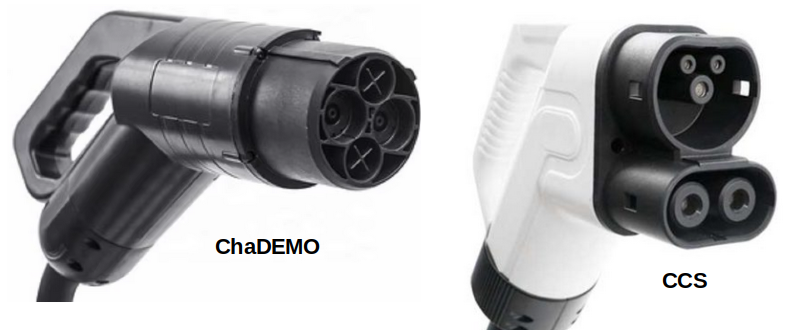
The present CCS connection system doesn't not facilitate discharging.
Indra Renewable Technologies developed the V2G unit on which the OVO Trial was based.
They were subsequently awarded a grant to create a CCS compatible unit.
How they hoped to achieve that is not publicised, but no public Trial was undertaken and no V2G or V2H units were released.
That need not mean that Indra's approach failed.
It could simply be the result of a decision by the shareholders not to proceed to production units.
This post was modified 9 months ago by Transparent
Save energy... recycle electrons!
1

29/01/2025 11:38 pm
@transparent I got as far as realising that patience would be a necessity! I did know the above at a superficial level but you have spelt it out clearly for anyone reading this thread.
2kW + Growatt & 4kW +Sunnyboy PV on south-facing roof Solar thermal. 9.5kWh Givenergy battery with AC3. MVHR. Vaillant 7kW ASHP (very pleased with SCOP >4) open system operating on WC

20/02/2025 8:51 pm
Highlights which might be significant here are:
There is to be a new All-in-One inverter/battery combo, which is yet un-named.
The battery capacity is to be 13.6kW (from which we can infer that it has 16 cells, rated 280Ah),
and the inverter will be rated 12kW for input (charging) and export.That's a major change of design.
Until now, GivEnergy's inverters have only delivered half-power for export/discharge.There is presently no facility to operate these units in parallel, but that is being worked on.
(12kW offers 50A at mains voltages, which will be sufficient for many houses if you don't have an electric shower).However, there will be a facility to increase the storage capacity by adding up to four DC-modules.
But note that GivEnergy have adopted a 'high-voltage' architecture. The more storage modules you have, the higher the voltage they present to the integral inverter.The new All-in-One will have six MPPT inputs for solar panels,
each of which will be capable of operating from 90v - 600v, which roughly equates to 3-panels up to 15-panels.
That's a wider range than most other inverters.For comparison, The Sunsynk ECCO inverters (3.3kW, 5.5kW and 16kW) have MPPT inputs operating between 150v - 425v.
Gateway-2 is a new development from Givenergy which allows in-home appliances to be activated according to If-Then-Else rules which are entered via the App.
It's up to the user to decide what gets connected, which could include:
- an existing (old style) non-Smart EV charger
- an immersion heater to use electricity from solar panels once the battery has reached a certain State of Charge (SoC)
The Gateway-2 also allows the user to define two categories of appliances which will be supplied from the All-in-One storage battery:
- Those essential devices which will supplied from the battery in the event of a power outage (internet, boiler, lights etc)
- Those devices which will be supplied from the battery whilst it still has more than 50% charge available
That all sounds very much like the Tesla Powerwall 3, but with slightly higher figures so the GivEnergy always comes out top in a game of Top Trumps (although I note the PW3 MPPT DC voltage range starts a little lower at 60-480V). I'm not complaining, strong competition pushes forward product development and we all benefit.
Samsung 12kW gen6 ASHP with 50L volumiser and large radiators. 7.2kWp solar (south facing), Tesla PW3 (13.5kW). Net Zero

28/12/2025 1:56 pm
One thing worth noting with GivEnergy, in comparison to all other batteries, GiivEnergy allows suppliers to lock out the user indefinitely. Where PW3 and others can lock you out for the duration of an event, yet users can still override it, GivEnergy is FOREVER. Once a lock has been initiated, you cannot remove it and gain access to your system unless the supplier or GiVEnergy remove the lock. Changing tariffs or removing API access doesn't fix it, so you can easily change tariff and remove API (as that's the logical thing to do) and Octopus will still control your battery screwing up with your new tariff.

This is a new feature introduced this year (2025).
This post was modified 9 months ago by DREI

28/12/2025 2:32 pm
One thing worth noting with GivEnergy, in comparison to all other batteries, GiivEnergy allows suppliers to lock out the user indefinitely.
Not accurate, I’m afraid, @drei. GivEnergy allows you, the homeowner, to choose to relinquish control of your inverter and battery to Octopus in line with the conditions of their intelligent tariff. If you don’t want to lose that control, you can choose not to sign up to Intelligent Octopus Flux.
This is not big bad Octopus and big bad GivEnergy imposing some sort of Orwellian dystopia on you; it’s an update to your system based on your choice, and it’s simply configuring that system to ensure Octopus get their side of the bargain too.
Once a lock has been initiated, you cannot remove it and gain access to your system unless the supplier or GiVEnergy remove the lock.
This demonstrates the restriction isn’t forever, and also that you have two different routes for regaining control - just not whilst signed up to a tariff that specifically prohibits it.
As far as I can see, the only people who’ll be put out by this are those trying to game the system; who want the extra discount on their rates (compared with non-intelligent Flux) but don’t want Octopus to have what they’re paying for through that extra discount.
I personally hate the idea of my energy supplier deciding when to charge or discharge my battery. That’s why I choose not to sign up to IOF. Similarly, in order to retain control of when I do or don’t charge my EV, I avoid signing up to Intelligent Octopus Go.
105 m2 bungalow in South East England
Mitsubishi Ecodan 8.5 kW air source heat pump
18 x 360W solar panels
1 x 6 kW GroWatt battery and SPH5000 inverter
1 x Myenergi Zappi
1 x VW ID3
Raised beds for home-grown veg and chickens for eggs
"Semper in excretia; sumus solum profundum variat"


28/12/2025 3:07 pm
I personally hate the idea of my energy supplier deciding when to charge or discharge my battery. That’s why I choose not to sign up to IOF. Similarly, in order to retain control of when I do or don’t charge my EV, I avoid signing up to Intelligent Octopus Go.
I have INTELLI-FIX-12M-25-08-29 and Octopus only insisted I would connect the car.
But I wonder if they would allow me to stay with this if I install an ASHP.. In any case, it is only a 12 month tariff
8kW Solis S6-EH1P8K-L-PLUS hybrid inverter; G99: 8kW export; 16kWh Seplos Fogstar battery; Ohme Home Pro EV charger; Vaillant Arotherm Pro 7kW; 100Amp head, HA lab on mini PC
28/12/2025 3:36 pm
GivEnergy allows you, the homeowner, to choose to relinquish control of your inverter and battery to Octopus in line with the conditions of their intelligent tariff. If you don’t want to lose that control, you can choose not to sign up to Intelligent Octopus Flux.
The strategy of a 3rd-party having (remote) control over devices in the home is in line with Government Policy.
It's understandable that two British companies would want to try out how this might work in advance of DESNZ allowing Elexon to issue the first licences for
their proposed Smart & Secure Energy System (SSES).
SSES depends on a consumer opting in to a particular scheme, just as Octopus are doing.
The 3rd-party Agent may or may not be your existing Energy Supplier.
But if you agree to the terms, then they have the capability to turn off whatever devices you have offered to be part of Consumer-Led Flexibility (CLF).
- heat pump
- EV charger
- home battery storage
Your electricity account then receives a credit for the time your device(s) have been off, plus a bonus for taking part.
That bonus, plus the Agent's management fees, plus Elexon's costs are to be funded by a levy placed on all electricity consumers.
Ie electricity prices will be higher for everyone when SSES 'goes live'.
Domestic devices which are to be accepted into the SSES scheme must have an on/off control mechanism to accept commands across the internet.
To prevent a householder bypassing that 'smart switch' and running the device during an off-period, readings are also taken from your Smart Meter.
DESNZ reckons that the scheme will be attractive to device manufacturers, who will start selling SSES-ready appliances in Britain.
They also anticipate other (European) countries wanting to join in, and use the Smart Control system under licence.
You may or may not agree with the SSES strategy, or the DESNZ expectations of it's popularity.
But GivEnergy have obviously decided that they need to have SSES-ready controls available on future products,
which is why it's advantageous for them to be tying up with Octopus at present.
Save energy... recycle electrons!

28/12/2025 3:48 pm
@transparent I know it is relatively early days for such technology; I found that IOF needs further development and sent details to Octopus in the hope that their programmers would take my comments on board. I found that as my Tesla Powerwall system is able to export to the grid at a rate of 10kW, my battery was drained to the lower limit in a little over two hours; the problem then was that the system started to re-charge again at the peak rate and at the time when the grid is under greatest strain!
Such ‘whoopsies’ are not what one wants if you would have no means of taking back manual control! Regards, Toodles.
Toodles, heats his home with cold draughts and cooks food with magnets.
28/12/2025 4:06 pm
Then, perhaps @toodles , you should've made a submission on that point when DESNZ ran a Public Consultation on the Governance of their SSES Strategy 3 months ago.
That consultation closed on 29th Sept, but you can read the 'Government Response' online here.
Have a look through to see if they've considered the need for compensation if consumers' devices are controlled to an extent which exceeds the contract with the Agent.
There were only 31 submissions to the Governance consultation.
There's no breakdown of those respondents by sector.
However, I'd be unsurprised if the majority of the other 30 were from companies in the energy sector who wish to be licensed as an Agent.
Save energy... recycle electrons!
Page 1 / 2
Next
SPONSORS
Degrees of Separation
Latest Posts
-

RE: Who's your electricity provider and what's your tariff?
@old_scientist There’s such enormous flux in energy mar...
By Papahuhu , 3 hours ago
-
RE: Analysis of the economics of switching to an A2W ASHP compared to other heat sources
@rob-of-york Very sound analysis, albeit for a curre...
By JamesPa , 6 hours ago
-
RE: Is it just me, or does tradesperson timekeeping and communication drive you absolutely mad?
Yes, and I would suggest likely to get worse with more ...
By Batpred , 1 day ago
-
RE: Electricity price predictions
This topic seems more suitable for this thread... I a...
By Batpred , 1 day ago
-
RE: Why are ASHP installs so expensive?
It is clearly difficult to say, there must be cases whe...
By Batpred , 1 day ago
-
RE: Panasonic Free Multi Z and Etherea Internal units.
@dgclimatecontrol Thank you for that information and re...
By Toodles , 1 day ago
-
RE: My Kronoterm Adapt 0312 ASHP is finally installed!
@editor It was serendipitous really. Both my wife and I...
By tomasmcguinness , 2 days ago
-
@mrkfm, I'd also suggest that whenever you're ready, st...
By Mars , 2 days ago
-
RE: Are you planning to use a wood burner to supplement your central heating this winter?
I use my stove daily for backup and comfort. Definitely...
By Margarethomas , 2 days ago
-
@rob-of-york Thanks. I wish I'd started on this site as...
By mrkfm , 2 days ago
-
RE: Solar Power Output – Let’s Compare Generation Figures
@downfield I just checked this morning and OE just r...
By Papahuhu , 2 days ago
-
RE: Passiv Smart Thermostat - Help & Forum Support
Thanks Will. I'll probably be a week or so before get...
By Singlespeed , 3 days ago
-
RE: Cooling using an air to water heat pump
From experience this summer, a single-split A2A unit on...
By Rob of York , 3 days ago
-
RE: Cooling with air to water heat pumps
@editor does that mean you have to have two separate ex...
By mrkfm , 5 days ago


SPONSORS