Joining the Renewable Heating Hub forums is completely free and only takes a minute. By registering you’ll be able to ask questions, join discussions, follow topics you’re interested in, bookmark useful threads and receive notifications when someone replies. Non-registered members also do not have access to our AI features. When choosing your username, please note that it cannot be changed later, so we recommend avoiding brand or product names. Before registering, please take a moment to read the Forum Rules & Terms of Use so we can keep the community helpful, respectful and informative for everyone. Thanks for joining!
@heacol and I are very much in agreement on this issue.
As we migrate to a grid with more high-current inductive loads and switch-mode power supply units (SMPSUs) we are increasing losses on the Distributions Grid (132kV and below).
The main thing I disagree with @editor is the choice of graphic for this discussion and Brendon's main article! 😘 Solar panels themselves are DC, and therefore have no harmonics. If I could draw cartoons, I'd be creating an image of a solar inverter and a heat-pump singing in discord!
Everything we do on this journey towards Net Zero needs to be DNO-friendly. Otherwise they will be forced to take ever more expensive measures to overcome the heat we create by introducing losses on the grid. Ultimately we are all paying for that... especially through hefty rises in Daily Standing Charges.
The two main electrical interferences we throw at the grid are
Phase imbalance
Harmonics
Phase imbalances occur because most of our houses have only a single-phase supply from the 3-phase local substation.
The larger the current we take, the worse will be the level of imbalance.
The current taken on our 1-phase feed completes the circuit via the neutral wire. But Neutrals were never intended to carry such currents. Older (underground) 3-phase feed cables most often used a neutral conductor only 50% the size of the three phases.
The Neutral is not fused at the local substation. When it passes too much current, it gets degraded by thermal stresses and will fail.
Although I can obtain data from a number of monitored sub-stations, I do not have access to the engineers' reports of what I'm seeing. The annotations in the above diagram are my own interpretation/analysis of what's going on, rather than an authoritive statement of facts.
The time when our substation feeds and transformers are most at risk of damage due to phase-imbalance is in the early days of households installing EV chargers and Heat-pumps.
The first such Low Carbon Technology (LCT) on that substation will obviously invoke imbalance. You would need to have three identical installations on each of the three-phases, and with the same on/off timings to restore balance.
But DNOs have only sparse information on which phase supplies which property. In practice the phase connections are random. Statistically we will experience increasingly large losses due to phase imbalance until around 10% of houses have LCT installations.
Turning to the subject of harmonics, these cause more serious issues for DNOs because the frequencies pass through the local substation and onto the entire network of transformers.
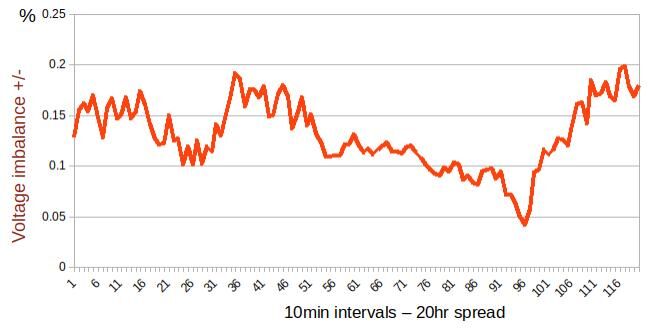
The usual way that network engineers assess the adverse effects of harmonics is to measure the voltage deviations (plus and minus). These are then added together and logged at 10-minute intervals to produce a timeline like this:
Since the harmonics are introduced by the heat-pump itself, you may think that there's little we can do about it.
As @heacol states in his article, the DNO's solution of 'network upgrades' can be eye-wateringly expensive (£134k!).
But we could instead operate our heat-pumps in an off-grid mode by using battery storage.
This wouldn't resolve the issue referred to by Brendon, where the heat-pump itself is outside of specification. Whilst the battery is being recharged from the grid, the inverter temporarily supplies the 'off-grid' devices directly from the household mains incomer. Such a connection would therefore still be illegal.
But for an in-spec heat-pump, faced with a choice of a £134,000 payment to my DNO, or the installation of an impressively large storage battery, the latter option becomes extremely viable.
What is even more attractive is the added resilience which is gained by running the heat-pump (and other household appliances) from a storage battery. In the coming years we will see the introduction of Nodal-Pricing. That provides cheaper electricity during times of abundant supply within your own locality.
The more we can store during times when renewable generation is plentiful, the less load we place on the grid during times of national peak-demand. In turn, that reduces the likelihood of power-cuts. And, even if there is an outage in the area, we probably won't notice because our storage battery has effectively de-coupled the house from such occurrences.
As consumers we expect the electricity supply to our homes to be both reliable and of consistent quality. We are immediately aware when the supply is no longer reliable, since our lights go out, but I don't know of anyone who would actually check, or be aware, if the quality of the electrical supply was sub-standard.
According to the Electricity Supply Regulations a single phase supply should be at a nominal voltage of 240v +/- a specified percentage, at a frequency of 50 Hz +/- a specified percentage. The regulations do not appear to contain any specified limit on harmonics present.
From the point of view of generated harmonics there are two categories of equipment:-
Devices that take power from the mains supply and produce other frequencies within the equipment that may possibly leak back into the mains supply either by direct connection or radio transmission outside the equipment. As far as direct connection is concerned, there are regulations about the amount of back fed harmonics that are allowed from consumer equipment, which should contain suitable filters to prevent or at least limit such back fed harmonics. Obviously there is a possibility of back fed harmonics if the filtering should fail. Radio transmission harmonics should be prevented or at least be limited by suitable screening, but are more likely to effect communication equipment rather than the mains supply.
Devices that generate electrical power are a more likely source of harmonics within the electrical supply system, since they will probably be taking a DC supply and converting it to an AC output. This is where the quality of the electronic circuit design and operation will come into play.
The generators in power stations are machines, in which the rotor turns at approximately 3000 rpm (hence the 50 Hz frequency) and produce a sinusoidal waveform output. Inverters are electronic devices which take DC and produce an AC output, but may not produce a true sine wave. When selecting such equipment one should look at the specification, to check the Total Harmonic Distortion (THD), which is a measure of how close the waveform produced matches a true sine wave. Wherever possible equipment claiming to be a Truesine device should be selected.
Having seen the quality of industrial equipment coming from some of the far eastern countries, I always look very closely at the specification of any equipment coming from such sources. It is often a matter of 'never mind the quality, feel the width' for those old enough to remember.
The main thing I disagree with @editor is the choice of graphic for this discussion and Brendon's main article! 😘 Solar panels themselves are DC, and therefore have no harmonics. If I could draw cartoons, I'd be creating an image of a solar inverter and a heat-pump singing in discord!
Point well taken. Images for subjects like this can be tricky. Replaced with an AI interpreted generic image. No heat pump, but less ambiguous.
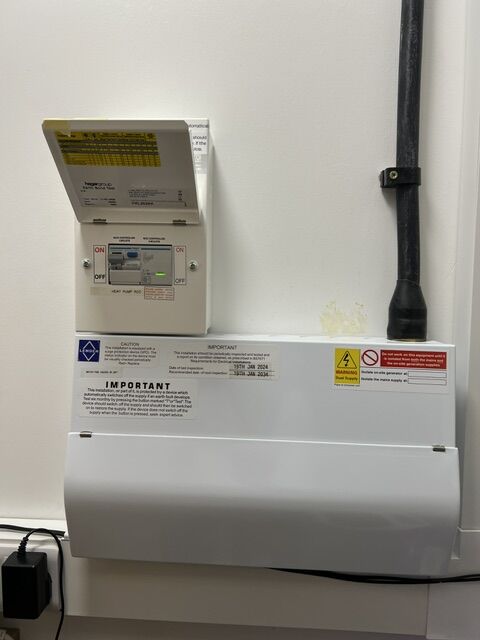
We had a discussion elsewhere about protection devices and specifically the type of RCDs required by some heatpumps. Vaillant specifically collaborated with Hager for this.
My understanding (and I could be wrong) is that the harmonics passed upstream by heatpump inverters (that convert the AC current into DC) can cause issues to grid transformers. And that this could limit the number of appliances that can be connected in the same "street".
And not knowing for sure if the DC leakage is solved,
The issue isn't DC leakage.
Type-B RCDs and RCBOs will trip correctly despite the waveform having a DC component present.
You need the contacts to open when there is a genuine difference of 30mA or more between the AC current being supplied via the Live and returning in the Neutral. A Type-B will do so; ie the DC element is ignored.
The presence of a DC component is usually regarded as an undesirable effect imposed by EV Chargers.
The presence of harmonics is generally associated with heat-pumps.
It seems odd to me that Vaillant have introduced an AC to DC power supply into their ASHPs which is imposing both errors onto the mains incomer to sufficient extent that the company has teamed up with Hager to recommend a particular protection trip. The message it gives to me is "our power supply design isn't good, and we haven't fitted HF filters either!"
Consumers shouldn't be asked to spend £600 having an expensive RCD fitted just because the heat-pump power supply has design deficiencies.
I've created the above timeline from spreadsheet date sent to me by a DNO.
It shows the absolute deviation of voltage imbalances which are being passed through local substations and on to the higher voltages of the Distribution Grid (11kV and above).
Whilst losses due to phase imbalances are substantially occurring only at the local substation level, harmonics pass right through every transformer on the grid. This is what causes the audible hum when you're in the vicinity of larger transformers. That's energy being lost.
Vaillant are introducing a new heatpump range, the Pro, that we will probably use. But I am not sure this is addressing the harmonics.
The Arotherm Plus includes the following statement when the describing the electrical installation:
This unit complies with IEC 61000-3-12 under the prerequisite that the short circuit line Ssc at the connection point for the customer's installation to the public grid is greater than or equal to 33
This apparently (and I could have got this wrong) implies that there is a maximum number of heatpumps that can be connected, as each contributes its own set of harmonics and the DNO local grid has limited capacity to absorb this.
The current process is that any new heatpump requires an application to be made to the DNO (not a notification), which arguably adds to the time for a retrofit heatpump install. This time is critical in the case of distress purchases.
Heatpumps also need to be in the ENA list before the DNO´s express application process can be used (the Arotherm Pro heatpump is still not in the ENA list).
The translation of the Arotherm Pro also mentions the same standard and limit.
Applicability: VWL 55/7.1 A 230V or VWL 75/7.1 A 230V. This appliance complies with IEC 61000-3-12 provided that the short-circuit power Ssc at the customer's connection point to the public network is greater than or equal to 33. It is the responsibility of the installer or operator to ensure, after consultation with the network operator if necessary, that this appliance is connected only at a connection point with an Ssc value greater than or equal to 33.
I am curious regarding whether it is this risk of harmonics that is justifying the DNO applications? And could the DNO process be shortcircuited without technical risk in case of heatpumps not using DC inverters?
8kW Solis S6-EH1P8K-L-PLUS hybrid inverter; G99: 8kW export; 16kWh Seplos Fogstar battery; Ohme Home Pro EV charger; Vaillant Arotherm Pro 7kW; 100Amp head, HA lab on mini PC
The current process is that any new heatpump requires an application to be made to the DNO (not a notification),
I cant comment on harmonics but, if I read this flow chart correctly (by the ENA so presumably definitive) a whole load of heat pump installs will be connect and notify. Other than in unlikely circumstances only if your supply is looped in or you need a fuse upgrade is it an application
This post was modified 2 months ago 2 times by JamesPa
4kW peak of solar PV since 2011; EV and a 1930s house which has been partially renovated to improve its efficiency. 7kW Vaillant heat pump.
In my recent Vaillant install I had some lengthy discussions with my installer as to why I needed another consumer unit and this special RCCB from Hager. I gave in at the end. Added over £600 to my install costs.
I am just curious as to whether the need for an application instead of a notification is related to the harmonics. As this could be causing delays to heatpump retrofits (your other post).
Reading the original news of this thread, that I understand @heacol made and that @editor mentioned, it seems a heatpump model was seen by a DNO to have caused a issue. I wonder how this is resolved in other countries like Germany..
8kW Solis S6-EH1P8K-L-PLUS hybrid inverter; G99: 8kW export; 16kWh Seplos Fogstar battery; Ohme Home Pro EV charger; Vaillant Arotherm Pro 7kW; 100Amp head, HA lab on mini PC
I am just curious as to whether the need for an application instead of a notification is related to the harmonics. As this could be causing delays to heatpump retrofits (your other post).
Not according to the ena flowchart to which I posted the link earlier. I therefore question why an application is needed in your case
4kW peak of solar PV since 2011; EV and a 1930s house which has been partially renovated to improve its efficiency. 7kW Vaillant heat pump.
One reason is that the Arotherm Pro is currently awaiting inclusion in the ENA database (so not marked as "connect and notify"). This approval is required before the installer can submit what they call the "standard fast-track DNO application".
Our installers are treating it as an application.
8kW Solis S6-EH1P8K-L-PLUS hybrid inverter; G99: 8kW export; 16kWh Seplos Fogstar battery; Ohme Home Pro EV charger; Vaillant Arotherm Pro 7kW; 100Amp head, HA lab on mini PC
One reason is that the Arotherm Pro is currently awaiting inclusion in the ENA database (so not marked as "connect and notify"). This approval is required before the installer can submit what they call the "standard fast-track DNO application".
I spoke to UKPN and they just asked to use a form (as the portal system does not have that specific model).
it goes through the lot, details asked are extensive and they would have “fun” with our case.
This is why our installers will prefer to wait for a connect and notify option..
8kW Solis S6-EH1P8K-L-PLUS hybrid inverter; G99: 8kW export; 16kWh Seplos Fogstar battery; Ohme Home Pro EV charger; Vaillant Arotherm Pro 7kW; 100Amp head, HA lab on mini PC