
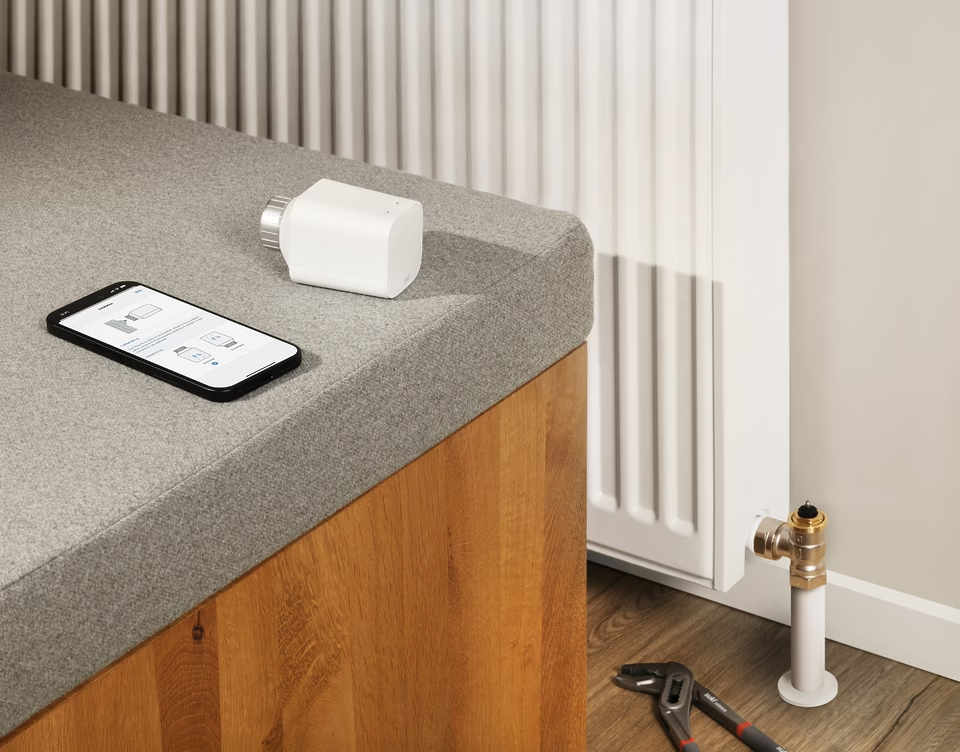
The Eve Thermo Gen 5 has arrived as one of the most refined smart radiator valves on the market, launching in late 2025 with a sleek redesign and cutting-edge features that set it apart in a crowded field.
This isn’t just another gadget… it’s a premium, privacy-first solution that combines Matter and Thread connectivity for seamless integration across major platforms like Apple Home, Google Home, Alexa and SmartThings, all without subscriptions, cloud dependency or data sharing.
What makes this generation truly special? The compact, tapered design with matte and glossy finishes blends effortlessly into modern homes, while the built-in LED display and touch controls allow instant manual adjustment… no app required.
The real game-changer is its near-silent operation, a massive improvement over previous models that addressed common complaints about noisy valves. Pair it with the optional Eve Thermo Control external sensor for pinpoint accuracy (measuring temperature at your bedside or across the room instead of next to a hot radiator) and you get unparalleled precision. Add in thoughtful details like automatic valve exercising to prevent sticking, year-long battery life from simple AAs and effortless installation that even DIY novices can handle in minutes: unscrew the old, screw on the new, scan a QR code, and you’re done.

er,,, but presumably its still a TRV and thus not particularly suitable for heat pumps?
@JamesPa I think there’s a role smart TRVs can play in botched heat pump systems… As I explained in the video, rooms with significant solar gain will benefit from a well set up TRV, with that water being circulated to rooms that need the extra heat. We certainly feel that in our system. Also as mentioned in the video, a well set up, balanced heat pump system will not need TRVs, but I feel there’s a place for them in zoned systems.
Fair enough. I confess I didn’t listen to the video. Im not sure the use you describe is limited to botched heat pump systems though, as you say rooms with solar gain may benefit even in well balanced ones as solar gain is very variable.. What I guess I was getting is clarity that this is still a TRV and so not suitable for ‘mass’ installation on every or even most rads in a typical heat pump system.
I do personally still think there is a role for an automated FRV, basically what Adia do but meshed without the central controller (if its possible to design the control algorithm). Clearly such a device isn’t necessary, but it might act as a useful way to stop people who insist on putting TRVs on everything because that’s what they are used to from messing up their system (or their customers system) as a consequence. It would also give the control industry a future, which might reduce the extent to which they foist wholly unsuitable products on us!
There’s a very interesting product coming out this year that’s been developed by one of our podcast members (top secret) that’s going to give Adia a real run for its money. We have an NDA with them, and I get regular updates from them, and I think it could be a real game-changer for heat pumps (and boilers).
On the subject of our non-automated FRVs, I think that they do a reasonable job, but I’m finding that they’re not very accurate.
Thats an interesting comment. Does accuracy matter or is it sufficient that the adjustment (valve authority according to Heat Geek) is reasonably linear and constant once adjusted? Surely there is still an element of tweaking needed at set up time (relative to the ‘theoretical’ setting) because rads will never, ever, be perfectly sized!
We have three rads at the start of the heating circuit that get the bulk of the hot water. I’ve ‘throttled’ the FRVs down to 0.5 litre/minute. Even with that, the rads get toasty. Then last week my wife told me the rads in those rooms are now stone cold. I checked, the FRVs are still at 0.5 litre/minute but zero hot water. So I had to open them further to 1 litre/minute. That’s allowed the water to flow again, but this has already had a knock on effect on our rads at the far of the system. It’s painful.
Interesting. Are they getting bunged up do you think, or somehow ‘shifting’. I haven’t seen them in the flesh but from the photos they look like they are based on the flow valves used for UFH. I saw another post where these had clearly got bunged up, you could see the grot! 0.5l/min is 175W at DT5, fairly low but nowhere near outside the range at which they need to work if they are to cover most reasonable situations.