
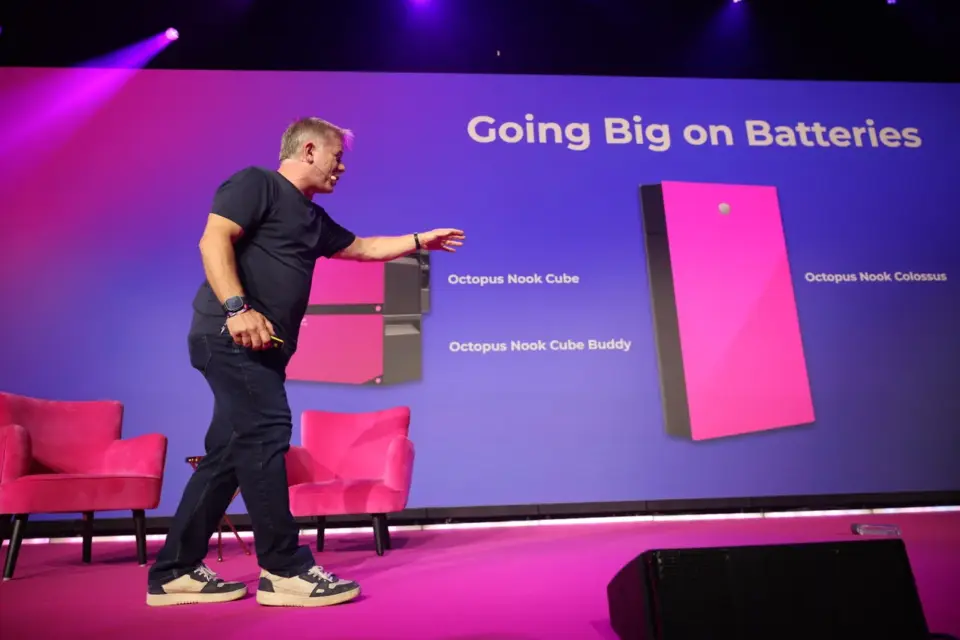
Octopus Energy has become the first major British energy supplier to launch its own home battery range, unveiling two products at its Energy Tech Summit in London that between them target a market the battery storage sector has largely ignored: the ten million households in the UK who rent.
The announcement covers two distinct products aimed at two very different living situations and the timing is not subtle. With energy bills rising 13% from July and wholesale gas prices still lurching in the wake of Iran conflict, the case for taking your energy future into your own hands has never been made more forcefully, and Octopus is positioning itself to profit from exactly that anxiety.
The first product is the Nook Cube, a compact, 2kWh plug-in battery roughly the size of a shoebox that connects to a standard household socket with no engineer and no installation required. Up to five units can be stacked to reach 10.5kWh of total storage. It takes solar MPPT inputs too, so it can run as a pure tariff battery from day one and accept panels later without swapping the unit.
For renters, the concept of simply plugging in energy hardware has until very recently been not just impractical but illegal. Until April 2026, BS 7671, the UK’s wiring regulations, treated any source of generation behind the consumer unit as a fixed installation, which ruled out consumer kits plugged into a standard socket. BS 7671 Amendment 4 came into force on 15 April 2026, capping plug-in output at 800W per home. The UK spent years watching Germany register over a million plug-in solar installations while British renters were told their ring mains couldn’t handle it. .
Whether the product standard that certifies specific kits for the UK market will be in place before Octopus begins selling next year remains to be seen. The BSI product standard has still not been published, though it is expected around July 2026.
The second product is the Nook Colossus, a wall-mounted 10kWh system installed by Octopus engineers and stackable up to 30kWh for larger properties. Jackson said it will be priced at around a third cheaper than the best-known battery brands, a direct shot at Tesla’s Powerwall, which currently retails at around £8,000.
Both products ship with what Octopus calls Octopus Intelligence, software that automatically optimises charging and discharging against their smart tariffs, buying cheap electricity at off-peak rates and drawing on stored power during expensive periods. The headline claim is a two to three year payback with no solar at all, purely from charging on the cheapest grid rates and using that energy through expensive peaks.
Take that figure with appropriate scepticism. It assumes a wide and sustained spread between cheap and peak tariff rates, a household disciplined enough to let the system optimise properly and Octopus tariff pricing remaining competitive. That said, the underlying logic is sound, particularly for households already on Agile or Intelligent Octopus tariffs, where the off-peak and peak price differential can be substantial. For a heat pump household already running overnight charging, a battery that automates that logic without manual timer-setting is genuinely useful.
Both products are compatible with solar panels, carry a 12-year warranty and will be available to Octopus customers in the UK, Germany, France, Italy and Spain from next year. Neither firm pricing nor full technical specifications have been published.
The question that has not been answered yet is whether the Nook products will be available only to Octopus electricity customers. Nobody has confirmed this either way. Given that the Octopus Intelligence optimisation is tied directly to their tariffs, the likely answer is yes, which means this is as much a customer retention and acquisition play as it is a product launch. Households considering a battery will have a meaningful commercial reason to switch to or stay with Octopus. That is not a criticism. It is just worth naming clearly.
For the heat pump community, the combination of a time-of-use tariff, overnight cheap electricity and a battery to store it represents the closest thing to genuinely affordable low-carbon energy management that currently exists for most households. If the Nook Colossus is priced as aggressively as Jackson is suggesting, it makes that combination meaningfully more accessible. At a moment when bills are rising again and the structural case for energy independence has never been clearer, the timing of this launch is either very well planned or very fortunate.
Probably both.
