
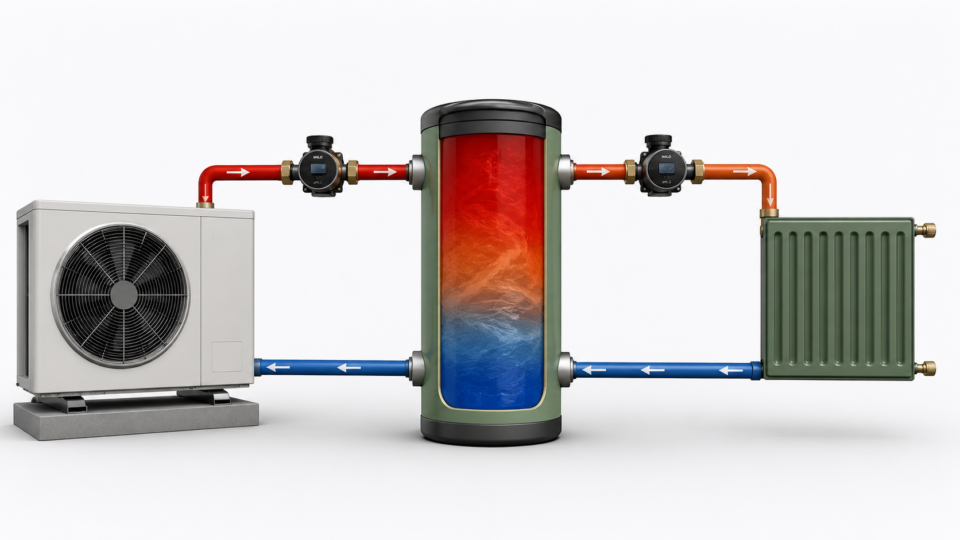
Most homeowners never see what’s happening inside a buffer tank. The heat pump is producing hot water. The radiators or underfloor heating are receiving warm water. Everything appears to be working as intended. But in almost every heat pump system fitted with a 4-port buffer tank, one critical question is rarely asked: Are the flow rates on either side of the buffer actually matched?
In reality, they almost never are. The heat pump circuit and the heating circuit are typically operating at different flow rates. Unless both sides are being measured and carefully commissioned to match one another, the system is hydraulically out of balance most of the time. The result is mixing inside the buffer tank.
This process is often invisible, the system still runs and the house may still heat up, but some of the heat energy the heat pump has generated never reaches the emitters at the temperature intended, and that is far more important in a low flow temperature heating system like a heat pump.
So the question is not whether mixing is occurring. In most buffer tank systems it almost certainly is. The question is how much. A small mismatch may have little practical impact. A large mismatch can significantly reduce emitter temperatures, force the heat pump to operate at higher flow temperatures and ultimately increase running costs.
This calculator has been designed to help visualise that effect. By entering flow rates and temperatures on both sides of the buffer, you can estimate how much temperature distortion may be occurring and how much potential heat is being diluted before it ever reaches the radiators or underfloor heating.
It is not a commissioning tool and it does not replace proper design, measurement or system balancing. Real-world performance depends on many factors including pipework design, pump settings, controls, buffer geometry and system resistance.
What it can do is help reveal one of the most poorly understood aspects of heat pump system design: the difference between the temperature being produced by the heat pump and the temperature actually being delivered to the home.
If you’ve ever wondered why so many top heat pump designers and installers work hard to avoid unnecessary hydraulic separation, this calculator may help explain why.
Buffer Tank Mixing Calculator
This tool shows how mismatched flow rates on either side of a 4-port buffer tank can blend hot flow water with cooler return water, reducing the temperature reaching your radiators or underfloor heating.
Inputs
What this shows
When the heating circuit asks for more flow than the heat pump is supplying, the missing water has to come from somewhere. In a 4-port buffer, that can mean cooler return water being blended into the heating flow. The result is that your radiators may not receive the temperature your heat pump is producing.
If the heat pump then has to run hotter to restore the lost emitter temperature, efficiency can fall. This tool uses a simple rule of thumb: each additional 1°C of flow temperature may add around 2.5% to running costs.
