
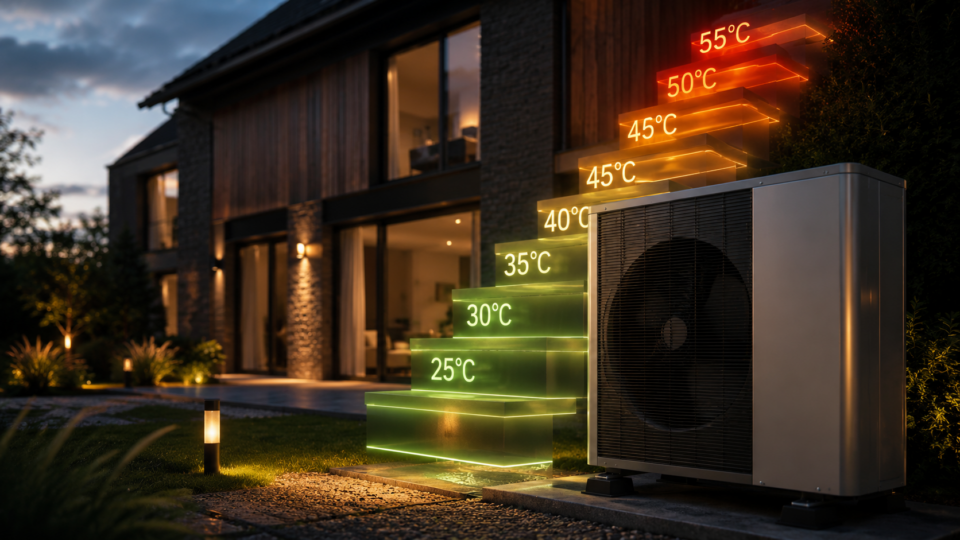
Most homeowners are told that heat pumps work best at lower flow temperatures. The problem is that nobody explains what that actually means.
Many heating systems are still operated with a traditional boiler mindset: set the flow temperature high, leave it there and assume hotter water equals better heating. Heat pumps don’t work like that.
As flow temperatures rise, efficiency falls. The heat pump has to work harder, electricity consumption increases and running costs can climb surprisingly quickly.
Our interactive simulator below allows you to compare a weather-compensated heating system against a typical fixed-flow approach. Move the sliders, explore different scenarios and see how outdoor temperature, flow temperature and efficiency interact.
You may be surprised by what happens when you start turning the temperature down.
Weather Compensation Curve Simulator
See how lower flow temperatures can improve heat pump efficiency and reduce running costs.
This is an educational estimate only, and the tool is still being developed and improved. Real-world performance depends on heat pump model, emitter sizing, controls, commissioning, hot water use, defrost behaviour and the quality of the installation.
