
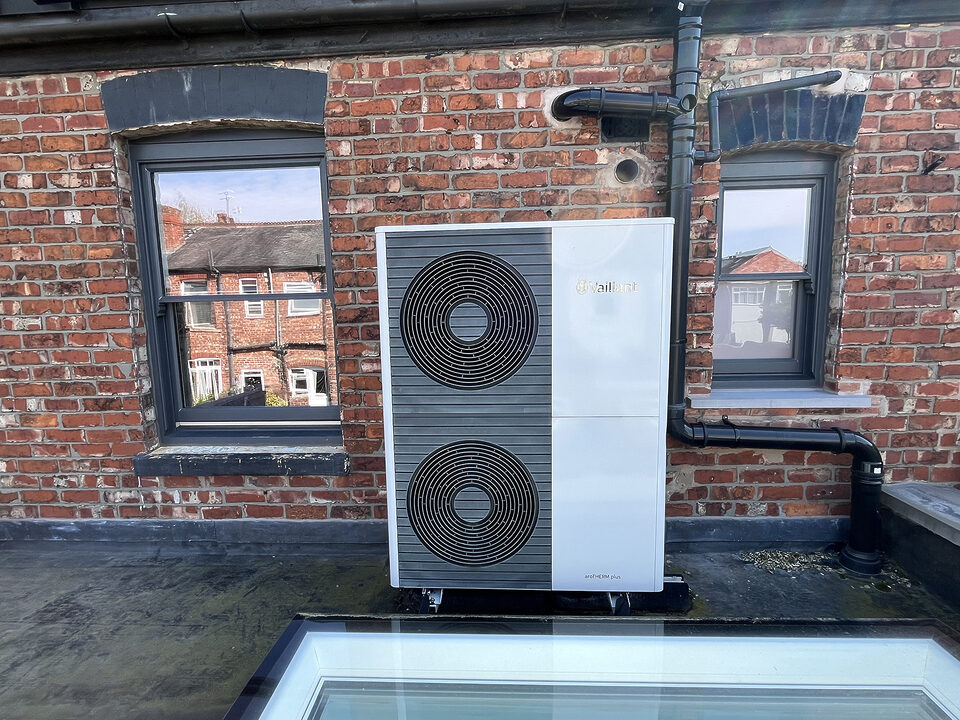
We are an unremarkable couple in our 60s, living in a 1900 three-bedroom terraced house in South Manchester. In 2022, after receiving a small inheritance from our parents, we decided to take the plunge and invest in a new central heating system to replace our temperamental 30-year-old boiler.
After much research and deliberation, we decided to ‘do the right thing’ environmentally and invest in an air source heat pump. The environmental credentials were appealing (roughly four units of electricity generated for every unit consumed), as was the government’s support in the form of a BUS (Boiler Upgrade Scheme) grant which, at the time, was £5,000. We would also be able to get rid of the gas supply completely and save additional costs by not having to pay the monthly gas standing charge.
We didn’t know of anyone else who had installed an ASHP, so we were in unfamiliar territory and learning one step at a time. There were so many acronyms to come to terms with (EPC, MCS, NAPIT, BTU values, BUS grants, CWI…).
It was complicated and confusing, and we felt quite overwhelmed and lacking in confidence. It would have been so helpful to have had some independent, easy-to-understand overview of the process… a metaphorical ‘holding of our hand’ through it all. We didn’t know where to look. Advice seemed patchy and far too technical for us newbies to understand. We were both working full time, still supporting adult children, having building work done and had very little spare time to deep dive into the world of heat pumps. But we took it one step at a time, researched as much as we could, and kept asking lots of questions.
The first step was to find an ASHP installer. We knew from online research that it was important for the installer to be MCS registered. We contacted ten installers based in and around Manchester, all of whom were MCS registered. After asking some basic questions as part of the initial enquiry, we shortlisted these down to five. We invited them to come and look at our property with a view to providing advice, a quote and a recommendation for which model of ASHP they thought would best suit our home. From the quotations received, we chose RA Renewable Solutions. We discussed the pros and cons of different ASHP models and settled on the 11kW Vaillant aroTherm. They were also happy to install underfloor heating in the kitchen as part of the installation, which some installers were not willing to do.
To qualify for a BUS grant, we had to commission an EPC (Energy Performance Certificate) assessment and implement any recommendations, particularly in terms of insulation. The assessment recommended cavity wall insulation (CWI). However, because of the age of the house (1900), our walls only had finger cavities which were too narrow to accommodate regular insulation. This all had to be proved and documented.
Firstly, we had to commission a chartered surveyor to inspect our walls. He asked us to commission a CWI installer to inspect the walls with a borescope and send him the photos, which we did. Three reports later (and a rapidly depleting budget), we were finally able to complete a ‘Cavity Wall Insulation Exemption Form’. Instead of CWI, we committed to removing the existing plaster on the two external walls (front and back) and replacing it with new thermally insulated plasterboard, which would have the same effect. With this in place, we were finally eligible for the Government’s BUS grant.
The next step was to buy radiators so that the builders knew where to put the pipe centres when installing the plumbing first fix. The ASHP installer commissioned an assessment of the BTU values required for each room. This came to us in the form of a rather blurry, difficult-to-read WhatsApp screenshot, rather than the detailed report we were expecting. However, we took it along to a radiator retailer and asked them to interpret the values for us so that we could properly size the radiators. Radiators were ordered and pipe centres marked on the plans.
An ASHP system needs a large water tank. We had originally specified a Vaillant uniTower hot water cylinder. However, after discussions on site, the installer suggested we change this to a horizontal hot water cylinder, which would fit under the eaves in the loft and be a better use of space. We emailed the installer to ask if the new cylinder (Joule) was compatible with a Vaillant ASHP system and whether it had a warranty comparable to the Vaillant uniTower. We received a reply confirming that the Joule cylinder was compatible with our ASHP system and had a 25-year guarantee.
There were some delays to the building work. Some were the fault of the builder (subcontracted suppliers were not organised in a timely manner). Others were caused by unforeseen structural issues. After removing the old plaster to replace it with thermally insulated plasterboard, it was discovered that the front elevation of the house was structurally unsound and had to be rebuilt. We provided the ASHP installers with the builders’ contact details and vice versa so they could coordinate timescales. We asked the installers whether the delays would affect the BUS grant (given the three-month expiry period) and were assured that it would not.
Once the installation was completed and we had paid in full, we received an MCS certificate and an IWA Insurance Certificate by email. The installers received a £7,500 BUS grant as part of the final payment. We did not receive a formal ‘handover pack’ explaining how to use and maintain the system, which we later learned should have been provided. Instead, the installer verbally explained the controls. There was no independent verification that the system met required standards, and as homeowners, we were not qualified to assess whether everything had been done correctly.
Four months after completion, we experienced a serious water leak from the area of the water cylinder. The leak was severe; water came through the ceiling and ran down the walls below. We tried contacting the installers via WhatsApp and email but received no response.
Following guidance from Ofgem and MCS, we contacted the MCS helpdesk. They advised us to write to the installer by letter and allow 14 days for a response. NAPIT provided the same advice. We were also warned that using another installer could invalidate warranties and insurance.
This advice was impractical. We had to turn off the water to prevent further damage and could not realistically live without heating or hot water for two weeks. We eventually found another engineer who agreed to help as an emergency. He fixed the immediate issue (a failed automatic air vent) and identified multiple problems with the installation. We commissioned a report detailing faults, non-conformities and recommendations.
The scale of the issues was a shock. We followed the formal complaints process, but the installer denied any problems. One key issue was the hot water cylinder, which was not a high-gain model suitable for a heat pump system. The installer claimed it was. We contacted the manufacturer directly, who confirmed it was not suitable.
We then commissioned a second independent report from a Vaillant engineer, which corroborated the findings and identified further issues, including electrical faults.
Shortly afterwards, we discovered the installer had ceased trading. We submitted a claim to the insurance provider (IWA), which was rejected because we had not contacted them within 30 days of the issue arising, despite following official guidance at the time.
After escalating to the Financial Ombudsman, we initially won our case, but the insurer rejected the claim again under a different clause. Ultimately, only two minor issues were accepted for coverage. The majority were deemed ‘upgrades’ rather than defects.
After months of further reports, evidence gathering and correspondence, we were left with an expensive, poorly installed system and no meaningful recourse.
We didn’t know where to turn until another engineer pointed us towards Mars and Renewable Heating Hub. For the first time, we felt we had found someone willing to listen and help. It became clear that our experience was not unique. There are systemic issues: poor oversight, weak enforcement and inadequate consumer protection.
We have now contacted our MP, Jeff Smith MP, and will be meeting him in April 2026 to discuss our case.

Thanks for the post @Ian and I find stories like yours deeply frustrating.
What stands out most isn’t just the installation issues (which are serious enough), but the complete breakdown in consumer protection once things started to go wrong. The fact that you followed the prescribed process (MCS, NAPIT, Ofgem guidance) and still ended up effectively locked out of any meaningful support is a real concern.
That said, I’d be really keen to understand a bit more detail on the insurance side, if you’re happy to share.
Specifically, do you have clarity on exactly which clauses IWA relied on when rejecting your claim, both the initial 30-day notification issue and the later “upgrades vs defects" argument? And did they provide any detailed justification as to why something like an incompatible cylinder wouldn’t be considered a fundamental installation defect?
Also, when they re-rejected the claim after the Financial Ombudsman ruling, did they explicitly reference different policy wording, or was it more of a reinterpretation of the same terms?
I’m asking because I’d like to dig into this further and because I’ve heard some really dodgy things about IWA. There are some pretty serious implications here around how these policies actually function in practice (particularly when installers cease trading) and whether homeowners are being given a false sense of protection. Just another policy blunder IMO with no real backbone.
Once I have the reasoning, which I would like to document publicly, I will take this up with the chiefs at IWA because it’s simply unacceptable.
Thank you for looking into this on our behalf Mars. I can’t tell you what a relief it is to finally find someone who is: taking us seriously; who has a good handle on the issues; and who doesn’t just pass us on to another unhelpful organisation.
Firstly, I would like to reiterate that we didn’t go into choosing an ASHP lightly. We did a lot of research and followed all advice to the letter. We’ve spent a lot of money and didn’t cut any corners. Yet we still ended up with a poor installation. We are determined to fight this battle to the bitter end for a number of reasons:
I just wanted to explain our perspective – and that this isn’t just about getting recompense for our own poor installation, but an attempt to highlight systemic issues that will only become entrenched if not dealt with effectively as a matter of urgency.
I will answer your specific questions in the following reply…
Our initial claim was rejected by IWA under Clause 2 of their T&Cs (… “providing that (a) the IWA has been notified within 30 days of the fault first occurring…”).
After the first rejection of our claim, we went to the Financial Ombudsman. They found that this clause was unfair because:
So essentially, whatever action we took when the fault first occurred would have resulted in our claim being rejected by IWA. We were in a “no win” situation.
The Financial Ombudsman stated that IWA Insurance should reconsider our original claim. IWA came back to us and told us that they would be rejecting the original claim based on two further clauses in their T&Cs:
“Clause 4: No cover is provided for faults that occurred (whether notified or not) prior to the supplier ceasing to trade other than breaches of building regulations which will be covered"
“Clause 5: No cover is provided for any items or work carried out that is not a result of faulty workmanship"
We replied to IWA with a tabulated document, listing all the faults that had been listed in the two reports (one from an independent ASHP installer, and one from an independent Vaillant engineer, both of which corroborated each others’ reports). Next to each system fault or issue of non-compliance, we stated where this did not meet building regulations.
IWA Insurance replied and stated that:
“…unfortunately we regard the majority of faults as upgrades to an existing installation to improve its performance and efficiency, we do not regard the replacement of parts for more efficient parts to be a breach of building regulations and also not a fault of poor workmanship"
This reply was bewildering. Our original installation was still intact and at no point had we “replaced parts for more efficient parts”. It felt like IWA was inventing things that hadn’t happened in order to wriggle out of its obligations to us.
IWA did, however, agree to accept liability for two minor faults:
I would like to point out that, as consumers, we had no say in the appointment of IWA Insurance to underwrite our installation. The company that installed our ASHP and central heating system were responsible for this choice. If we had read the IWA Trustpilot reviews, we would have avoided them at all costs. I looked at the Trustpilot reviews in June 2025 and found that 60% of customers that had reviewed them gave them only 1* (out of 5) and there were a plethora of complaints, which included:
Also, IWA stated on the home page of their website:
“We protect our contractors’ customers with policies that are user-friendly, easy to understand and with no hidden small print“
However, the clauses that IWA relied on to reject our claim were buried in tiny print on page 3 of a 4 page document. (I noticed that IWA have recently removed this statement from the front page of their website).
As consumers, it’s very difficult to know whether a system has been installed correctly or not as there’s no independent verification or oversight. Most domestic customers are not engineers! That’s why we commissioned (and paid for) three independent engineers’ reports. However, it has been fairly easy to check whether the hot water cylinder was compatible with an ASHP run system as we simply rang Joule (the cylinder manufacturer) and asked them. They categorically stated (and confirmed in a follow up email) that the cylinder that had been installed in our system was NOT compatible with an ASHP system. IWA Insurance have NOT provided any detailed justification as to why faults such as the installation of an incompatible cylinder were not considered as ‘faulty workmanship’.
IWA seems to have a policy of rejecting claims on very tenuous grounds. They also put responsibility back on the customer by asking them to provide quotes (ASHP engineers are incredibly busy people and it’s very difficult to get them to come out and provide quotes for fixing small issues caused by another installer), which adds to the delays in resolving the claim. After two years of pursuing this, many customers would have given up on their claim because of the huge amount of time and additional expense it incurs. I believe that this is the outcome that IWA are hoping for.
Questions need to be asked about whether IWA’s dubious practices are legal. At the very least, our experience is evidence that they have acted in “Bad Faith” and avoided their obligations under the Insurance Backed Guarantee. Regulators need to ask whether IWA can continue to provide insurance for ASHP installers, especially as the victim of their unscrupulous methods of rejecting claims are not the person that took out the insurance, but the customer of the installer. This customer, by default, is already undergoing the ordeal of trying to get recompense for a poor installation and none of it is their fault.
Firstly can I say how sorry I am to hear your story. Water leaking isn’t bad design or anything to do with ASHPs, its just shoddy workmanship which (sadly) can happen with any plumbing work, which is neither a comfort nor an excuse. Poor oversight and weak enforcement/consumer protection is, sadly, true of the construction industry generally, its not confined to heat pumps.
Often in these circumstances self help (or an element of self help) is the best help. If you would like to post the report on the problems (redacted if you choose) and summarise those that actually remain, we may able to give some simple pointers/advice. It can almost certainly be broken down into several individually fairly easy changes, which it may well be possible to advise on. The basic kit you have, a Vaillant 10/12kW heat pump, is a very good piece of kit indeed and, connected directly to a heating system, should be returning about 4* the energy you put into it and keeping the house much more comfortable than you can ever achieve with a conventional boiler set up. As you have swapped from a 30 year old boiler you should be saving money and be more comfortable, as well as doing ‘the right thing’.
Your alternative is a long complaints process. If you paid anything on Credit Card then section 75 protection may well apply and at least one person here has been successful in using that.
If you would like to explore ‘self help’ or even just receive a commentary on the severity of the problems that remain, please do post further.
Hi James
Thank you for taking an interest in our predicament.
Tbh I’m very surprised that you suggest we pursue a ‘self help’ option. We have paid £14,000 of our own money and the Government have contributed an additional £7,500 BUS grant, meaning that the installers walked away with £21,500 after completing an installation that was not fit for purpose. Why should we have to fix a plethora of serious problems ourselves after paying out such an enormous sum of money?
We have no engineering qualifications or experience. If we try to fix some of the problems ourselves, we run the risk of making things worse because we don’t know what we’re doing, as well as invalidating the insurance.
We didn’t pay on credit card unfortunately. The money came from my hard working Mum in the form of an inheritance after she died. This is another reason that we’re so upset that this has been squandered by people who didn’t do a good job, and that the people who are supposed to be regulating them and protecting us have also failed to do their job properly.
@Ian, thank you for the detailed update and for not letting this drop after two long years. Reading through the contradictory rejections again, the ‘upgrades not faults’ line, the buried small print and the mountain of effort you’ve put into independent reports (Vaillant + specialist + manufacturer confirmation on the incompatible cylinder), it’s exhausting just to follow. You’ve done everything right, followed the advice and still hit a brick wall. That’s not bad luck … it’s a symptom of how broken the safeguards really are, and the forums and my inbox are filled with similar cases.
I’m taking a straight stance here… successes in these complaints are slim. The system is hideously broken. Your “no win” situation with the 30-day clause, the Ombudsman nudge and then the pivot to other exclusions is classic. Many people simply give up because of the time, stress and extra cost involved, and I suspect that’s exactly what some in the chain are banking on. It’s a ridiculous system.
We’ve helped hundreds of homeowners tackle similar issues with different installers, warranties and faults over the years, and the honest truth is that very few of the overseeing organisations have been of any real assistance. The responses are often slow, defensive or pass-the-buck, which only adds to the frustration.
The IWA model (which I’ve not really dealt with much) feels particularly flawed. Installers hand over a policy customers never shopped for, with the reassuring “user-friendly, no hidden small print” claim on the old homepage (now removed). MCS itself stopped allowing IWA policies to be bought through the MID back in December 2024, and the whole Insurance Backed Guarantee (IBG) approach is being phased out during the 2026 redevelopment of the MCS scheme. The new setup brings in mandatory MCS-approved financial protection products with a minimum 6-year workmanship cover, simpler claims routes, stronger consumer focus and even direct outreach from MCS to households after installation. I’ll caveat that by saying it looks lovely on paper, but MCS do not have a great track in implementing anything of substance.
On the wider picture, we’re funnelling public money into this transition at a time when energy security and genuine Net Zero progress is more vital than ever. Underperforming or non-compliant systems don’t cut emissions efficiently, they drive up running costs and they undermine confidence in clean heat exactly when we need it most. Your fight isn’t just about getting your own installation sorted properly at no extra cost to you… it’s about forcing accountability so others don’t have to go through the same ordeal.
I will personally bring this thread to the attention of the organisations responsible for oversight (MCS, DESNZ/BUS team, Ofgem) and see what they say.
Out of interest, who was your installer’s consumer code… was it HIES or RECC? That can open up another route for escalation and arbitration, even if the main warranty battle is with IWA.
Thanks for the support and excellently articulated summary Mars. So good to hear that you understand our situation.
The installer’s consumer code was RECC. I did contact them, but they just passed the buck and told me to contact our insurer.
Noted.
Im being pragmatic, recognising the reality that (a) you presumably want working heating and (b) the complaints path is long and tortuous (and not always successful) and you appear to have hit a bit of a brick wall (c) you appear to have no section 75 protection which can be an option of last resort and (d) the insurer is being uncooperative.
Im not defending the position, just saying it as it is. Unfortunately there are scum out there who will rip people off and, whilst we have much better consumer protection than many countries, it is still not bombproof.
Given that the ombudsman suggested that IWA should reconsider the claim and they did but still rejected it, is it open to you to go back to the ombudsman? Presumably you could take IWA to court if you believe that they are in breach of contract?
I completely understand your entirely reasonable desire to get it fixed at no cost to yourself, and wish you the best of luck in doing so. Like you I have recently been the victim of poor workmanship by the construction industry (which, lets face it, is notorious for poor workmanship) and know just how frustrating it is.
I have just dug out my own guarantee (which is by IWA) and read the conditions, which I reproduce below.
Its pretty limited. Its cover applies only if the supplier has ceased to trade. Faults must be notified within 30 days otherwise they are not covered. Faults which occurred before the supplier ceased to trade are not covered, whether or not they were notified.
The effect of this in practice is to exclude pretty much any poor workmanship (because the fault occurred before the supplier ceased to trade). Essentially, as I read it, it would cover only failed parts occurring after cessation of trading, which would probably anyway be covered by manufacturers warranty. So it’s only obvious value is cover for fitting the parts. Also crucially it won’t cover anything if the fault occurs before a supplier ceases to trade, they fillibuster, and then cease. This is another hole in something that is already a collander masquerading as a saucepan.
I would personally rate this insurance as near worthless.
I must admit the very strict limits of cover, some of which I can understand but some of which I can’t, have come as a surprise to me. Its not positioned this way by the industry imho. The old saying ‘insurers never take risks’ certainly applies here!
Nevertheless, shocking though it may seem, I can see no way that this can be reinterpreted to cover poor workmanship occurring before the supplier ceased to trade. @Ian it might be worth your while reviewing your list in case there are further elements you could dispute. I’m presuming the installer went into administration in which case you may have a claim on that, but you are not a preferential creditor so in practice the probability of getting anything is small.
I know this is not what you want to hear but it’s probsbly better to be realistic about the prospects, as @Mars says above.
I’m sorry to have to say this, it shouldn’t be this way!
I know you have a pretty good eye for detail, @JamesPa, but even then I wonder if you spotted at the time of install just how toothless the guarantee was.
It highlights to me something I’ve seen plenty of times before – and been guilty of myself plenty of times too – which is that no matter how rigorously you try to research something new before committing to it there will still be a lot of important things you don’t know you don’t know. I was just plain lucky when we had our install that, each time I learned something new on this forum, I went back to my system to check and found the installers had followed best practice. I was far less prepared than @Ian and it’s pure good fortune we managed to pick an honest and competent installer.
IMHO, industry bodies (like MCS) should be protecting the customer from the consequences of ignorance in things only a professional should be expected to know, but as we’ve seen so many times before that simply doesn’t happen. I know I’m not saying anything new, but it’s such a significant failing within the industry that it bears repeating again and again. As things stand, it seems customers are expected to be heating system experts to spot design flaws, project managers to keep installers on track, professional negotiators to avoid unnecessary hidden costs, contract solicitors to ensure the safety nets are actually fit for purpose and clairvoyants since even the best installers may well encounter the unexpected.
Simply put, no I didn’t.
That said I didn’t place much mental value on the insurance element. I watched the installer carefully to ensure that they did what they contracted to do, and made sure I had the manufacturer guarantees. I was confident in the design so this element wasn’t a consideration.
Thanks for the contributions on the issue of IWA Insurance everyone. I think we are all agreed that this insurance company is not fit for purpose (personally I feel that we have been scammed by IWA).
However, my point remains that this is a systemic issue. The person that chooses the IBG is the installer who will not be affected if they turn out to be rogues. The person that stands to lose out financially by this inadequate insurance cover is the customer who has no say in the choice of the insurer. This disconnect enables insurance companies to act with impunity as there’s no consequences for them in terms of business loss due to poor reviews.
Agreed, @Ian.
And, to do the point justice, that systemic failure extends way beyond the insurance. It often seems as if all the involved parties are united AGAINST the consumer. Every instance of a happy customer I’ve ever heard of has been the result of the chosen installer doing what they’re supposed to. I have not yet heard of an instance of a customer successfully overcoming a botched install except either by their own efforts or with the help of communities like this forum.
We just received an initial guestimate from EDF for a BUS heatpump install. It included an IWA leaflet…
This is an extract of what it says for deposit protection:
At the time of paying a deposit you should be issued with a Deposit Protection certificate from IWA. This document will protect your deposit, prior to the commencement of the contract for up to 25% of the contract value, subject to the terms and conditions on the certificate
Also, for the IWA Guarantee Insurance:
Your contract will be insured for a period of up to ten years and is underwritten by FCA authorised Insurers,subject to the terms and conditions on the Certificate.
Then, under Warning:
In the event of an insurance claim refer to the Certificate for the procedure. If you have not been issued with a policy you do not have insurance cover.
And EDF did not include the terms and conditions for neither the IWA Deposit protection nor the Guarantee when they send the IWA leaflet…
Interesting, my protection was only for 2 years and, as I post above, essentially worthless.
I didn’t even get the terms of the insurance when I contracted, I only got them after completion. Given the wording of the insurance itself (if yours is similar to mine) this is arguably mis-selling by the installer (who has probably never read the terms himself).
… perhaps the main reason why, when people come here with tales of woe, I fairly soon suggest self-help with the assistance of this forum. Its the only proven way to get botched instals fixed once the installer has vanished, and certainly the only way likely to yield results within a heating season.
There is one exception I know of, @DREI, who had the good sense/good fortune to pay in part on credit card, has succeeded (after a long battle) in getting money back under section 75 of the Consumer Credit act. Thats no credit to the industry though.
@JamesPa In a different but somewhat similar situation, I had bought kW’s in Ripple Energy’s Project 4 Wind Farm. Due to poor management, and possibly worse, this project collapsed but as I had paid by credit card, I was able to claim full reimbursement from my bank under a section 75 claim. Regards, Toodles.
Completely agreed. Unfortunately this sort of situation is not restricted to heat pumps. As I say above, our consumer protection is better than some countries, but nothing like bombproof. Caveat emptor!
I am going to say again that, as voters, we must bear some responsibility. For 53 years out of 80 since the second workd war the government we have voted for has been overtly ideologically disposed towards low/no regulation. MCS, the industry watchdog, is a product of that. It was originally established by Government, but in 2018 it was spun off as a private organisation funded by the industry. He who pays the piper calls the tune. That is no consolation for affected individuals, but we may all need to adjust our expectations given our collective voting habits, whilst of course continuing to campaign for better.
@Ian. If there is any way we can assist with pointers to things you could do (or have done fairly cheaply) to improve your system I, and I’m sure others, am/are happy to try.
RECC are abysmal. I was hoping it’d be HIES.
I’m not convinced that quite captures the problem because we do have a lot of regulation, we’ve got volumes of Building Regulations with reams of requirements and legal obligations to fulfil when doing pretty much anything on our own homes, which now restricts what work the average person can do legally. We’ve got numerous Competent Person Schemes with all of their training, registration and on-going membership requirements, more industry bodies and schemes than you can shake a stick at.
It’s not that Britain has too little regulation, in some areas I’d argue we have too much, but rather it’s that a lot of the regulation is poorly defined and inadequately enforced. Britain also seems to have a serious problem with regulation creep, where because regulation is itself now a profit-making industry, all of those bodies involved with regulation are continually pushing to expand their power, expand their responsibilities, introduce new requirements to then require further training, further accreditation all with more fees and incomes to those bodies and training providers. It isn’t clear whether this is actually raising standards and beneficial to the end consumer.
Britain has far too much regulation, with so much that it is unenforceable, we need less regulation, cut it back to the really important things but with much more rigorous enforcement processes for those critical regulations.
@Temperature_Gradient
The problem with this argument is, what is critical/important? Obviously people will disagree. So if you start of with the ideological principle of little regulation, as you propose, you will almost certainly not get the regulation that is critical to you. Whatever you may think someone else wont want it/wont deem it critical and, if the principle is little regulation the arguments against hold more sway than arguments for.
However, as I say, low regulation has been the argument for 53 out of 80 years since the second world war, and what we have is the result. I’m not saying that’s wrong or right, just how it is. With this approach don’t expect bombproof consumer protection or even building regulations that stop 72 people dying in a tower block fire.
Also I disagree that regulation is unenforceable, it is enforceable through the courts. The problem with this is that going through the courts is a slow process which most individuals wont be willing to do. Of course one could set up some state backed ‘regulation police’ as an alternative individuals going through the courts, but thats effectively more regulation which you oppose.
Your point about regulation being industry led is something that I wouldn’t argue with. However this is also a consequence of our choice to elect governments committed to low taxes and a reduced civil service. The consequence is a civil service that is reliant in part on industry for technical advice, and less capable of challenging the (almost inevitably partisan) advice when its given by the industry. Thus there will inevitably be an element of regulation that ‘suits’ industry, even in a ‘low’ regulation regime. As I say above MCS is a great example of this, set up, arguably for good reason, by Government but then privatised and funded by the industry. What outcome do you expect?
Again I’m not saying that any of this is wrong or right, just that we have to own the real-world consequences of our decisions, rather than blaming everything on others, remembering always that human beings will, for the most part, act in their own self interest.
Of course it is easy just to blame everything we dislike on ‘others’ and deny any personal responsibility. Elections are won that way so its also very powerful.
@Temperature_Gradient, @JamesPa, I think there is a significant trap that is easily overlooked. “Unenforced” and “unenforceable” are linked but not the same thing. Eventually, we have a lot of regulation that is perfectly enforceable but is to all intents and purposes not enforced. That has the effect of removing that regulation entirely since, if it’s ignored, it might as well not exist.
I don’t have all the solutions but the answer cannot be more regulation that is similarly ignored. A good start, IMHO, would be improving enforcement of existing regulations and pressuring MCS etc. to do their job seems an obvious first step. However, that requires political cohones and I see precious little of that in any of the parties on offer.
Before worrying about cohones you need to have the political desire. A low regulation environment also comes with a presumption against special government-sponsored systems to enforce regulation, because these are themselves more regulation and of course raise taxes. We have a system, the courts, it works if we choose to use it. That is entirely consistent with a low regulation mindset and I think those who espouse that mindset would argue that nothing else is needed
I would argue that the current government may well have the political desire, but as you say doesn’t (by and large) currently have the cohones and, like you, probably doesn’t currently have a solution even if it did. I would also argue that, in a political environment where the electorate predominately vote for low regulation, that is something we cant reasonably expect in a first term, its more a second or even third term thing.
So IMHO we have to make a choice. Low regulation and enforcement through the courts only (= low enforcement) or higher regulation and maybe, if we give a government sufficient time and make our desires clear, a more stringent enforcement regime (albeit at the cost of higher taxes).
Yet again we need, IMHO, to own the consequences of our decisions.
The current Government has clearly indicated it intends to monitor MCS more closely from a consumer protection standpoint than was the case under previous governments. It remains to be seen whether this will have any effect in the remaining approx three years of the current term. I would argue that this is barely long enough for any major effect to be visible, so our expectations should be fairly low however hard the government may try. If, at the next general election, we choose a government which has a similar political desire, then I think we can reasonably expect greater change. If we again opt for low regulation, then not so much.
That said it is unclear to me what the job of MCS actually is. Since 2018 it became a private body sponsored by the industry and as such is primarily answerable to industry not to the electorate, the Government or consumers. It does have a privileged position, which is the leverage the Government has over it. That leverage only applies (since May 2025 in England) when the BUS grant (or other grant that requires MCS) is in play, not to any case where there is no such grant. That’s significant but not absolute.
The fact that MCS is a private body sponsored by the industry is, you surely cannot deny, a more or less direct consequence of our collective preference, expressed through the ballot box, for low regulation and low taxes.
Once again Im not advocating any particular position, but I do feel very strongly that we need to accept that we make choices when we cast our votes, and own the consequence of those choices even when that works against us.
Risk based – does a particular activity/product pose a significant risk to people, in terms of harm, requiring regulation to bring that risk down to a tolerable level.
There’s a difference between the quantity of regulation and the quality of that regulation. I disagree that Britain is a ‘low regulation’ country, in terms of the quantity of regulation, Britain has masses of regulation. I would argue the problems lies not with the quantity and the broad scope of activities covered, but rather the quality of that regulation and the enforcement of it is where the problem is.
We need less quantity, but better quality and better enforced regulation. That has been the issue with building fires, we have lots of regulations covering this, and testing houses and processes but the quality of that regulation, its effectiveness and enforcement is where the problem lies.
If the mechanism for enforcement is highly slow, inefficient or unworkable then the outcome is the same as if it’s unenforceable, because effectively it is.
It wouldn’t be a state ‘regulation police’ rather it would be likely be a reversion back to more local building inspection and a much tighter, more crisply defined regulations on what building products can be used, product testing, minimum acceptable designs etc.
I agree there’s a real problem about the UK Government and civil service and it’s lack of technical expertise, which affects a vast number of policy areas.
Again though it’s the difference between quantity of regulation and quality, we do have significant quantity of regulation around these areas. For a heat pump, it needs to meet and be signed off against the Building Regs to be legal, which in practice (for almost all installs) means it needs to be installed by a installation company registered in a Competent Person Scheme, in theory the company and its staff need to have been adequately trained, follow the standards, they’re tested, the company is accredited, they’re part of consumer redress schemes etc etc.
There’s a very large amount of regulation here, no lack of quantity we don’t need more, any issues lie in the quality and the enforcement and the regulation we’ve already got.
So does that excludes consumer protection (which is what triggered this discussion) other than safety matters (which weren’t involved in the trigger)?
If it does include consumer protection what is ‘significant’. To someone with little money every £ is significant. To Jeff Bezos £1M is small change? This particular case is £10-20K, nothing to Jeff Bezos, an annoyance but ultimately bearable to many, life changing to many others. Where do you draw the line and more importantly how do you get agreement on that and the tax/cost implications?
As I say people will disagree and if the disposition is to low regulation then you wont get the regulation you want, because others will have different priorities.
I didn’t originally say we were a low regulation country, what I said originally was that for 53 out of 80 years we have elected governments that are ideologically disposed towards low government intervention/regulation. That disposition could manifest itself in ineffective regulation (ie regulation in name only – there for appearance but deliberately near useless in practice) just as it could manifest itself in low regulation. I would argue it has in fact done a mix of both and that MCS is (possibly by design) actually a shining example of a regulator that may not be useless, but clearly doesn’t fulfill people’s expectations.
The first point is undeniably true for those with little money. Unless the issue is life threatening its not true for people who can afford to wait for the courts. For them its just a manageable cash flow matter because they will eventually recover by suing the culprit. Again it depends on your perspective. For those with the money to sue, regulation (other than for life threatening things) is largely unnecessary. This itself has consequences which I will touch on towards the end.
Local building inspection is a form of state regulation police, ie its a government sponsored/defined organisation which polices regulations. If the electors express a preference for low regulation/low tax then expanding this force this runs contrary to the preferences expressed by the electorate. It has to be paid for one way or another and if we dont want to pay for it we cant expect to have it.
Who will write this? Who will do the product testing. If its to be independent of the industry it will need to be state supported or a tax on the industry which is then used by one level of Government or another to sponsor independent work. The building regulations are already pretty crisp from my reading so we are going to need some even better people and thus we will have to pay them more.
This whole discussion started because of a clear example where this doesn’t work to protect the customer. So everything you say in the above quote may be true, but it doesnt address the point that triggered the discussion.
IMHO the other thing to bear in mind is that regulation, other than for life threatening matters, doesn’t materially advantage those who have the means to sue. In fact it probably disadvantages them because effective regulation enforced other than through the courts costs money and they are quite likely to end up paying more (through taxation, levies or restrictions on what they can do to rip other people off) than it would cost them simply to sue on the occasions when things go wrong for them. It may advantage such people if there is some ineffective regulation, it doesnt cost much, fools a good proportion of people for long enough to secure their vote, and provides a reason to argue against regulation in the future!
Thus the only thing that almost everyone has a shared motivation to regulate well is life threatening matters. Even that isnt quite as simple as it first seems, those who are unlikely to live in tower blocks in Kensington and Chelsea have little motivation to regulate well even life threatening things that only affect such tower blocks! Ultimately it comes down largely to an argument about the extent we should, as a nation, protect those who do not have the means, at the expense of those who do. Answers to that one in the ballot box please!
My fundamental point though is that we, by and large, get what we vote for, within the constraints of the real world, which is populated by imperfect people most of whom act largely in their own self interest. Therefore we have to take some responsibility for that. Put another way Disgusted of Tunbridge Wells should IMHO consider whether their own voting choices have contributed to the situation with which they are expressing disgust and, if they have, should recognise that their moral right to complain is severely curtailed. I am not referring to anyone in particular, but I would be fairly certain that some who complain about the situation both here and elsewhere fall into this category.
@ian-w Getting back to the problem in hand, what do you plan to do next?
If there is any way we can assist with pointers to things you could do (or have done fairly cheaply) to improve your system I, and I’m sure others, remain happy to try. As I said earlier your principal component, the Vaillant 10/12kW heat pump, is a good piece of kit so this situation is surely recoverable quite possibly at modest cost.
Even if all you did was to work out, with the help of those here, what actually must be done (and what could be left) that might well help your next steps
Most of you will have seen Sarah and Ian Ward’s thread and their experience of a botched installation in south Manchester, an incompatible cylinder, a collapsed installer and an IWA insurance policy that turned out to be near-worthless when they needed it most. We published their story on the site and I’ve been working with them in the background since to try to get some traction.
Today that work landed. The Financial Times published a full reported piece on what happens when heat pump installations go wrong, and Sarah and Ian are at the centre of it. Renewable Heating Hub and our forum data featured centrally in the piece too. If you haven’t read it, it’s worth your time: https://www.ft.com/content/83d3342b-55dd-4414-8ccc-e7c25423550e
Here are some RHH-related snippets from the piece.
Now, to the MCS bit in the article, because this is where it gets interesting.
Ian Rippin, CEO of MCS, made two commitments in the piece. First, that MCS will from now on handle all complaints an installer hasn’t addressed. Second, that all 5,000 UK heat pump installers will be vetted before admission to a new scheme by March 2027, focused on quality work rather than paperwork.
The driving test analogy used in the piece sums up the structural problem as well as I’ve ever heard it put: when the enforcers who run the driving test depend on subscription fees paid by the very installers they’re supposed to be policing, you can fail the test and still be waved through. That’s not a bug in the MCS model… it’s a feature (possibly intentional) of how it was built. The certification bodies are private companies with a commercial relationship with the installers they certify. The incentives are not aligned with the consumer… I’d argue they are polar opposites.
So are the commitments welcome? Yes. Are they sufficient? I really don’t know. And do I have confidence in MCS’s ability to execute? Based on track record, definitely not.
This is an organisation that has been aware of the complaints problem for years. Our own forum data, which I’ve shared with MCS directly, showed installer quality complaint mentions growing 24-fold between 2021 and 2024. Not 24%. 24-fold!
The certification concerns in our data grew 259% over the same period. MCS has known the direction of travel for a long time and the response has been slow. The IBG insurance framework was also structurally flawed from the start.
@JamesPa pulled out his own IWA policy in this thread and concluded it was near-worthless. MCS-approved insurance that is near-worthless is not a minor administrative oversight. It’s a shocking failure of consumer protection!
The vetting of 5,000 installers by March 2027 is an ambitious target on a tight timeline. The question is what vetting actually means in practice. Does it identify and remove the incompetent, or does it create a paper trail that looks like quality assurance without actually delivering it? The history of this market gives you reason to ask, and I suspect I already know the answer.
Is it too late for some of these reforms? For Sarah and Ian (who are still fighting to get the system they paid for) yes, it is too late. For the thousands of other homeowners in similar positions with nowhere to turn, it’s also too late. Reform that arrives in 2027 doesn’t help anyone who had their installation in 2022 or 2023. That’s not a reason not to reform.. it’s a reason to be clear-eyed about who these announcements are and aren’t helping.
I’ve contacted MCS’s communications team to invite Ian Rippin onto the RHH Homeowners’ Q&A podcast to talk about this directly… the failures to this point, what’s actually changing and why anyone should believe it will be different this time. That conversation should happen in public, with a homeowner audience, not in a trade press statement. If he’s willing to come on, I’ll let you know… I don’t think he will because i’ve invited him on several times in the past 18 months, and it’s always been scheduling issues.
In the meantime, Sarah and @Ian (if you’re reading this) thank you for sharing your story and for not letting it drop.
@Mars Mars thank you! Tbh you have been the only person in this whole sorry debacle that can clearly see what the problems are, how to fix them, and that has the courage to speak truth to power. Others in this industry, who are being paid very significant salaries in the regulatory bodies, the insurance sector and government are frankly failing to do their job properly. I doubt this is a coincidence. There’s too much greed and short-term profiteering which is what you get in a highly privatised, rapidly expanding new sector. It’s no wonder that the majority of other European countries are way ahead of the UK in adopting cleaner, greener technologies. This is yet another example of ‘Rip Off Britain’ where those in power have the means to make a quick buck at the expense of well-meaning punters who are just trying to ‘do the right thing’ environmentally and are being let down, if not scammed, by them all. Unless those in power stand up to the corporate greed and corruption, especially in the insurance industry, people in the UK will continue to be beholden to the fossil fuel companies and the instability of the global energy market for decades to come.Finding out about the Renewable Heating Hub, and having you take on our case was a game changer Mars. If I’m honest, we were close to the point of giving up, like many before us. People reading these comments need to know that you have walked alongside us, offering relevant, experienced advice at every step. You gave up your weekend to read through the 84 separate reports, correspondence and research that made up our case, and had the tenacity to keep fighting for us (and many others like us) behind the scenes, even when the chance of success looked bleak. Words are not enough to thank you.Going back to the point about structural failures (and the driving test analogy), isn’t this exactly what has been going on in the water industry for years? Ofwat, the water regulator, is funded by individual water companies, and therefore cannot enforce regulations without compromising its own source of income. It’s not surprising that our seas and rivers are now full of sewage. Structural failure is at the heart of many of the UK’s problems, and these structures always seem to benefit the wealthy, leaving the rest of us to suffer.
@Ian, thank you for your kind words, and I was happy to help, but you and Sarah did the hard part. You documented everything, you kept pushing when most people would have stopped and you had the courage to put your story on the public record. All I did was try to get it noticed by the right people.
Your point about structural failure is exactly right and the water industry analogy is painfully apt. Ofwat, MCS, the insurance framework around certification… they all share the same fundamental design flaw. The bodies supposed to protect consumers are bizarrely either funded by, appointed by or structurally dependent on the industries they regulate, and I can’t help feel that the conflict of interest is not incidental.
But I’m really pleased you triumphed and got the W, and hopefully we’ll start to see more positive outcomes to homeowner complaints.
For me this is a failure not just of the heat pump industry, it’s also a failure of the financial services industry.
Insurance is as technical as heating systems. Insurers understand insurance, and have.a moral responsibility to design products that are fit for purpose, just as much as heating engineers have a moral responsibility to design heating systems that are fit for purpose. They haven’t. Unless they were told by MCS (or whoever commissioned them) to make it next to useless this is inexcusable (and even if the were told to make it next to useless they should have added a health warning).
That doesn’t absolve MCS for one minute, they (presumably) endorse the product if only by implication. Arguably it does, to a limited extent, take a bit of the edge of the blame for the ‘smaller’ installers, who can no more be expected to be skilled in interpreting insurance that a rich financier in London can be expected to be skilled in designing heating systems. The insurers should be ashamed of themselves, the product I was sold was literally worthless and I would be willing to bet that my one man band installer genuinely didn’t realise that because it is not his skillset. I was fortunate that I didn’t have to call on it but this tale has made me suspect insurance products even more than previously. ‘White collar’ immorality is still immorality!
@JamesPa you’re absolutely right that the financial services dimension of this failure has been largely invisible in the public conversation. Everyone focuses on the installers, and rightly so, but the insurance product sitting behind MCS certification was presented to homeowners as meaningful consumer protection. In most cases it has proven to be anything but. Whether that is by design, by negligence or by the kind of institutional indifference that produces unreadable policy documents full of exclusion and get out clauses, the outcome for the homeowner is identical.
The point about installers is one I think deserves more credit than it usually gets. A one-man-band heating engineer is not in a position to forensically assess the insurance product their accreditation scheme has attached to their work. They are told it protects their customers and they have no choice but to accept it. They pass that assurance on in good faith. The fact that the product does not perform as described is not something they have the expertise or the regulatory standing to scrutinise.
That does not let bad installers off the hook for bad installations. But it does mean that when we talk about the consumer protection failure in this market, we need to be precise about where the responsibility sits. MCS endorses the product by association. The insurer designed a product that does not deliver what a reasonable person would expect it to deliver. Those are the accountable parties on the financial services side… apparently that’s supposed to change under this new magical MCS 2.0. Let’s see.
White collar immorality is exactly the right phrase. Bang on.
Many of the estimates we received mention IWA and RECC. I try to not read much into it. As @JamesPa says, an installer is not expected to be able to evaluate these products in detail.
The method used to sell this insurance, where someone agrees to it with only a title of a document (the document only being made available when requested) gives it away a bit.
But if consumers are to consume, they cannot be mentally testing and investigating every possibility to identify what seems to me a plain and simple an insurance scam. Products like this are simply abusing the system of Financial Regulation that the vast majority of industry parties stick to. These are parasitical relationships, the effect being very similar to misuse of a brand.
@Batpred spot on.
When a consumer agrees to an insurance product by accepting a title rather than reading terms that are only available on request, that is not informed consent… it’s a process designed to generate a signature rather than genuine understanding and the FCA’s own rules on fair presentation of insurance products exist precisely to prevent this. Whether those rules are being applied with any rigour to MCS-attached warranty products is a question that has not, to my knowledge, been asked publicly or answered.
Your broader point about the limits of consumer due diligence is one that the financial services industry has been resistant to accepting for decades. The theoretical position is that consumers should read everything before signing. The practical reality is that nobody does, nobody can, and the system is structured in a way that exploits that gap rather than closing it. A product that relies on the consumer not reading the exclusion clauses in order to sell is not a product that has been designed in good faith… and that’s precisely why the insurance industry is worth billions.
“The method used to sell this insurance, where someone agrees to it with only a title of a document (the document only being made available when requested) gives it away a bit. "
Fortunately insurance is covered by the consumers rights rules so misrepresentation, and unfair clauses are covered. Might even be an opportunity to sue the installer as well if the installer or their professional body had reason to believe the insurance policy was not actually of any use and so were either mis-selling it or negligent.
I’m not sure its a failure of consumer protection so much as a failure of people to know their rights and be willing to take on insurers all the time. Deny Delay Defend isn’t just a US healthcare scum thing, it’s the whole industry that relies on people not being willing to take every reasonable refused claim to arbitration or small claims.
The laws are there, the enforcement is as ever a joke because UK government wilfully defunded everything involved in regulatory oversight to the point that our rivers are full of turds, our shops full of unsafe goods, kids sand has asbestos in it and temu sells exploding ebikes with impunity. Trump was incompetent and abolished everything he hated so people noticed, our lot were just smarter and people didn’t notice.
An update.
The Wards have won.
Following the recent coverage and the wider publicity generated by this community, IWA Insurance have reversed their position and agreed to fund the significant remediation work on Sarah and Ian’s installation. @LiamK (part of the Renewable Heating installer network) has been contacted directly to carry out the work. Eight of the ten documented non-conformities will be rectified at the insurer’s expense.
We see too many homeowners in identical situations who are scared to make noise, worried about being difficult or simply exhausted into silence by a process designed to wear them down. The Wards refused to be worn down, and it made all the difference.
The full update is here: https://renewableheatinghub.co.uk/when-you-fight-back-how-one-couples-refusal-to-give-up-changed-everything
If you are going through something similar, please do not stay quiet. DM or email me (editor@Frank.co.uk).
@Ian, congratulations to you both. Despite the fact I’m only a homeowner like you, I can’t help feeling vicariously saddened that you are owed a huge apology from the heat pump industry for what you’ve been put through. Nonetheless, I’m very pleased you’ve finally had a measure of acknowledgement and success even if it’d be rather a push to call it justice. Well done.
Firstly I am delighted you have won this one and congratulations on your persistence. There is no question that this is a major victory. Well done to you and everyone involved.
That said I confess that, before you did, I doubted you would succeed. My doubt was based on the wording of my own insurance contract which, frankly, is not worth the paper it is written on.
My question therefore is, did they admit that they were wrong, or did they just change their mind without admitting fault. The significance of this question is that, in the latter case, it might well be a cynical attempt to minimise poor publicity without any long term effect, whereas the former case is a real change of position.
I share your concerns about structural failing, which is why I cynically suspect it might be more about avoiding bad publicity rather than about a real change of heart.
Hopefully you can tell us and hopefully my cynicism is misplaced.
@JamesPa I have read and seen the IWA correspondence but it’s not my place to publicly comment on what it said and if any fault was admitted to. I will leave that to @Ian to disclose if he so wishes.
I will say this much though… sometimes the most revealing thing about a letter is not what it admits, but what it carefully stops short of admitting.
@JamesPa the letter from IWA Insurance stated: “This assessment was undertaken by the Claims Manager but their report unfortunately misquoted what should have been undertaken in line with breach of building regulations.” Further on they state: “It has been recognised by IWA that this should not have been missed in our final response to you…”. I read this to be an admission that they made a mistake. This letter was issued the day before the FT article came out in print (which enabled them to ask the editor to add the line “After this article was first published online, IWA told the Wards that it accepted the bulk of their claim”. There can be no doubt that this was also a cynical attempt to minimise poor publicity.
Remarkable things, words. So many of them in that letter to @ian-w… and yet somehow, in all those carefully chosen words, not a single one that actually says sorry.
Quite possibly the most honest thing they’ve said, then. One has to be sorry to truly say sorry.
Thanks and that’s very interesting. I agree its admission, and the key words, if your policy is similar to mine are ‘building regulations’. I reproduce my policy below which I had (perhaps erroneously) previously decided was worthless. The wording carefully excludes any fault occurring before the supplier continued to trade, which essentially excludes any and all design faults, but there is an exception for the exclusion covering breaches of building regulations.
Actually this exception is potentially very powerful, if difficult to prove, because building regulations require that heating systems are designed to be efficient (I cant recall the exact words). Bearing this in mind together with your experience may help future claimants.
I applaud you for following through on and apologise that I was pessimistic at the start. That said I somehow suspect that the clincher for their decision was the FT article, not a genuine recognition that hey should have paid up in the first place which they will carry forward to future cases.