
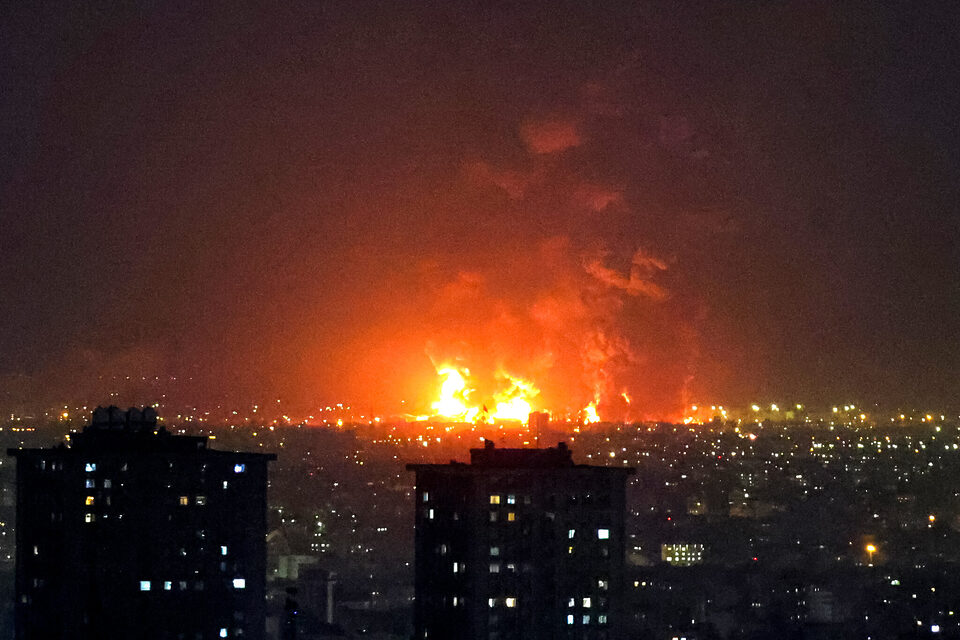
The images from Tehran continue to dominate the screens: vast plumes of black smoke rising from the Shahran oil depot and other fuel storage sites in the Iranian capital, ignited by strikes carried out jointly by American and Israeli forces as the conflict enters its second week.
Credible reporting from outlets including Sky News, BBC, CNN, France 24, The New York Times, AP and Reuters confirms that these attacks, which began targeting energy infrastructure in earnest over the weekend of 7-8 March 2026, have set alight depots holding millions of litres of refined products. The fires are not brief flares. They burn with the intensity that turns night into an orange haze, releasing hydrocarbons directly into the atmosphere in quantities that dwarf everyday calculations of domestic emissions.
A single large oil storage tank, when breached and ignited, can release tens of thousands of tonnes of petroleum products into combustion within hours. The combustion is unforgiving. Each tonne of fuel burned produces approximately 3.1 tonnes of CO2.
Eyewitness footage and satellite observations suggest multiple tanks at Shahran and nearby facilities were compromised, with fires spreading across infrastructure linked to the Revolutionary Guard. Conservative estimates, drawing on the known capacities of these depots (often in the range of hundreds of millions of litres) and the visible scale of the blazes, place the immediate CO2 release from one night’s strikes in the order of 50,000 to 200,000 tonnes or more.
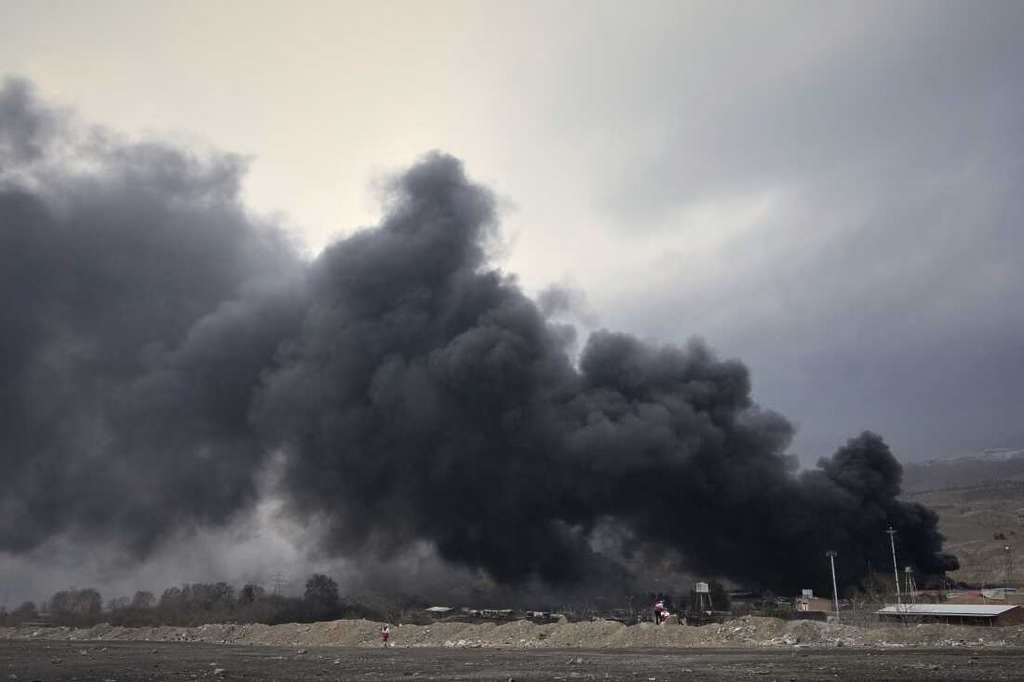
This figure excludes additional emissions from associated refining complexes damaged in the campaign, as well as the black carbon and other short-lived climate forcers carried aloft by the smoke.
The military operations themselves compound the damage. The United States has deployed carrier-based aviation from the Abraham Lincoln strike group in the Arabian Sea, launching waves of F/A-18 Super Hornets and F-35 Lightning IIs. Israeli squadrons of F-35 Adirs and F-15s have conducted long-range strikes, supported by aerial refuelling tankers.
Each fighter sortie consumes between 5,000 and 15,000 litres of jet fuel, each B-2 or refuelling mission several times that. Aviation kerosene emits approximately 2.53 kg of CO₂ per litre when burned. A single Super Hornet combat sortie therefore generates 15-40 tonnes of CO2… a B-2 mission more than 60 tonnes.
With hundreds of sorties flown since 28 February, when the joint operation began, the cumulative fuel burn from aircraft alone already exceeds 35,000 tonnes of CO2 in the conflict’s first week, according to preliminary assessments modelled on similar campaigns. Tomahawk cruise missiles launched from US warships add further emissions, as do the logistics flights ferrying munitions and personnel across the region. The Pentagon’s own historical data show that modern warfare is among the most carbon-intensive activities on earth. In fact, the US military alone accounts for a larger annual emissions footprint than many entire nations.
When these direct releases from targeted infrastructure and operational fuel burn are combined, the carbon cost of even a limited phase of the campaign becomes staggering. A single concentrated assault on Tehran’s fuel depots, coupled with the sorties required to execute it, can equate to 100,000-300,000 tonnes of CO2 released in days.
In the United Kingdom, the switch from a conventional gas boiler to an air source heat pump typically saves between 1,400-1,900 kg of CO2 per household annually, according to figures from British Gas, Energy Saving Trust and other analyses. Pairing the heat pump with a domestic solar array pushes that saving comfortably above two tonnes per year for many homes.
The arithmetic is merciless. The emissions from one strike in Iran offset the annual decarbonisation gains of 50,000 to 150,000 British households. Extend this across the full scope of the ongoing campaign (with its repeated waves, retaliatory exchanges and broadening regional disruptions) and the equivalent quickly reaches hundreds of thousands, potentially millions, of household-years of effort erased.
This disparity raises a question that cannot be evaded by those of us who have invested time, money and conviction in home-level decarbonisation. Is it worth it?
When geopolitical decisions taken far beyond our borders unleash carbon pulses of this magnitude, when a handful of precision-guided munitions can incinerate the equivalent emissions savings of entire cities’ worth of retrofitted homes, what rational basis remains for the individual householder to persist?
The British government urges millions of installations by the end of the decade, backed by grants and mandates, yet the global carbon ledger appears to be balanced not in planning documents or domestic energy bills, but in the targeting cells of distant command centres.
The conflict’s wider repercussions compound the futility. Disruptions to the Strait of Hormuz, where roughly one-fifth of global oil and liquefied natural gas transits, have already forced rerouting of tankers, idled production in Qatar and elsewhere, and driven up energy prices worldwide. I covered this in my video here.
Such shocks historically prompt short-term shifts toward coal in import-dependent markets like Europe and Asia, as gas supplies tighten which is a “nightmare scenario” for energy security and emissions alike, in the words of analysts tracking parallels to the Ukraine invasion.
The war has suspended significant fractions of Middle Eastern supply, pushing consumers toward dirtier alternatives and elevating overall global emissions even as physical production halts in some areas.
None of this diminishes the intrinsic value of the technologies themselves. Heat pumps remain vastly more efficient than gas boilers, solar generation displaces marginal fossil-fired power on the grid. The physics holds.
Yet the episode exposes a profound asymmetry in accountability. Domestic climate action in Britain is measured with precision (every kilowatt-hour tracked, every tonne saved audited) while the carbon consequences of state violence remain largely externalised, uncounted in national inventories and politically insulated from scrutiny.
Humanity’s capacity for self-destruction appears to outpace its capacity for self-restraint by orders of magnitude. The same species that can engineer a heat pump capable of extracting warmth from minus five degree air cannot, it seems, restrain itself from setting fire to oil depots on the other side of the planet.
For the UK homeowner who has spent thousands on a retrofit, who monitors their smart meter with satisfaction, the question lingers. Why persist when distant decisions can undo it all so effortlessly?
The answer, if there is one, lies not in abandoning the endeavour but in recognising its limits. Individual and national action, however diligent, cannot insulate against a world where conflict remains the ultimate emitter. The fires in Tehran are burning more than oil, when the blazes at Shahran alone can release in days the carbon equivalent saved annually by tens of thousands of British heat pump and solar homes, one is forced to ask whether all this domestic effort is simply futile in the face of such effortless, distant destruction. They are burning any illusion that our small, earnest efforts can outrun the larger folly of which we remain collectively capable.
Image credit: U.S.-Israeli Strikes Grow as Fuel Depots Burn in Tehran – The New York Times

No it isn’t. Conflicts will continue, its the human condition and we can only change what we can change. The good news is that climate change may well be non linear, but it isn’t binary. Every tonne of carbon we save here reduces global warming a bit and makes it less likely that tipping points will be reached and more likely that the worst effects will be avoided. Furthermore, every time we build a wind turbine, fit a solar panel or move a house off of gas, we take another step to becoming energy independent, as opposed to our current position of perilous dependence on a resource shipped from despot countries through fragile shipping routes. Doing this is a key pilar of national security in a highly insecure world.
@JamesPa, I don’t disagree with the core of what you’re saying… conflicts are baked into the human condition, and every tonne saved does chip away at the risk of tipping points in what is a non-linear system.
And you’re right that shifting to renewables and heat pumps builds energy independence, which in this volatile world (hello, current Middle East mess) is a pillar of national security. Ed Miliband and others have hammered that home recently too… dependence on imported fossil fuels shipped through fragile routes leaves us exposed to price spikes and supply shocks that no amount of domestic North Sea output can fully shield us from long-term.
Where we might differ a bit is on the scale and psychology of it all. My piece wasn’t arguing we should stop (far from it) but highlighting how disproportionate the carbon math can feel when a single strike undoes household-level savings on a massive scale.
It can leave people wondering if their individual efforts are just pissing in the wind against geopolitics. That said, your framing flips it positively, each installation isn’t futile. It’s a brick in the wall of resilience (couldn’t think of a better metaphor) reducing both climate risk incrementally and our collective vulnerability to despot-controlled resources.
@Mars If we are to believe what that verbose leader of a rather large country is telling us, global warming is nonsense and as to a shortage …. well … Drill Baby, Drill!
Ever Warming Regrets, Toodles.
Yes, it is a good observation I had not heard before.
Targeting oil and gas infrastructure is an act that does not attract the same scrutiny. Not long ago, the high losses of methane to the atmosphere from operations in the Gulf were painstakingly reduced.
One positive effect of the bombing and cycles of price hikes is that they may lead many consumers to take steps to reduce their dependency on fossil fuels. I see no signs of any erosion of the transition towards a decarbonised future.
But the reaction to the bombing confirms that armies are not being scrutinized regarding the emissions that their attacks are causing.
@Mars
I share your frustration and I often feel like an ant in front of an army of a gazillion of elephants, but I am 100% with @JamesPa on this.
We started our 4 year investment plan on insulation/pv panels/heat pump, not because we expected a viable ROI but because the 2021 wildfires in our country shook us to our core.
I believe that climate change is the biggest challenge the world is facing and as a mother and part of the generation who f**ked up, I will do everything in my power to promote awareness and action.
I try to instill in my son and his friends a culture of low energy and low water consumption, I confront and challenge my (beloved) US-based relatives who seems to have no sense of the urgency (ignoring all the while the smirks), I make an effort to use public transportation and yes I support Greenpeace (even though I do not agree with all their actions, at least they do take action). Even if I am a tiny ant, I will not give up. Every drop, every gram of fossil fuels that is not burned counts.
Allow me to chip in here. Before the Iran strikes kicked off, we decided to top up our oil tank (we have an oil-fired AGA). We ordered and paid for 1100 Litres of oil. The delivery has just been done, but only 500 Litres were deposited. The driver told us that the amounts were now being limited/rationed due to the conflict in Iran and that we should contact Boiler Juice to arrange a refund of the overspend.
Just my 2pennorth.
@Morgan The chances are that when you request the balance of your ordered quantity, that balance will be at a somewhat higher cost! Toodles.
Did they charge you on the pre-Iran war rate?
@Mars Yes, but………….. we now wait for the overspend to be refunded to confirm that is what has actually been returned.
@Morgan that’s why I suspect they only delivered 500 litres.
My suppliers have just written back to me: “Unfortunately, due to the unpredictable rising market, we are unable to quote a price. If you would like to place an order, we can do this for you and then give you a call the night before delivery to tell you the price. If you are not happy to go ahead we can cancel your order at that time."
Wild times!
@Morgan I’ve been hearing that kerosene is currently selling for £1.57/litre! Staggering!
In order to keep track of how much our switch to heat pump/solar PV setup is costing or saving us I keep an eye on the price of the heating oil we would’ve had to buy. In December, we’d’ve been buying at 70.29p/L ex VAT. I’ve just checked today (although historically we wouldn’t have needed to buy again until May) and the same supplier is currently quoting 138.59p/L ex VAT. That’s an increase of 97%.
Same here – I record the price of oil on the 1st of each month in my spreadsheet and work out what my break even price for electricity would be given my current monthly COP (even though I’m on Cosy, I’m interested to know if a heat pump on the SVR would be cheaper than the oil boiler it replaced)
At the start of the month kerosene was 62.5p per litre here, yesterday it peaked at 144p and this morning it’s down slightly at 135p (inc VAT) – more than double pre-war prices.
I keep hearing on the news that suppliers won’t quote for delivery. That’s not due to any shortages in kero, simply that they would rather do no business than trade at a loss where the price is currently so volatile. I’m guessing they’d rather lose a few orders and wait a few days for things to stabilise a bit.
@Mars at the time of writing heating oil is £1.28 / ltr in our area. One positive item to come out of all this is my Wife, who was very sceptical of all this renewable technology, is not so sceptical anymore. She is now glad I ignored her and went ahead with everything! 😀
@Morgan A friend of ours told us they placed an order with Boiler Juice just before the conflict and Boiler Juice cancelled the order a couple days later, just leaving them hanging. They managed to reorder from a local supplier at twice the cost. Our local supplier was charging 62.5p at the start of the month and now it’s 144p per litre.
At the moment, someone is making a killing (no pun intended). Crude oil is bought in advance on the futures market (it’s bad news to run out of crude oil in a refinery), and takes 1-3months for delivery, refining and distribution into retail channels, so there is no reason for price rises to be passed on to consumers right now. I wonder if prices will be as quick to drop at the back end of the crisis?
At least those of us who have switched to solar and a heat pump are relatively isolated from such shocks.
As an aside, many of you may already know that the Jet Fuel used in fighter jets is exactly the same as the domestic kerosene we burn in our oil boilers, other than for the addition of a fluorescent dye added to prevent people sticking it in their diesel cars due to differing rates of fuel duty.
@Old_Scientist
I have switched to solar and a heat pump, but retain an oil-fired AGA.
“I wonder if prices will be as quick to drop at the back end of the crisis?" I suspect that we all know the answer to that. 🤬
Oil typically does… if prices normalise back to pre-war levels it’ll probably take a week for us to get back to 50-60p per litre.
I wonder how much coal the Germans are going to burn when they run out of natgas.
@bobflux I’m always staggered by how much coal Germany still burns and their coal mines are gigantic!
Since electricity prices follow oil and gas prices, I thought I’d share with whomever is interested what happened here after the invasion in Ukraine and how government intervened to moderate prices. Warning: this is a long post, aimed at those who have an academic interest in how markets work in other parts of the world.
First some basic (simplified) background about how the electricity market works here for medium and low voltage customers:
1. All electricity producers chip in their production in a common pool, at a price that they deem best serves their interests (variable throughout the day)
2. The System Operator decides the variable mix of producers that actually will participate each day (based on price optimization and system stability criteria)
3. All electricity sellers buy from this common pool at the variable spot price determined by the System Operator and subsequently resell it to end users (each using their own commercial policy)
4. Greece has a high percentage (>50%) of renewables in the daily mix (solar, wind and hydro)
Following the invasion in Ukraine, oil and natural gas prices skyrocketed. Producers using natural gas had no option but to offer highly priced electricity to the common pool. And since this is a free market, producers using renewals followed suit taking advantage of the situation.
The result was staggering bills for consumers and record profits for renewals producers. Hence the government intervened, passed a limited time bill for taxing the super profits of producers and distributed the money back to the consumers (to all consumers based on their consumption and regardless of their income level).
No producer dared complain. Sometimes, a long government arm makes sense….
PS I know the above because I have had clients in all the spectrum of the local energy industry.
@MK4 thanks for dropping in with that Greek deep-dive.
What strikes me most is the sheer absurdity it exposes: renewables, which should be the stabilising force, end up profiting wildly from gas-driven price madness because of marginal pricing rules. Producers with near-zero marginal costs pocket the same sky-high rates as the gas plants setting the price. Consumers get hammered, governments scramble to claw money back and in the end everyone’s playing catch-up to a crisis they didn’t cause. I find situations like this so bizarre.
It also makes you wonder. If governments can tax super-profits and rebate consumers after the fact, why not redesign markets upfront so renewables actually dampen volatility instead of amplifying it? Until then, the push for personal independence (more panels, bigger batteries, smarter usage) feels less optional and more like basic survival strategy.
Again, really appreciate you sharing the Greek angle.
Unfortunately this tale of woe perfectly illustrates why removing the link to gas prices in the UK system won’t result in cheaper electricity prices as long as a portion of UK electricity demand is still met from gas.
The current UK system sounds very similar to the Greek system, except that in the UK every bidder is automatically paid the highest price (normally that of the gas power stations) rather than going through the process above whereby cheaper supplier can bid up their price. The solution is to completely remove dependence on the most expensive sources of electricity so only the cheaper (renewable) sources remain.
The extra tax was a measure introduced under a sort of force majeure situation, it was not meant as a permanent measure. You cannot limit profits in a free market, else companies will not invest. Some 30 years ago electricity was a state monopoly (production, sales, DNO, TSO all functions under one company) – not any more. Bear in mind also that during spring and autumn (when RES production is high and demand is low), the TSO cuts off the system for some hours several large PV parks to preserve system stability. Less often during high summer because there is high demand from airconditioning units (which units of course only make the situation worse, but this is another discussion).
Unfortunately the interconnections we have with surrounding countries do not yet have the bandwidth required to support export of all the excess RES energy.
And since we are all worried about oil and petrol prices, a new measure was just announced today valid till the end of June. Oil and petrol profits are capped to 5c/lt in wholesale and 12c/lt in retail in the local market, else hefty fines apply.