
We debate biomass carbon accounting, agonise over the electricity-to-gas price ratio and argue about heat pump coefficients of performance. And yet the cleanest, most abundant energy source on the planet has been staring us in the face, quite literally, since the Victorian era. The frustrating truth at the heart of Britain’s renewable energy story is not that we lacked the vision. It is that we had it, proved it worked, and then buried it under a century and a half of commercial conservatism and institutional inertia.
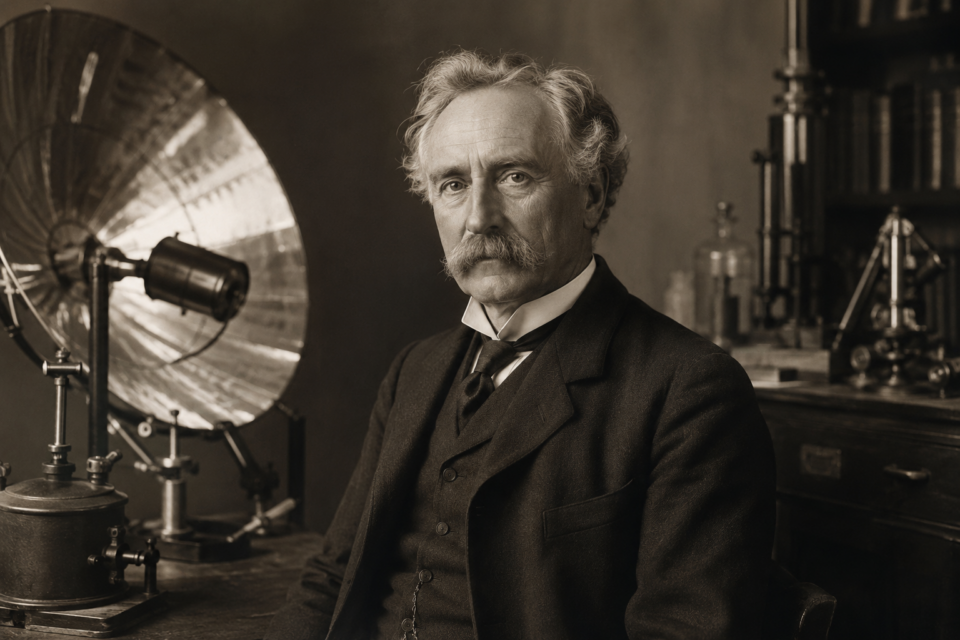
The man who should sit at the centre of that story is William Grylls Adams. He does not.
The Cornish Physicist Who Changed Everything
William Grylls Adams was born on 18 February 1836 in Laneast, Cornwall. He was, by any measure, a man of formidable intellect. After receiving his BA from Cambridge, he was appointed Lecturer in Natural Philosophy at King’s College, London in 1863, where he worked under James Clerk Maxwell, one of the greatest physicists in history. In 1865 he succeeded Maxwell as professor, holding the post for the next forty years. He was elected a Fellow of the Royal Society, served as President of the Physical Society of London and later of the Institute of Electrical Engineers. His brother, John Couch Adams, had mathematically predicted the existence of Neptune. Scientific distinction, in the Adams family, was something of a habit.
But it was not in a London laboratory that William Grylls Adams made his most consequential contribution. It was in Bombay, in the sweltering heat of 1876, where this professor-turned-colonial-bureaucrat turned a 24-foot concave mirror toward the Indian sun and changed the course of energy history, or at least tried to.
The Storm of Solar Fire
As a young man, Adams had worked as a clerk in a London patent office in the 1860s, giving him early exposure to some of the first British designs for exploiting solar energy. He had read about the French mathematician Augustin Mouchot’s solar steam engine, which had impressed Napoleon III when demonstrated in 1866. Adams soon designed and patented his own rudimentary solar boiler. The only problem was, he needed more sun.
He found it in India. Appointed deputy registrar of the Bombay High Court in 1870, Adams spent years developing what he believed was a technology capable of transforming not just the subcontinent but the fundamental economics of industrial energy. He built a giant concave mirror, 24 feet in diameter, and had his London solar boiler delivered by ship to Bombay in 1876. One morning, wearing dark glasses for safety, he turned his mirror on a copper cylinder filled with water.
“The rays beat like missiles in a continuous and incessant storm of solar fire,” he wrote. An hour later, the cylinder registered 55 pounds of pressure per square inch. He connected a three-horsepower steam engine to the boiler, and the pistons moved. Adams had built the first working, British-designed solar steam engine.
For a fortnight he demonstrated it to government officials, newspaper reporters, mill owners and the local Indian communities. In 1877, he wrote to the editor of the Times of India arguing that the application of his solar steam engine would “make India the seat of the principal manufacturing industries of the world.”
It was not the hyperbole of an eccentric. It was the measured conviction of a serious scientist who had done the numbers. And he had done far more than build a steam engine.
The Discovery That Underpins Every Solar Panel on Earth
Here is the fact that most histories of solar energy either understate or omit entirely. In the same extraordinary year of 1876, Adams (working back at King’s College in London with his student Richard Evans Day) made a discovery of even greater scientific consequence than the solar steam engine in Bombay.
Adams and Day discovered that a solid material (selenium) produced electricity when exposed to light. Today we call this the photovoltaic effect. Conducting experiments with selenium bars placed close to a lit candle, they observed instantaneous reactions on their measuring device when the selenium was exposed to light, ruling out the possibility that the effect was thermal rather than photonic. Adams and Day coined the term “photoelectric” to describe what they had found.
Werner von Siemens (a contemporary whose reputation in electricity ranked him alongside Edison) called the discovery “scientifically of the most far-reaching importance.” He was understating it. Selenium was not ultimately the material that made solar cells commercially viable (silicon, developed at Bell Labs in 1954, achieved that) but Adams and Day had proved something of foundational importance: that light alone could generate electricity in a solid material, without heat, without moving parts, without combustion of any kind.
Total solar capacity in the UK reached 22.1 gigawatts at the end of March 2026, with over two million solar installations powering British homes and feeding into the grid. Every single one of those panels operates on the photovoltaic principle that William Grylls Adams demonstrated in a London laboratory a century and a half ago. The UK added 2.6 gigawatts of solar in 2025 alone, a record year, with 257,397 certified installations, up 32% on 2024. And yet Adams’s name is absent from the school curriculum, from the public conversation about renewable energy and from virtually every government document that purports to chart Britain’s clean energy history.
The Colonial Rejection
Adams’ solar steam engine met a fate that will feel grimly familiar to anyone who has watched promising renewable technology struggle against the institutional weight of incumbent energy interests.
The colonial government was extremely sceptical that solar heat could be scaled up for commercial purposes. Government engineers noted that the limited power storage capacity of Adams’ machines meant workers had to arrive well before dawn to get the boilers started, and had to be sent home when the sun was not strong enough. These were real limitations. They were also the kind of engineering problems that investment and iteration could, in time, solve. The colonial government chose not to find out.
In his treatise Solar Heat: A Substitute for Fuel in Tropical Countries, published in 1878, Adams argued that nations near the equator “possess, in their clear skies, a gratuitous and inexhaustible source of wealth, equal to that which western nations have to dig, with infinite labour and toil, from the bowels of the Earth.” He sketched out plans to use solar heat for cotton gins, desalination and industrial processes, and called upon the colonial government to invest in this promising substitute for coal, which was then being imported to India at enormous expense.
His bosses were not interested. Coal was cheaper, at least in the short term. The political economy of empire ran on fossil fuels and saw no reason to question that. Adams returned to King’s College, continued his scientific career and died in Broadstone, Dorset, on 10 April 1915.
The What-Ifs That Should Haunt Us
History’s counterfactuals are always treacherous, and it would be too simple to claim that Adams’ rejection by the colonial government condemned the world to a century of fossil fuel dependency. The commercial, logistical and engineering challenges facing solar technology in 1878 were immense, and the path from selenium bars to silicon wafers to gigawatt-scale solar farms was never going to be a straight line.
But the questions linger. What if the colonial administration had committed serious capital to solar development in the 1870s and 1880s, at the same moment it was pouring investment into coal and steam infrastructure? What if Adams’ hybrid solar-coal approach (which he advocated, as a pragmatic transition strategy) had been taken seriously as an industrial model? What if the photovoltaic discovery of 1876 had received the same level of government and commercial interest as, say, the internal combustion engine? India, with its vast solar resource, might have led a global energy transition that instead took 150 years to begin. The carbon debt we are now urgently trying to pay down might have been a fraction of what it is.
These are not idle speculations. They are a reminder that the choices made by those in power (to fund or not fund, to back or not back) echo across generations in ways that are rarely visible at the moment of decision.
An Unsung Pioneer in a Country That Should Know Better
Adams served as President of the Physical Society of London, President of the Mathematical and Physical Section of the British Association for the Advancement of Science, Fellow of the Royal Society and President of the Institute of Electrical Engineers. He was, in the language of Victorian scientific life, a figure of the highest standing. And still he could not get his own government to take solar energy seriously.
There is something poignant in that failure. Because the argument Adams was making in Bombay in 1876 (that the sun offers a “gratuitous and inexhaustible source of wealth” to nations willing to pursue it) is the same argument being made today by every solar advocate, every climate scientist and every government energy strategy paper published since the Paris Agreement. We are still, in essence, making William Adams’ case. We are just doing it considerably later than we should have.
In 2025, a record 6.3% of Great Britain’s power was supplied by the sun, up 30% on the previous year. The UK government targets 45 to 47 gigawatts of solar capacity by 2030. The solar industry is, at last, at scale. Adams, who spent his retirement years in a Dorset village with no particular legacy attached to his name, would perhaps find it vindicating. He might also reasonably wonder what took us so long.
