
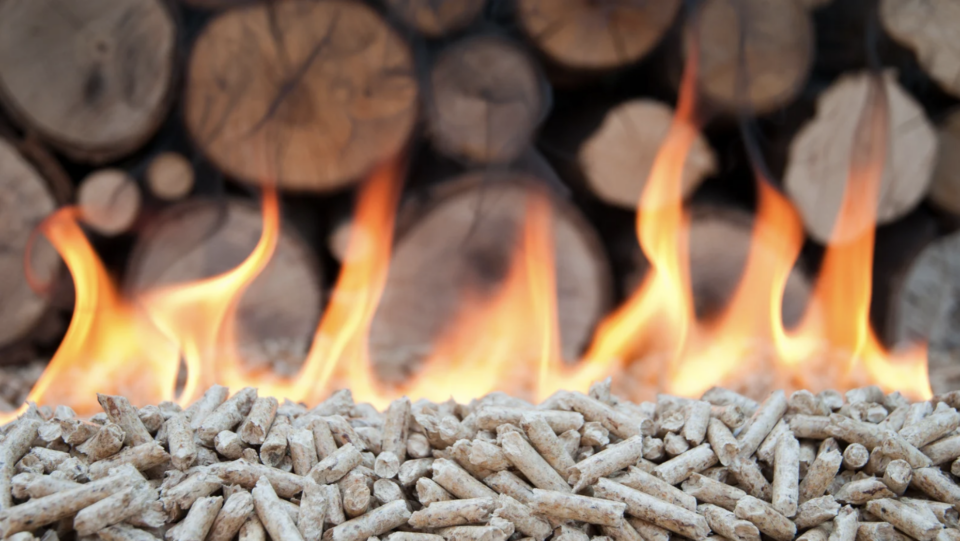
On paper, burning wood to heat your home is a renewable act. A tree grows, absorbs carbon from the atmosphere, is felled and burned, and another tree is planted in its place. The carbon released returns to the cycle. Nature’s balance is maintained. It is a reassuring narrative, and it underpins billions of pounds of UK energy policy.
It is also, in significant part, a fiction.
The fundamental problem with the carbon neutrality claim made for biomass is not that it is entirely wrong… it is that it is only potentially true across a timescale that has almost nothing to do with the climate emergency we are currently living through. A carbon debt is created as soon as biomass is burned. If the expected regrowth happens, it will take anywhere from decades to centuries to pay back that debt, depending on the type of wood burned and the ecosystem from which it was harvested. In the meantime, that carbon is in the atmosphere, warming the planet right now, today, in the decades that are supposed to be vital for meeting the Paris Agreement’s 1.5C target.
Research compiled by Penn State in the United States found that carbon payback periods for forest biomass energy projects range from zero to 8,000 years, depending on factors including the type of forest, the fossil fuel source being replaced and whether natural disturbances are factored into the models. Zero to 8,000 years! The government grants biomass a renewable designation and hands you £5,000 toward the cost of installing it. Read that juxtaposition slowly.
The European Academies’ Science Advisory Council has stated bluntly that carbon emissions per unit of electricity generated from forest biomass are higher than from coal. Burning wood is less energy-dense than coal, meaning more fuel is needed to produce the same energy output, releasing more carbon dioxide per kilowatt-hour at the point of combustion. The only way forest biomass comes out ahead is if you count trees that have not yet been planted as an offset against carbon that has already been released. Madness.
What the Government Actually Classifies Biomass As
The UK currently designates biomass as a renewable energy source, meaning it qualifies for support under the Boiler Upgrade Scheme, the same programme that funds heat pumps. The Boiler Upgrade Scheme offers a £5,000 grant toward a biomass boiler installation, though with significantly tighter eligibility criteria than heat pumps: the property must be both in a rural location and off the gas grid. Self-builds are explicitly excluded. The biomass boiler must carry a valid emissions certificate demonstrating that particulate matter and NOx emissions are within prescribed limits.
That emissions certificate requirement exists for a reason, and it points to the second major problem with domestic biomass that rarely features in the marketing materials.
The Air Quality Problem
Domestic burning through wood burning stoves and solid fuel appliances now makes up the single largest contributor to national emissions of fine particulate matter in the UK. Short and long-term exposure to wood-burning pollution has been associated with chronic respiratory diseases, heart disease, pulmonary function deficits, lung cancer, developmental abnormalities, and harm to the lungs, kidneys, liver, nervous system and brain.
A 2025 study published in Scientific Reports found that residential wood burning significantly increases short-term exposure to ultrafine particles, PM2.5, black carbon and carbon monoxide, with all types of wood-burning appliances (including modern eco-design models) posing potential health risks. The researchers concluded there is a need for health-focused strategies when considering wood burning for domestic heating.
Modern pellet-fed biomass boilers are substantially cleaner than log-burning stoves or open fires. That much is true. A well-maintained system burning dry, quality-grade wood pellets and serviced annually will produce emissions vastly lower than an old stove burning wet logs. But “substantially cleaner than the worst-case scenario” is a low bar, and one that the industry has made considerable use of.
What MCS Says… and What It Doesn’t
MCS certifies biomass boiler installers under its standard framework. The MCS certification scheme covers biomass alongside solar PV, heat pumps, wind turbines and battery storage, certifying installation businesses rather than individual engineers and requiring adherence to MCS installation standards. MCS’s own data dashboard puts the average installed cost of a biomass system at just under £19,000 in 2025, before the £5,000 BUS grant brings that down to around £14,000 for eligible properties.
What MCS does not do (and this is important) is adjudicate on the fundamental question of whether biomass qualifies as genuinely renewable. That classification is a matter of government policy, not MCS certification. MCS certifies the installation. The government decides what counts as clean. Those are two entirely separate decisions, and the gap between them is where much of the confusion lives.
The MCS Standard MCS 040 covers planned and preventative maintenance of biomass appliances. Research underpinning that standard found a 15% difference in in-situ performance of biomass boilers, primarily caused by poor fuel quality, lack of operator knowledge and inadequate maintenance. A 15% performance gap driven by basic operational failures is a significant finding in a technology being promoted with public money to households who may have limited technical knowledge. It also echoes, uncomfortably, the broader pattern of renewable heating installations that look good on paper and disappoint in practice.
Where Biomass Does Make Sense
Renewable Heating Hub is not in the business of dismissing technology wholesale, and biomass is not without a legitimate role. For the specific category of rural, off-grid properties currently heating on oil or LPG (where the alternatives are limited, where fuel costs are high and where access to heat pump installers is often poor) a well-designed, properly maintained biomass boiler can represent a meaningful reduction in both running costs and carbon emissions relative to what it replaces. Agricultural residues, sawmill waste and fast-growing energy crops come closest to genuine carbon neutrality, as their carbon cycle completes within one to several years, a wholly different proposition from whole trees sourced from managed forests.
The problem is that the UK’s biomass policy does not meaningfully distinguish between these cases. The same renewable designation that covers a sawmill-waste pellet boiler serving a remote Scottish farmhouse also covers systems in homes that, by any reasonable analysis, would be better served by a heat pump. The grant exists. The MCS certification pathway exists. The marketing exists. The nuance sadly does not.
The Honest Assessment
Biomass heating has been sold to British consumers under a carbon neutrality claim that the science does not fully support on any timeline relevant to net zero. Studies indicate that even when wood displaces coal (the most favourable comparison) the excess carbon dioxide emitted is not fully reabsorbed by forest regrowth until well into the next century, with carbon debt payback times measured in decades to over a hundred years. We do not have decades. The net zero deadline is 2050. The Paris Agreement’s most ambitious target demands action this decade.
None of this means every biomass installation is environmentally reckless. Fuel source, supply chain, forest management practices and what the system replaces all make an enormous difference. A locally sourced wood chip boiler replacing an oil-fired system in a well-insulated rural property is a fundamentally different proposition from a pellet boiler in a suburban home with gas access two streets away.
But that distinction requires homeowners to ask questions that the industry, the grant schemes and the certification frameworks do not always encourage them to ask. At Renewable Heating Hub, we think they should ask them anyway.
If you are considering a biomass boiler, demand to know where your fuel comes from, how its carbon accounting has been assessed and what maintenance regime is required to keep the system performing to specification. If you are in any doubt about whether your property genuinely suits biomass over a heat pump, get an independent assessment from an engineer with no financial interest in either answer.

@Toodles don’t get me started on Drax!
If domestic biomass is the greenwashing of the living room, Drax is the industrial-scale version playing out in North Yorkshire and it is one of the most extraordinary stories in British energy policy IMO.
Drax received £999 million in government subsidies in 2025 alone having accumulated £6.5 billion in taxpayer subsidies since 2002. All of it justified by the carbon neutrality claim you’ve correctly identified as somewhere between optimistic and delusional. Ember’s analysis confirms that Drax has been the UK’s largest single emitter for ten consecutive years, producing 11.5 million tonnes of CO2 in 2023 alone, yet those emissions are zero-rated under current carbon accounting rules because they derive from burning woody biomass.
Zero-rated. The UK’s largest polluter. Mind-blowing.
A BBC investigation found that Drax was sourcing wood from some of the world’s most precious forests in Canada… the kind of forests that take far longer to regrow than any net zero timeline can accommodate. Drax consistently denied it, claiming to use only sawdust and timber industry waste. Then in 2024, Ofgem concluded a 15-month investigation finding that Drax had been inaccurately reporting the types of wood it was burning, resulting in a £25 million fine. And then in August 2025, the Financial Conduct Authority launched a further investigation into certain historical statements Drax made regarding its biomass sourcing between 2022 and 2024, and whether its annual reports for those years complied with listing and transparency requirements.
Drax’s own climate advisors have called on the company to stop describing burning woody biomass as carbon neutral. When your own advisors won’t back your core claim, the game is surely up.
And yet Ed Miliband (the self-declared champion of clean energy) has just handed Drax an estimated further £2 billion in subsidies through to 2031. The rationale is grid stability: Drax provides dispatchable baseload power that wind and solar cannot yet reliably replace. That argument has some genuine merit. But it is a reason to tolerate Drax, not a reason to subsidise it as though it were environmentally virtuous.
It’s crazy. The carbon is released now. The trees take decades.
Yes, it seems obvious they are not in it for the environmental value, so they should be subjected to normal market forces..
Did he have a choice? Given their (alleged) deceitfulness, I suspect Drax have stitched things up so well (either in the contract or in terms of dependency) that future governments, whatever the colour, will have to continue subsidising them for a decade or two.
I may be wrong but at the same time I wouldn’t rush to blame the current encumbant (again whatever their colour) for contracts and decisions made in the past, without first establishing the full facts. Look at what the water companies have done to us!