

Notifications
Clear all
Joining the Renewable Heating Hub forums is completely free and only takes a minute. By registering you’ll be able to ask questions, join discussions, follow topics you’re interested in, bookmark useful threads and receive notifications when someone replies. Non-registered members also do not have access to our AI features. When choosing your username, please note that it cannot be changed later, so we recommend avoiding brand or product names. Before registering, please take a moment to read the Forum Rules & Terms of Use so we can keep the community helpful, respectful and informative for everyone. Thanks for joining!

24/04/2023 5:19 pm
There will still be a substation number plate on that pole.
Every pole on the grid is numbered, even if it has no transformer and no wires currently 'live' !
Save energy... recycle electrons!

24/04/2023 5:32 pm
@transparent the only number I can see is RSFCCA1
Our experiences with solar pv, ASHP, battery, and EV: ourhomeelectric.co.uk
24/04/2023 5:47 pm
Ah yes - I can see it:
Rear of Steevjo's Field - Code? - Couldn't Arrange 1 😉
So what's the number on the next pole?
Save energy... recycle electrons!
24/04/2023 6:06 pm
@transparent RSF CC13 is next
Our experiences with solar pv, ASHP, battery, and EV: ourhomeelectric.co.uk

25/04/2023 9:40 am
I've run those pole numbers (and variations thereof) through NGEDs entire database of substations and that pattern of naming doesn't occur @steevjo
So I've emailed a senior NGED engineering manager to ask for assistance.
It's possible that the asset-number labels for those poles and transformer haven't been applied for some reason.
The labels you're seeing could just as easily refer to something else.
For example, CCA (Copper Covered Aluminium) is a type of cable commonly used for overhead wires in rural locations.
Save energy... recycle electrons!
25/04/2023 10:35 am
Just a bit more re powerwall earthing…
The powerwall gateway includes a breaker to disconnect house live and neutral from incoming when there is a power outage - as required by regs.
it also includes a normally open breaker which closes during a power outage to restore the earth neutral bonding which has gone because the neutral has disconnected…
only the earth wire it connects to goes straight to the incoming PEN cable a few feet away - so can’t really see how neutral is still disconnected.
you can see all this in the diagram posted earlier.
NGED had this diagram (actually a similar diagram that better represents our house but with the same earthing arrangements) as part of the G99 application which was approved.
I admit I’m completely confused.
Our experiences with solar pv, ASHP, battery, and EV: ourhomeelectric.co.uk

25/04/2023 11:08 am
@steevjo indeed. there are some photos of mine in that speakev thread, that I was able to take at one time when the sparks were here, showing the earths, they're all commoned - house, batteries, earth rod, DNO cable
My octopus signup link https://share.octopus.energy/ebony-deer-230
210m2 house, Samsung 16kw Gen6 ASHP Self installed: Single circulation loop , PWM modulating pump.
My public ASHP stats: https://heatpumpmonitor.org/system/view?id=45
11.9kWp of PV
41kWh of Battery storage (3x Powerwall 2)
2x BEVs
25/04/2023 12:31 pm
Let me provide the background detail which shows the electricity supply used for the majority of the UK population.
Protective Multiple Earth (PME) derives from the way in which local substation transformers are designed.
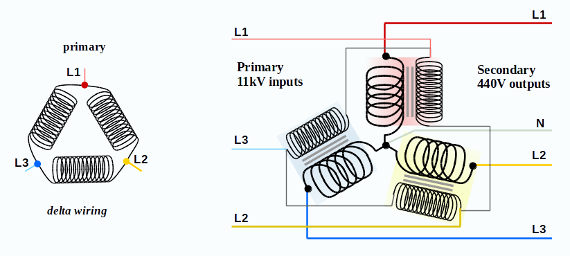
The 11kV 3-phase supply connects to the three primary coils of the transformer in a Delta pattern.
The Secondary windings are in a Wye pattern.
This not only provides the optimal efficiency for energy transfer using magnetic flux, but the centre-tap becomes the Neutral for houses which are connected to single-phase feeds.
That Neutral is connected to earth (ground) at the transformer.
It can therefore be used to provide an 'earth' to the houses.
In practice it looks more like this...
... where there is local substation called East Village.
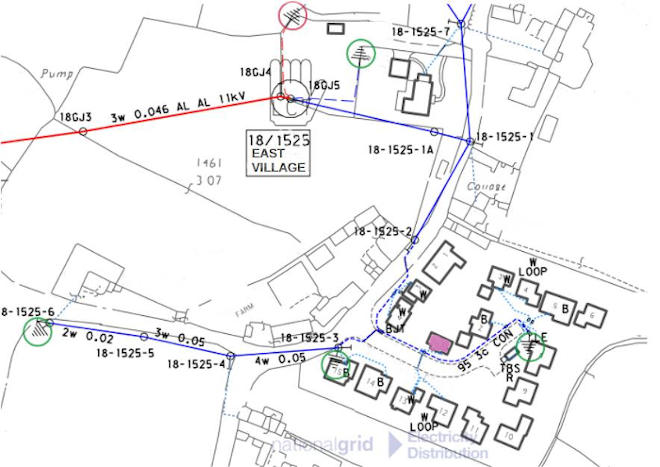
This map has been 'anonymised'.
East Village doesn't actually exist, nor is there a location with precisely this layout for the electricity supply.
The 11kV supply to the substation is marked in red.
It has one 440v Feed (blue) which divides into two.
The safety earth for the metal transformer itself isn't directly beneath it, but instead about 40m north.
I've circled that in light red.
The 440v 3-phase feed also has four points at which it is tied to earth.
Those are circled in green.
One of those points, closest to the transformer, is the one that creates the zero-volts reference for the Neutral.
The three other earth points are decided by the DNO according to local circumstances.
They are what makes this Feed a Protective Multiple Earth.
Each pole will have a label "PME", together with the pole number, such as 18/1525-1
If the house I've coloured in purple has a heat pump, EV charge-point or solar panels installed, there may be a regulation which requires the equipment to have its own earth stake.
But that local earth isn't the same as the earth provided by the DNO, which is derived from the Neutral feed.
Installers may not just add further earth points to the DNO's local supply.
Save energy... recycle electrons!
25/04/2023 5:27 pm
Thanks for the background @Transparent
Installers may not just add further earth points to the DNO's local supply.
But they clearly do.
To be honest I can see little difference between an earth spike and earth bonding to an incoming conductor. I know the purpose is different but both are wiring a piece of metal coming out of the ground to the DNO provided earth.
I absolutely understand that I don't understand enough of the details/know the rules. One option is I just trust the installers/NGED approval process and forget about it...
... but it's hard when what is there right now makes no sense to me.
Our experiences with solar pv, ASHP, battery, and EV: ourhomeelectric.co.uk
25/04/2023 8:37 pm
I may not appear to be responding directly to what you post @steevjo
but I am reading every point you've written to ensure that I cover it within my ongoing explanations. 🙂
EV charge points aren't installed by any electrician.
The firms that undertake this work have additional training and certification.
There are a number of safety components and practices which they must ensure are being incorporated.
The main methods of installing an EV charger are these:
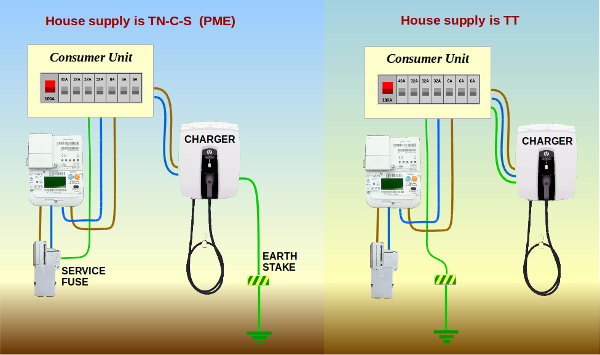
Notice the change in earthing arrangement, depending on whether the house earth is provided by the DNO (PME) or by using a ground-stake.
In each case the charger is earthed, and the householder can see a physical copper rod inserted into the ground at their house.
This makes it tricky for less-technical people to know whether it has been done correctly.
I'm now going to 'zoom in' on the PME version, on the left of the above diagram:
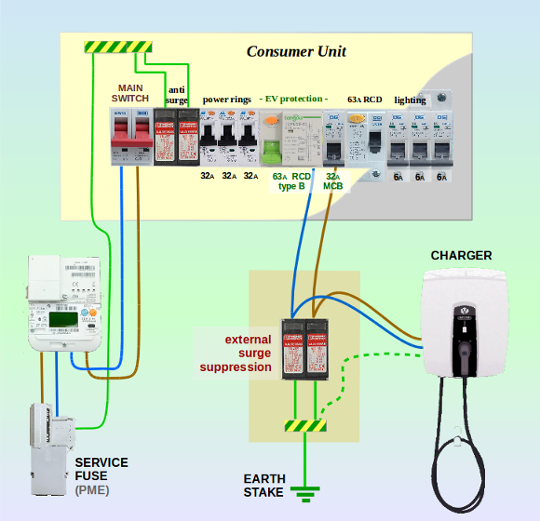
This more detailed view shows anti-lightning surge suppression for the EV charger.
It's separate from whatever surge suppressors may or may not be already installed in the house.
The new pair of suppression devices prevent the 'ground wave' created by a nearby lightning strike from entering the house.
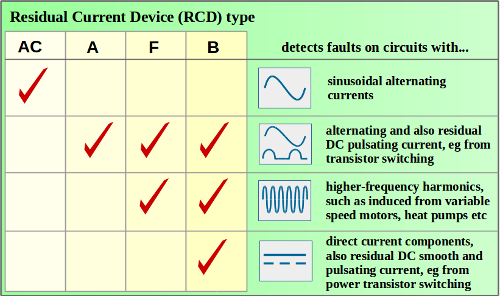
The second detail to notice is an RCD Type B in the consumer unit, next to the trip (MCB) which supplies the EV charger.
Type-B Residual Current Devices are the highest level of safety protection.
It's a double-pole device, costing about £250
It will interrupt the supply in case of fault currents occurring
- on the AC sine wave of the mains supply
- on any DC component which is induced by the charger
- on any high-frequency signal imposed on the mains supply by the charger
- on any pulsed or intermittent current imbalance
Some EV installers fit Type-A RCD units, which are a lot cheaper and easy to source.
This chart explains the four categories of 'earth leakage' protection:
So why is the earthing arrangement different for properties served by a PME supply?
This has to do with the possibility of damage to the (underground) feed from the substation which results in the Neutral being cut.
Remember that a house with PME has the earth provided by the wire being linked to Neutral at the 100A Service Fuse.
If the EV charger is incorrectly installed and uses the household earth, then it would look like this:
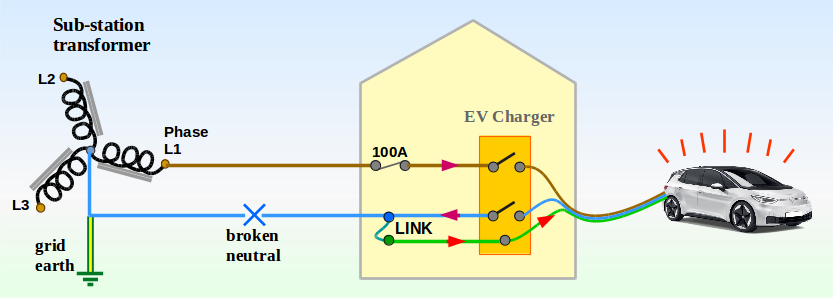
The EV charger still passes the LIVE to the car.
The return current passes back through the blue/neutral wire to the charger and on to the consumer unit, but can't return to the substation transformer through the DNO's underground cable.
Instead, it crosses the link to the earth wire and goes back to the car.
That causes the external metalwork of the car to rise to the same voltage as the LIVE. 😮
Even if the EV charger were also to have its own earth stake (which it shouldn't), that doesn't solve the problem:
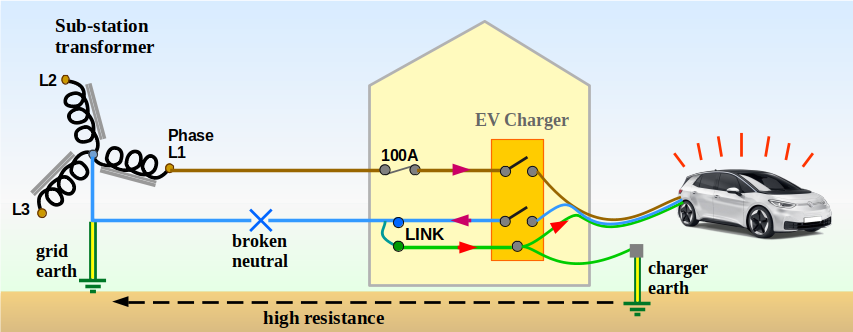
The return current will indeed now find a path back to the transformer through the ground, but there is a high resistance via that route.
Consequently the metalwork of the car tends to 'float' at around 50-120v.
That's still enough to kill you.
When considering the earthing arrangement you have had installed, it is insufficient to consider that "it works, so it must be OK".
The whole point of a safety mechanism is to assess "how does it operate when there is a dangerous fault?"
Save energy... recycle electrons!
25/04/2023 10:31 pm
@transparent Thanks for the detailed explanation.
I looked into EV chargepoint earthing a couple of years ago when ours was installed. At the time there was a bit of debate about 'unicorn' devices that would enable a charger to detect neutral and earth problems so they could safely be installed in PME systems using the house earth without needing their own earth spike.
Our pod point has such a system - there's a decent write up here: https://pod-point.com/electric-car-news/earth-rod-details Interestingly (I'm sad) when the powerwall was installed and the earth spike added the pod point refused to charge - I'm assuming it saw the new earth spike as some sort of earth problem. Fixed by speaking to Pod point who changed some configuration remotely.
Completely understand your point about "how does it operate when there is a dangerous fault?"
Looking forward to the next instalment 😀
Our experiences with solar pv, ASHP, battery, and EV: ourhomeelectric.co.uk
26/04/2023 8:26 am
Looking forward to the next instalment 😀
Maybe I have found a spoiler!
I’m thinking the isolator in the neutral allows the system to be safely switched to island mode and back again. Once in island mode it’s not really doing anything.
this is a sort of glimpse through the mist for me (although it seems to confirm system is installed correctly!).
A proper explanation or correction would be great!
Our experiences with solar pv, ASHP, battery, and EV: ourhomeelectric.co.uk

SPONSORS

Degrees of Separation

Latest Posts
-

RE: Heat pump branding. Clever, contemporary… or a bit too much?
I think Heat Geek have done an amazing job on their bra...
By Tomtheheatingengineer , 10 hours ago
-
RE: HeatGeek vs Octopus surveys: puzzling disparity - any ideas why?
I have just had 3 heat loss surveys, one by heat geek o...
By David , 10 hours ago
-
RE: Heat Geek Zero Disrupt: Are We Sleepwalking Into Another Race to the Bottom?
I think that's the key question. After all inverter uni...
By Prunus , 12 hours ago
-
RE: battery storage without solar
As of October 1st they need specific qualifications to ...
By EtchedPixels , 12 hours ago
-
RE: How should the Boiler Upgrade Scheme be reformed?
A unit which uses water to transfer the heat/chill from...
By Temperature_Gradient , 13 hours ago
-
RE: Renewables & Heat Pumps in the News
With regards to the BUS grant raid, I gave it more thou...
By ASHP-BOBBA , 13 hours ago
-
RE: Why are ASHP installs so expensive?
The whole system seems to work on the basis of...
By ian33a , 14 hours ago
-
RE: Missing flow temperature in Heat Geek proposal
Good plan. If you can get half hourly meter readings a...
By JamesPa , 19 hours ago
-
RE: Heat Pumps Without Grants: Would You Have Installed One & Will You Now?
@editor Most certainly. The heat pump was an ideal s...
By Abernyte , 19 hours ago
-
Although regulations may well vary from country to coun...
By Majordennisbloodnok , 19 hours ago
-
RE: Does anyone have experience of a smart water meter?
Yep I caught our slow leak from a £100 bill rise 8)
By EtchedPixels , 19 hours ago
-
RE: Do You Need a Buffer Tank or Low Loss Header for Underfloor Heating in a Large Property?
@jamespa in some cases, failing the Turing test might b...
By GrahamF , 23 hours ago
-
RE: Passiv Smart Thermostat - Help & Forum Support
@energystoragetech The heat capacity of some...
By JamesPa , 1 day ago
-
RE: tepeo ZEB UK Support & Info Thread
Sorry you are correct, I was remembering figures from t...
By JamesPa , 1 day ago




SPONSORS