
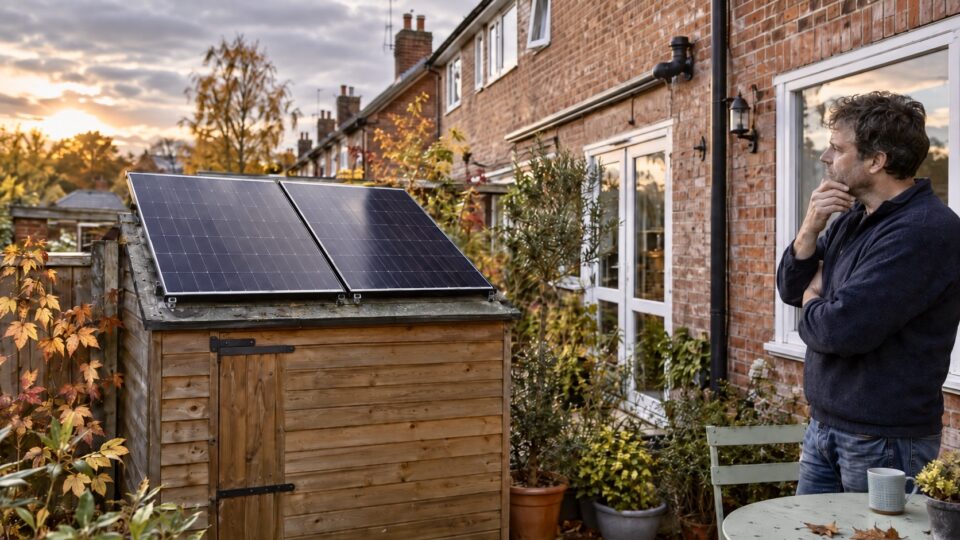
Britain has finally legalised plug-in solar and, in principle, I think it is one of the more interesting changes to domestic energy we have seen for years. Since 27 August, compliant systems producing up to 800W can be connected directly to a household socket, opening solar generation to people who may not own a suitable roof, cannot justify a conventional rooftop installation or simply want a relatively inexpensive way of generating some of their own electricity.
Government estimates suggest a system could provide up to 20% of an average household’s electricity consumption and save as much as £110 a year. My enthusiasm for the concept, however, does not mean I would rush out and buy one this September. In fact, unless you have a compelling reason to be an early adopter, I think there is a strong argument for doing precisely the opposite and wait until spring.
The reason becomes obvious when you look across the North Sea. Germany did not discover plug-in solar last month. Its Balkonkraftwerk market is mature, fiercely competitive and enormous. Changes introduced through Germany’s Solar Package in 2024 simplified the regime for systems with up to 2,000W of panel capacity and 800VA of inverter output, while registration was streamlined through the national Marktstammdatenregister. More than 426,000 German balcony systems were registered in 2025 alone, with actual sales likely to have been higher. That scale has consequences because dozens of manufacturers, retailers and component suppliers are fighting for the same customer and prices have been driven down accordingly.
Today, German price-comparison site Idealo lists complete 920W-panel, 800W-output systems from around €253, while Netto has sold a SUNNIVA 920W, 800W package for €279. That works out at roughly £217 to £240 at current exchange rates. A German kit using the same APsystems EZ1-M 800W microinverter now appearing in British products can be found for around €304, or roughly £261. Geizhals listings also show the APsystems EZ1-M inverter itself available in Germany for around €90 to €100. Germany is no longer treating plug-in solar as exotic renewable technology. It is increasingly an ordinary consumer product.
Now look at Britain. One of the more competitive compliant UK offerings I found through Plugin Solar is a 920W two-panel Bolt system with an 800W microinverter and ground or wall mounting hardware at £749.99. A 930W Perlight package using the APsystems EZ1-M has been listed at £798, while other two-panel systems currently sit between roughly £849 and £1,200 depending on the panels, mounting arrangements and accessories supplied.
These are not perfectly like-for-like comparisons. Panel specifications, warranties, mounting hardware and safety equipment vary between packages. Britain has also adopted a somewhat different regulatory and safety framework, so it would be simplistic to assume that every €250 German system can simply be placed on a pallet, shipped to Birmingham and legally sold for £215.
Nevertheless, the broad price gulf is difficult to ignore. Germany is selling the fundamental proposition for a few hundred pounds. Britain, barely into the life of its legal market, is frequently asking nearer £800.
There are legitimate reasons for some of that difference. Britain’s emerging specification places particular safety requirements on products entering the market and those requirements inevitably have costs attached to them. There is also a significant tax disadvantage for British DIY buyers. Qualifying solar installations can benefit from favourable VAT treatment in Germany, whereas plug-in panels bought by British householders for self-installation do not currently receive the same VAT treatment as some professionally installed energy-saving technologies. A £750 retail kit carrying standard VAT contains £125 of tax before we even begin discussing retailer margins, distribution or manufacturing costs.
But tax and standards cannot explain the entire gulf. Britain is experiencing something considerably more mundane, the economics of a market at launch.
Supply is still limited, compliant products are only beginning to appear and retailers have little reason to engage in aggressive price competition while early adopters are prepared to pay for novelty and availability. Some current systems are being advertised on preorder or with extended lead times, hardly evidence of a settled mass market. At the same time, names including Amazon, Argos, Currys, Wickes, B&Q and Screwfix have been associated with the developing British plug-in solar market. If even a proportion of those businesses begin competing seriously for volume, the economics could change quite rapidly.
This is where I think homeowners need to separate excitement about the technology from the timing of the purchase. Plug-in solar is interesting, but that doesn’t automatically mean September 2026 is the optimum month in which to buy it.
We are entering precisely the wrong half of the year to pay an early-adopter premium for solar generation. Solar panels obviously continue producing electricity during winter, but Britain’s shorter days, lower solar elevation and heavier cloud cover dramatically reduce output compared with spring and summer. PVGIS-based modelling for central England puts typical south-facing solar production at around 125kWh per kWp in July compared with approximately 36kWh per kWp in December. In one commonly used model, November through February contributes only around 17% of annual production.
That changes the buying calculation substantially.
If a plug-in system might save somewhere approaching £110 over an entire year under favourable circumstances, paying an additional £300 or £400 simply to own one six months earlier begins to look questionable when those six months contain the weakest generation period of the year. You would effectively be paying the highest likely market price in order to capture the smallest slice of annual solar production.
The same purchase made in March or April could potentially be cheaper, offer a wider selection of compliant hardware and arrive just as solar production begins accelerating towards its most productive months. By then we should also have considerably more information about real-world performance, installation practices, product reliability, warranty handling and which manufacturers are genuinely committed to the UK market rather than simply trying to capitalise on its launch.
None of this is an argument against plug-in solar. Quite the opposite. Britain has been unnecessarily slow to embrace a technology that Germany has already demonstrated can be cheap, accessible and extraordinarily popular. The ability to place a couple of panels on a suitable balcony, garden structure, garage or other appropriate outdoor location and offset a meaningful proportion of daytime household demand has obvious appeal. It lowers the financial barrier to solar and makes small-scale electricity generation accessible to households that may never install a conventional rooftop array.
That democratisation, however, depends heavily on price.
A £250 to £350 system capable of saving perhaps £80 to £110 a year presents an entirely different proposition from a system costing £800. At the lower price, payback can become short enough that the decision starts looking like the purchase of a household appliance. At the higher price, consumers are once again being asked to perform calculations about warranties, lifetime generation and long-term energy prices before buying two solar panels and an inverter.
Germany gives us a useful glimpse of where the British market could eventually end up. Scale drives competition, competition squeezes margins and standardisation turns specialist technology into an ordinary retail product. The really interesting moment for plug-in solar in Britain may therefore not be its legalisation, but what happens when several major retailers decide they all want to sell the same basic 800W system.
So my advice for the moment is unusually simple. Watch the market rather than chase it. See which manufacturers establish themselves, watch what happens when larger retailers arrive and pay attention to prices over the winter. Let the early adopters discover which mounting systems are awkward, which apps are dreadful and which warranties actually mean something.
Plug-in solar has finally arrived in Britain and I suspect it will become an important part of the domestic energy landscape.
That does not mean the smartest time to buy it was the week it became legal.
By spring 2027, the panels may be generating considerably more electricity, and the market selling them could look considerably more competitive.
