
For homeowners beginning to investigate heat pumps, the difficulty is rarely finding information. The difficulty is deciding which information is the most important.
Search online and it will not take long to encounter arguments about refrigerants, flow temperatures, radiator sizes, heat pump brands, COP figures, buffers, weather compensation and whether an older British house is even suitable. Add questions about planning, grants, hot water cylinders and running costs and what initially appeared to be a fairly straightforward replacement for a boiler can begin to feel remarkably complicated.
The useful starting point is to stop thinking about the heat pump as the first decision.
A heat pump is one component within a heating system and its eventual performance depends heavily on the building and the system designed around it. Before choosing a manufacturer or model, a homeowner should understand what their property needs from a heating system, how much heat it loses in cold weather, how that heat will be distributed and what they want the finished installation to achieve.
That begins with heat loss. A proper heat pump design should be based on an assessment of the property rather than the output of the boiler being removed or a broad assumption based on floor area. Wall construction, insulation, glazing, floors, ventilation and room temperatures all influence how much heat the building needs. Two neighbouring houses that look identical from the street can therefore require different systems.
Only when that load is understood does heat pump sizing become meaningful. The largest machine is not necessarily the safest choice and the smallest is not necessarily the most efficient. The heat pump must be capable of satisfying the building at the relevant design conditions while also operating sensibly during the much larger proportion of the year when heating demand is considerably lower.
Homeowners should also expect a conversation about emitters. Heat pumps generally achieve their strongest efficiencies when operating with comparatively low water temperatures, which means existing radiators need to be assessed at the proposed design temperature rather than simply assumed to be adequate because they worked with a boiler. Some may already be large enough. Others may need replacing. Underfloor heating can be particularly well suited to low-temperature operation, but it is certainly not a prerequisite for installing a heat pump in an existing home.
The same principle applies to pipework. There is a persistent idea that every heat pump installation requires every pipe in the house to be replaced. It does not. What is important is whether the existing distribution system can move the required quantity of water around the property without excessive resistance. That is an engineering question to be answered through survey and design rather than a universal rule.
Domestic hot water deserves equal attention. Someone replacing a combi boiler may suddenly need to accommodate a cylinder, and household hot water demand can influence both cylinder selection and system design. Where will it go? How much water does the household actually use? How quickly does it need to recover? These questions are easier to resolve before an installation has been agreed than while engineers are standing in the airing cupboard.
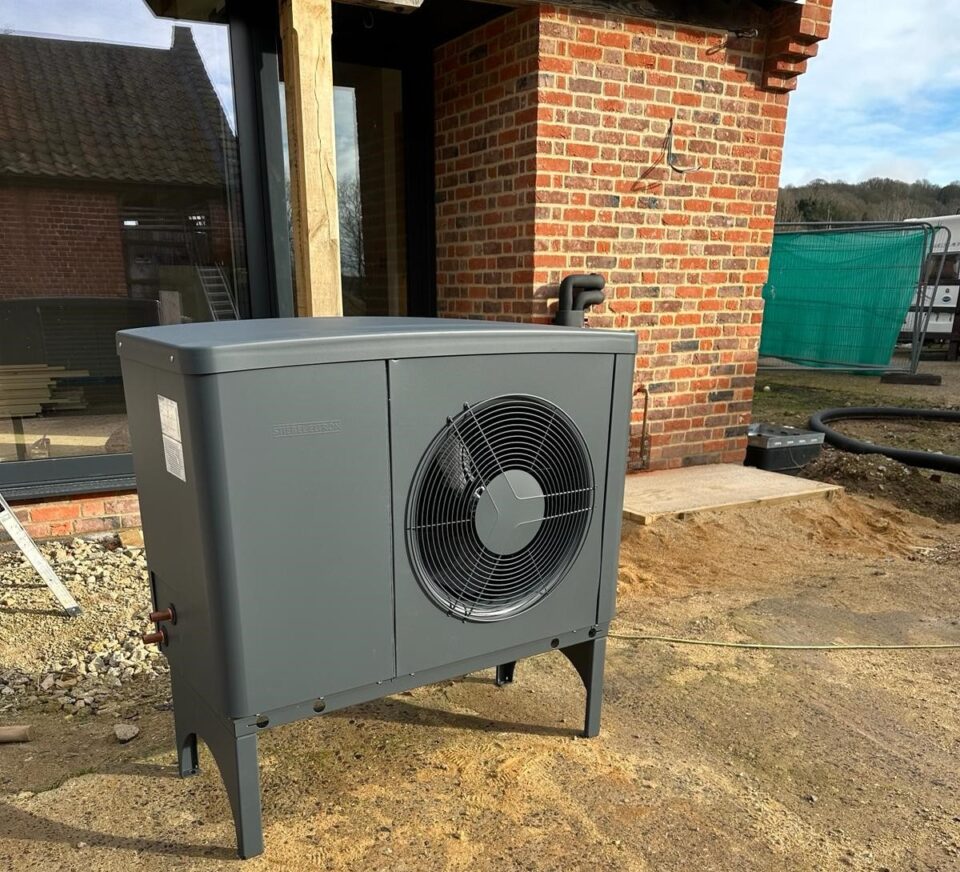
Siting is extremely important. An air source heat pump needs an appropriate external location, with consideration given to airflow, servicing access, neighbouring properties and noise. Ground source systems introduce different questions around land, boreholes and indoor plant space. STIEBEL ELTRON’s own UK range now spans air source, ground source and integrated indoor heat pump and ventilation systems, which illustrates an important point: there is not one universally correct type of heat pump for every home.
Finally, but increasingly important given recent record summer temperatures, is whether you want the system to perform cooling. Whilst almost every heat pump is capable of cooling in one form or another, not every system is. Making sure that you have the right system set up, components and emitters in place from the start is critical if you want to take advantage of this unique benefit of heat pumps without further disruption and costs.
Then there is perhaps the most overlooked question of all: how will the system actually be operated?
A heat pump does not generally behave like a large gas boiler. Rather than providing short bursts of very hot water, a well-designed system can run for much longer periods while producing only the heat the building requires. Weather-compensated controls can adjust water temperature as outdoor conditions change and inverter-driven compressors can vary their output rather than simply operating at full power or switching off. Homeowners who understand this before installation are far less likely to spend their first winter wondering why their new heating system behaves differently from the boiler it replaced.
None of this means a homeowner needs to become a heating engineer. Quite the opposite. A technically competent installer should do the engineering. The homeowner’s job is to know enough to recognise the right questions and to understand the answers.
Ask how the heat loss was established. Ask what design temperature is being used. Ask why that particular heat pump has been selected. Ask which radiators are being retained and at what water temperature they will provide sufficient output. Ask what efficiency the complete system is expected to achieve, how it will be controlled and what information will be provided at handover.
Those conversations are far easier to have before a contract is signed.
STIEBEL ELTRON is runs regular free online Heat Pumps for Homeowners webinars.
Register for a free webinar here.
This is a guest post produced in partnership with STIEBEL ELTRON. The views and information presented are those of the contributor. Renewable Heating Hub retains editorial oversight and only publishes sponsored content that we believe is relevant and useful to homeowners.
