
In the archives of forgotten patents and yellowing trade journals from the Edwardian era, one sometimes encounters a name that reframes everything one thought one knew about the slow, grinding ascent of clean energy.
For me, that name was George Cove, a Canadian inventor whose work on solar electricity surfaced quite by chance while I was tracing the prehistory of technologies that now heat our homes. What struck me was not merely the technical ingenuity on display more than a century ago, but the counterfactual it poses: how profoundly different the thermal (and indeed the entire energy) landscape of the developed world might look today had his vision been allowed to take root rather than being violently uprooted.
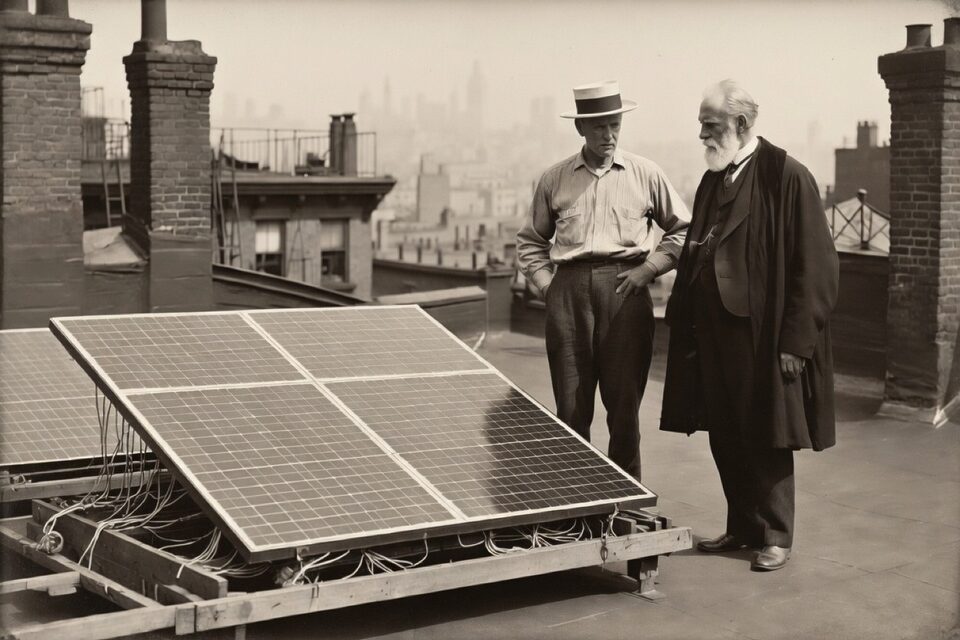
Cove’s device, first demonstrated around 1905 and refined in workshops in Halifax and later New York, was no laboratory curiosity. It was a practical solar generator designed for ordinary rooftops, converting sunlight directly into usable current and storing the excess in batteries for use after dusk.
Contemporary descriptions suggest arrays that would not look out of place on a modern semi-detached house: flat, modular panels capable of powering lights, small motors and (crucially) electric heating elements. In an age when most households still relied on coal scuttles or wood stoves for warmth, the promise was revolutionary.
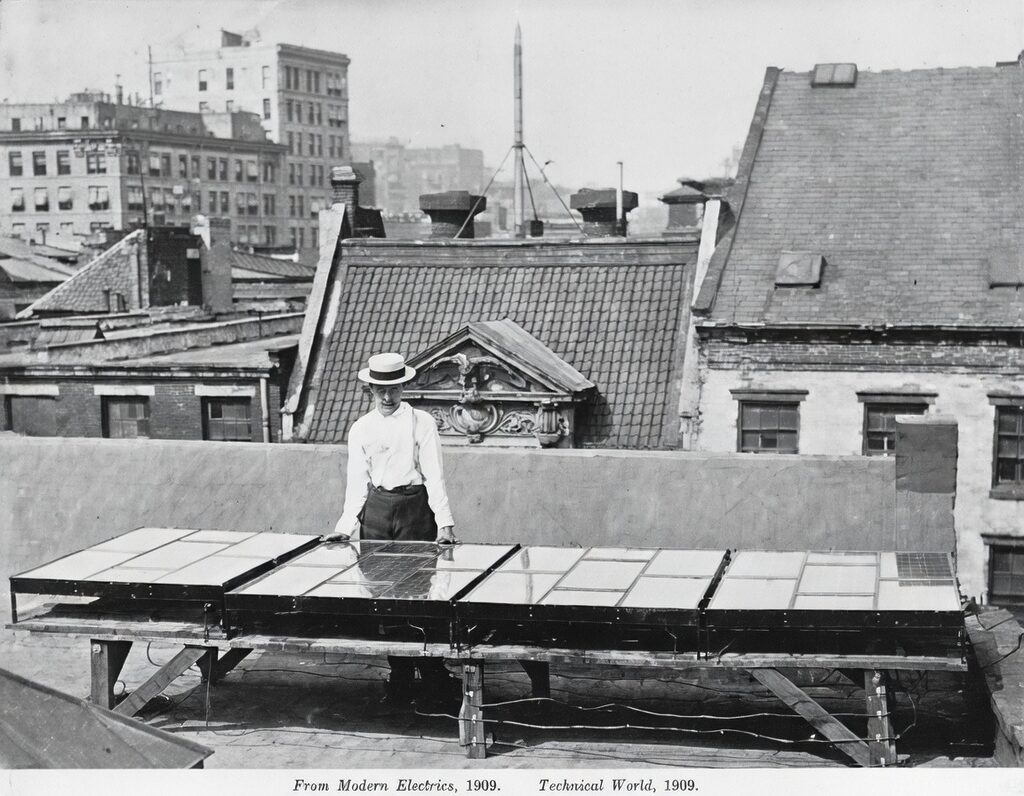
Electricity generated on-site could have displaced the smoky, labour-intensive business of hauling fuel indoors, offering a cleaner, more convenient source of domestic heat at a time when winter fuel bills were a genuine source of hardship. Investors evidently saw the potential. By 1909 his Sun Electric Generator Corporation had attracted significant capital and periodicals spoke of a coming era in which sunlight itself would keep families warm and illuminated without recourse to distant mines or central stations.
The broader energy context of the period makes the invention’s timing all the more poignant. The early 20th century was a moment of genuine flux in how societies met their power needs. Oil was beginning its ascendancy, coal still dominated industry and electricity grids were in their infancy.
What is remarkable is that even then, at the very dawn of the modern energy age, the fossil fuel industry (together with the nascent electric utilities that depended upon it) already displayed a willingness to suppress promising alternatives that threatened its emerging dominance.
Cove’s system offered a decentralised alternative that bypassed the emerging logic of large-scale combustion and long-distance transmission. It was, in essence, an early sketch of the very model now championed by advocates of renewable heating: generate power where you use it, minimise losses and pair it with efficient end-use technologies.
Here the story acquires an even sharper intellectual edge when one recalls that, half a century earlier, Lord Kelvin (then William Thomson) had already laid the theoretical foundation for the heat pump.
In 1852 Kelvin described the thermodynamic principle by which a modest input of mechanical work could extract heat from a colder reservoir (the air, the ground, a body of water) and deliver it at a higher, usable temperature indoors. The efficiency of such a system, he noted, could far exceed that of direct combustion or resistive heating.
Yet the idea remained largely dormant, awaiting affordable and reliable electricity to drive its compressors. Had Cove’s solar arrays achieved even modest commercial success in the 1910s and 1920s, the two innovations might have converged at precisely the right historical moment. Cheap, on-site solar electricity could have provided the power to run early heat pumps, multiplying every kilowatt-hour generated on the roof into three or four units of useful heat.
The learning-by-doing that drives down costs might have begun in earnest decades before the silicon breakthroughs of the 1950s, and the architecture of warmth could have evolved around distributed generation and high-coefficient-of-performance heat transfer rather than remaining tethered to fossil combustion.
Instead, the opportunity was lost. In October 1909 Cove was seized in Manhattan, reportedly told that continued promotion of his patents would cost him his life, and released only after refusing to surrender his intellectual property.

The episode has never been fully explained. Some contemporaries dismissed it as a hoax orchestrated for publicity, while others pointed to the obvious suspects… entrenched interests in oil, coal and the nascent electric utilities who had every reason to fear a competitor that required neither fuel contracts nor centralised infrastructure. Whatever the truth, the effect was decisive. The company faltered, production ceased and Cove himself faded from public view.
To dwell on this episode is to confront the truth that progress in energy is rarely a pure contest of ideas and efficiency. Economic historians have long studied how incumbent technologies can lock in advantages through network effects, complementary infrastructure and political influence.
Cove’s story adds a darker chapter: the possibility that outright intimidation can accelerate that lock-in. By the time solar re-emerged in a serious commercial form, the world had already committed trillions to pipelines, refineries, boilers and the cultural expectation that warmth arrives via flame or resistive wire. The result was a heating sector that, until recently, lagged far behind electricity generation in its decarbonisation efforts.
Consider the quantitative shadow this casts. Models of technological learning curves suggest that solar’s price trajectory could have been markedly steeper had deployment begun in earnest before the First World War. A modest but sustained rollout in the 1910s and 1920s might have brought photovoltaic costs into competitive territory by the late 20th century, rather than the 2010s.
For renewable heating, the knock-on effects would have been profound. Cheaper electricity would have made resistive heating more palatable earlier, buying time for the development of heat pumps whose efficiency multiplies the value of every kilowatt-hour generated on the roof. An earlier solar surge could have shortened the painful decades when electric heat was dismissed as prohibitively expensive.
Buildings themselves might have evolved differently – better insulated from the outset, designed around distributed generation rather than central boilers and equipped with thermal storage that complements intermittent solar supply. The synergy between Cove’s panels and Kelvin’s principle could, in short, have altered the trajectory of both heating and electricity itself.
One can only speculate how different the world could have been if renewables had been embraced as the natural path forward in the days of George Cove. An earlier convergence of decentralised solar power and heat-pump technology might have spared us a century of escalating fossil dependence, with its attendant geopolitical tensions, urban smog and mounting carbon emissions. The entire infrastructure of 20th-century energy (from vast extraction networks to centralised grids and combustion appliances) might have taken a gentler, more distributed form. Instead, the suppression of that early promise helped lock in habits of thought that still shape our energy choices today.
There is a deeper intellectual resonance here, one that transcends any single inventor. Energy transitions are not merely technical substitutions; they are social and institutional rearrangements. The 20th century’s reliance on fossil fuels entrenched not only physical infrastructure but assumptions that energy must be dense, extractive and centrally controlled.
Cove’s panels, paired with the heat pump’s elegant thermodynamics, challenged that assumption at its root, offering abundance that was diffuse yet democratic and efficient. Their marginalisation helped ensure that heating (the largest single end-use of energy in many temperate climates) remained the province of combustion engineers rather than systems thinkers. Only now, with the return of solar at scale and the maturation of heat-pump technology, are we rediscovering the possibility of warmth without extraction. The irony is that the solutions feel novel when they are, in many respects, the delayed realisation of an early 20th-century dream.
Yet this history need not breed fatalism. If anything, it sharpens the case for vigilance in the present. Today’s renewable heating sector faces subtler forms of resistance: regulatory inertia that privileges gas connections, supply-chain bottlenecks in heat-pump manufacturing and the lingering political weight of incumbents who benefit from the status quo.
The lesson of Cove (and of the unrealised meeting between his solar generators and Kelvin’s heat pump) is that such barriers are not inevitable; they are the product of choices, some of them deliberate. Policymakers and practitioners alike would do well to recall that innovation’s greatest enemy is rarely physics. It is more often the failure (or refusal) to imagine alternatives once a dominant system has taken hold. By accelerating deployment of solar-coupled heat pumps, hybrid thermal stores and smart district networks, we are not inventing the future from scratch. We are resuming a trajectory that was interrupted more than a century ago.
In the end, stumbling across George Cove’s story leaves one with a sense of tempered possibility. The world he glimpsed (a place where rooftops quietly convert sunlight into the steady warmth of daily life, amplified by the thermodynamic elegance of the heat pump) was not technologically fanciful. It was politically inconvenient. That inconvenience cost us decades of unnecessary emissions, higher energy costs for households and a slower reckoning with the limits of fossil dependence.
But the same contingency that allowed one era’s promise to be derailed also suggests that today’s momentum is not guaranteed. It must be defended, nurtured and accelerated. The renewable heating technologies now entering our homes and communities represent more than engineering progress; they are the vindication of a vision once nearly extinguished. If we recognise that earlier detour for what it was (an avoidable fork in the road) we may yet ensure that the path ahead leads, at last, to warmth that is both sustainable and sovereign. The sun, after all, has been waiting. It is time we fully honoured the appointment.

Very thought provoking Mars, and it just goes to reinforce the saying that ‘There is nothing new under the Sun’. So many times in history ‘interested parties’ have manipulated a rowing implement to disrupt a promising idea or invention for their own very selfish interests. We might well have had self sufficiency in electrical power and a much cleaner atmosphere along with better health and wealth for the whole world were it not for such greed by a few individuals.
We have the knowledge and technology and are slowly remedying the situation – but how much better it would have been had Mr. Cove’s ideas been allowed to develop and then embraced by mankind. Life is full of ‘If Only’s but, this really would have been a ‘big un’! Thank you for your efforts Mars, a good thought provoking read for any RHH reader!
Regards, Toodles.
A very interesting ponder Mars! I had never learnt of Cove, fascinating, was there any efficiency mentioned? The early ones in present technology were only ~10%.
Sadly there are plenty of instances (none that I can recall right now) where an up and coming technology company was purchased in order to NOT use the technology and let the IP wither.
@Judith, glad you found the story interesting.
On efficiency, I think that the very earliest solar devices, including Cove’s arrays, were extremely low-efficiency by today’s standards, probably in the region of 1-5% and certainly nowhere near the 10% of the first practical silicon cells in the 1950s. But that’s probably where the counterfactual becomes interesting.
Cove’s panels were never intended to compete with modern photovoltaics. I guess their real promise lay in being a decentralised, on-site source of electricity at a time when grid power was expensive, unreliable and almost entirely coal or oil-based. Even modest efficiency would have been transformative.
If ‘cheap’ rooftop generation had been available earlier, the effective system efficiency for heating could have been dramatically higher than burning fossil fuels directly because you multiply a modest solar output through the heat pump’s coefficient of performance. That combination could have made electric heating not just viable, but preferable, long before the 1970s oil crises.
Your point about companies being bought simply to shelve technology is spot on, and sadly all too common in energy history. It’s a reminder that the biggest barriers to progress are often not technical, but commercial and political and we’re still seeing echoes of that today if the roll out of renewables.
This is a (very long) but fascinating read on the link, of how the present solar/battery technology developed
https://www.notboring.co/p/the-electric-slide
If this sort of stuff interests you it’s a great rainy day read. Too USA centric obviously but that’s the nationality of the authors.
@Mars Mars it might make a good topic for you to write about and you can trim away the distractions of USA business models.