
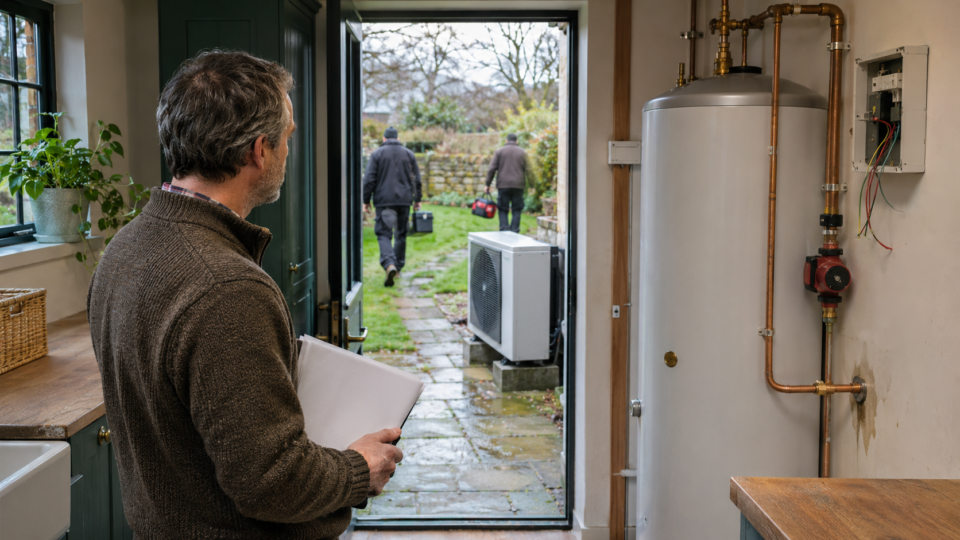
Heating certification promises reassurance, but homeowners should not need to understand an entire industry’s organisational structure to discover who is responsible when their heating fails.
A homeowner should be able to buy a heating system without first becoming an expert in the organisations that oversee the people installing it. They should be able to understand what they are buying, who is responsible for delivering it and where to turn if something goes wrong. Whether the appliance outside is a heat pump or the one inside burns gas, oil or biomass, those expectations ought to be unremarkable.
Yet consider the position of someone whose new heating system does not work properly and whose installer has stopped answering straightforward questions. There may be reassuring logos on a website and references to qualifications on an estimate, but no clear explanation of which organisation covers which part of the installation. Ask the installer to identify the scheme responsible for their work and receive an evasive answer, or no answer at all, and even the first step towards a formal complaint becomes an investigation.
That is the problem worth examining. How much protection does certification offer if the person it is supposed to reassure cannot establish what it covers or how to use it?
The arrangements commonly called Competent Person Schemes allow appropriately registered installers to certify that specified work complies with Building Regulations, rather than following the separate building control approval route. Current government guidance uses the term “self-certification schemes” and makes clear that businesses must be assessed against relevant competence requirements before certification. Installers are therefore certifying their work within an authorised scope, rather than simply declaring themselves competent. These particular arrangements concern England and Wales; building standards systems elsewhere in the UK differ.
There is a sensible argument for this approach. Requiring a separate building control process for every eligible installation would add administration and pressure on inspection capacity. Allowing assessed businesses to certify their own work can make the system more practical, provided oversight and remedies are effective. Government’s own 2026 consumer protection consultation describes the role of scheme audits and checks, alongside a review intended to strengthen the framework. Self-certification does not mean there is no external oversight. The question is whether that oversight delivers what homeowners reasonably expect.
Even understanding the promise requires care. Gas Safe registration, MCS certification and membership of a Building Regulations self-certification scheme are not interchangeable. The Welsh Government’s guidance specifically notes that Gas Safe is not technically a Competent Person Scheme, although its installers have corresponding Building Regulations responsibilities. Registration is also tied to particular types of work. A familiar organisation’s name on a quotation does not, by itself, tell a homeowner that every activity in the proposed installation falls within the business’s registered scope.
Those distinctions serve technical and administrative purposes, but consumers experience them together. They are buying heating for their home and seeing badges presented as reassurance. It is entirely reasonable for them to expect the relationship between those badges and the job being sold to be explained before they pay.
Public registers do exist. LABC’s “Find a Competent Person” service offers searches by postcode, business name and trade, while scheme operators provide their own checking facilities. It would be wrong to suggest homeowners have no way to investigate an installer. But a directory is only part of the answer. The questions after a disputed installation are more specific: which legal business undertook the work, what was it registered to do at that time, which parts of this particular job were covered and was the required notification actually made?
A failed search cannot automatically answer those questions. Nor should an installer’s refusal to explain their position leave a customer searching through multiple organisations, trying variations of a trading name and hoping that someone recognises it. If a business wants customers to rely on its certification, the connection between that business, its authorised work and the relevant complaints process should be explicit and independently verifiable.
There is another complication. Heating installations bring different disciplines together, while complaints processes can require those disciplines to be separated again. In a wet heating system, pipework, emitters and circulation have to work with the electrical supply, pumps, valves, sensors and controls. A boiler or heat pump can be physically connected and still fail to deliver the comfort or performance the customer was promised.
Sometimes one business provides all of this expertise. Sometimes it brings in an electrician. Sometimes the homeowner contracts different trades separately. Those arrangements affect responsibility, but they do not change the physical reality that the finished system has to function as a whole. The interface between the trades is part of the installation.
Imagine a system that repeatedly stops heating. Is the underlying problem a control setting, a wiring fault, inadequate circulation or a design decision? The homeowner may have no way of knowing. A complaints process that requires them to identify the technical cause before it can direct them to help asks them to perform part of the investigation they are seeking help to obtain.
There is already a published standard against passing this burden to customers. MCS’s 2026 complaint-handling guidance says responsibility remains with the MCS certified installer where subcontractors are involved, and that customers should not be referred to a subcontractor to raise a complaint or claim for damage. That is a principle worth extending across heating installations and making visible before contracts are signed. It also needs to work when the customer actually asks for help.
The Renewable Heating Hub forums show why these questions are more than theoretical. In a thread begun in August 2024, a homeowner reported inadequate heating, high running costs and an installer who was not responding. The homeowner took the complaint to NAPIT and later described disagreement over whether the heat pump had been sized correctly, saying calculations relied on by the installer had not been made available to them. That is the homeowner’s published account, rather than an independent determination of the technical dispute, but it illustrates how difficult it can be to challenge a decision without access to its supporting evidence.
In another discussion, begun in November 2025, a homeowner reported discovering that a heat pump quoted and originally certified as an 11kW unit was actually a 9kW model. They described receiving revised heat loss calculations and a later certificate showing the smaller unit. Their account raises a distinct question about transparency: how can a customer scrutinise what was designed, supplied and certified if the history of those records is difficult to follow? These examples are not evidence that every scheme fails or that either dispute remains unresolved today. They are evidence of the questions homeowners have had to bring to a public forum.
Finding the relevant body does not necessarily mean finding a remedy for every consequence. NICEIC’s published complaints process focuses on technical standards and says it cannot resolve requests for refunds or compensation, or intervene in contractual issues. NAPIT’s policy similarly says its complaints process does not pay compensation or fund third parties to rectify work, although a member may propose those options as a resolution. Both describe a role in addressing technical complaints. Their stated limits are nevertheless significant for someone who needs both a working system and a way to recover money spent putting it right.
These limits should not be presented as proof that there are no protections. MCS’s February 2026 complaints policy, for example, describes circumstances in which it can consider performance, design, workmanship, installer conduct and contractual concerns. Eligibility and scope still apply. The point is that different processes offer different help, and the person with the broken heating should not have to discover all those differences through successive rejected enquiries.
Nor should technical compliance, commissioning records and Building Regulations notification be treated as a single interchangeable piece of paperwork. Welsh Government boiler guidance distinguishes commissioning documentation from the notification and compliance process, and explains the alternative building control route where an installer cannot self-certify. For homeowners, the practical lesson ought to be delivered by the professional selling the installation: here is the approval route, here is who will arrange it and here is what the price includes. It should never arrive as an unwelcome discovery after the work has gone wrong.
The reforms needed are hardly exotic. Every heating proposal should include a plain-language statement identifying the contracting business, the registrations relevant to the proposed work and the organisation responsible for each certification route. It should explain who will deliver the electrical work, who will coordinate the completed system and how any work outside a registration’s scope will obtain the necessary approval. A homeowner should not need to ask the right technical question to receive essential information.
There should also be an accessible record for the installation itself, bringing together the agreed design, relevant certificates, commissioning results and notification references. Changes should retain their history and be visible to the homeowner. Registration checks should make the scope and relevant dates clear, and an unresolved complaint should have a named organisation responsible for coordinating the next step rather than merely supplying another contact address.
None of this removes the need for evidence, fair investigation or a reasonable opportunity to correct mistakes. It does require the system to recognise the circumstances in which complaints arise. A household without dependable heating needs a workable route to help, and a credible safety concern needs urgent assessment. Procedures should explain how necessary remedial work and evidence preservation can coexist, rather than leaving consumers frightened that making their home usable will undermine their complaint.
Self-certification can be defensible, but the authority to sign off work must be matched by accountability that customers can actually reach. Its success should be judged by the quality of installations and the handling of failures, including how quickly responsibility is established and problems are resolved.
A homeowner should be able to say that their heating does not work and receive a clear explanation of who will investigate, what happens next and what help is available. If the industry cannot consistently provide that, it has more to answer for than a confusing collection of acronyms. It has a system that asks consumers to trust competence, then leaves them struggling to locate accountability.
