
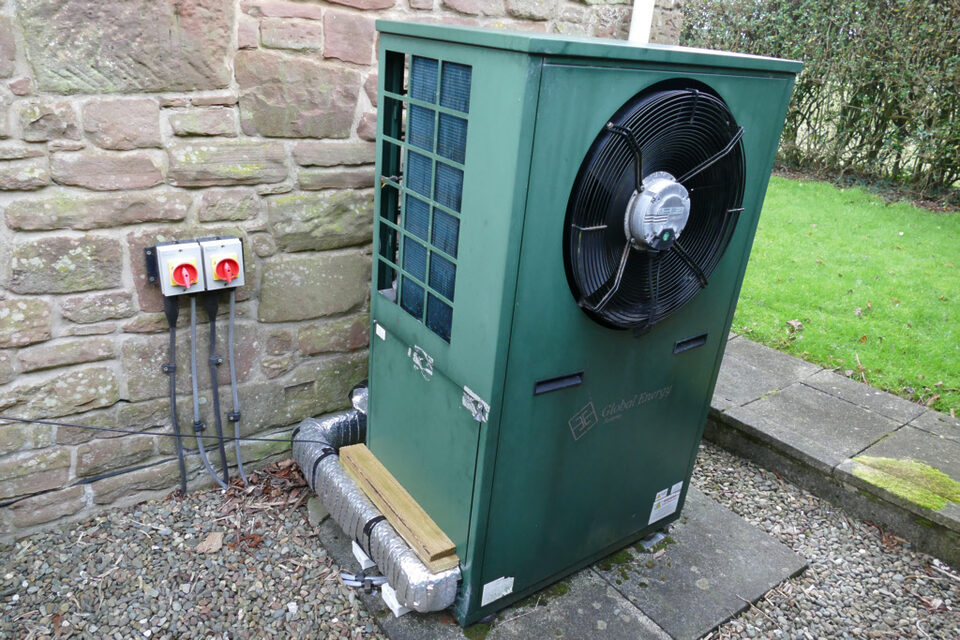
According to Global Energy Systems’ specifications, at 2C, with flow temperatures of 30/35C, the Thurso heat pump is stated to deliver a heat output of 7.88kW with power consumption of 2.67kW and a COP of 2.95, using refrigerant R410A.
So where do I begin to express my frustration with this ineffective system? I hope this review can serve as a cautionary tale to others. As the saying goes: caveat emptor… buyer beware.
In our defence, my partner and I inherited this system when we bought the house. However, we have experienced first-hand what is effectively a non-existent service, despite an annual £360 charge from Global Energy Systems, a UK designer and manufacturer of heat pumps based in the North West of England. I can understand why some people might be drawn to a UK-based manufacturer, but in my humble opinion, doing so in this case has proved to be a terrible and expensive mistake.
Looking at publicly available Companies House records today, I note that for the financial year ending 30 September 2023, the company reported zero employees. The previous year also showed zero employees, and the year before that (2021) showed two employees. There now appear to be two directors.
This raises a question for me as a homeowner: is this a semi-zombie company, surviving from quarter to quarter, potentially reliant on government pro-green incentives alongside the occasional private customer? A “UK designer and manufacturer of heat pumps” certainly sounds appealing and worthy on paper, although I have no direct knowledge of what government incentives or payments may or may not be involved behind the scenes.
Onto our issues. We live in a five-bedroom detached house in rural Cumbria, about a mile inland and roughly 200 feet above sea level. We have no access to mains gas (oh, how we wish we did) and the property is supplied via an overhead electricity line. The previous owner used oil central heating.
The house has 11 radiators in total. Apart from two bathrooms with towel rails and a kitchen with a newer single-panel tall radiator, all other radiators are dual-panel and typical of a high-temperature oil system. Two rooms, in a sandstone section of the house, have no wall insulation but are double-glazed. The rest of the house has cavity walls. In 2025, we installed 300mm of loft insulation throughout the property.
The system is a Global Energy Systems Thurso heat pump, paired with their specified UK-made World Heat CLIMACYLSS dual tank, containing 300 litres of hot water and a 100-litre buffer. A separate pump feeds the radiator circuit via approximately 22mm pipework running the length of the house through the attic, with 15mm drops to the radiators. There is a single heating thermostat in the hall.


The previous owner (let’s call him Joe) wanted a heat pump. He knew installation was expensive but believed it would save him money in the long run. We know this because we had many conversations with him before and after buying the house, following his sad and costly divorce which forced the sale.
Joe approached Mitsubishi, who told him he would need a proper heat loss survey and that most, if not all, of the radiators would need replacing. “Bugger that,” Joe thought. He knew central heating, and with oil the radiators were always hot.
Joe then discovered Global Energy Systems. According to Joe, Global Energy told him there was no problem. No heat survey was required. They referred him to one of their installers, and the Thurso model was recommended. Although the output was significantly lower than Mitsubishi had suggested, Global Energy said the Thurso would be fine. Joe accepted this advice and ordered the system. He lived with it for around three years before selling the house to us.


Global Energy charged £360 per year for an annual service and electronic monitoring. The system transmits mobile data back to them, allowing remote monitoring and adjustments. Customers have access to a summary page, but when using external control (a thermostat), you cannot remotely turn anything on or off.
Global Energy do not permit customer access to system settings. We are not allowed to adjust flow temperature, enable weather compensation or change any other parameters. All we have is the hall thermostat.
It later became apparent that the system is set to a fixed “flow” temperature of 45C, except the system is so badly under-sized that it is incapable of reaching this through the radiators, even on mild days. Most days it cannot even reach 31C.
What actually happens is this: every time the thermostat turns off, the system continues running in order to heat the buffer tank up to 45C before going into standby. This cannot be stopped. The radiator pump runs for around five minutes, then stops, after which the heat pump typically runs for another 25-30 minutes heating the buffer tank. Only then does the system shut down.
This is where things become absurd. 45C is clearly far too much for this system, particularly in cold or damp weather and it triggers multiple alarms every day. The manual provides no explanation, but the alarms include:
- Envelope Tc Low
- EVI High Superheat
- Inverter Overcurrent
- Compressor Alarm (often twice in succession)
- Lost Rotor
The system usually shuts down for around ten minutes to reset itself. By that time, the thermostat has often called for heat again, and the entire cycle of doom restarts. Occasionally (particularly in damp weather around 3-7C) the system also throws a “Major Defrost Failure” alarm and shuts down completely.
This happened while we were away on holiday. We returned to a bleeping alarm and no heating, requiring a manual reset. During that period another water pipe froze and burst, flooding the house and costing us thousands in re-carpeting and redecoration. I cannot hold Global Energy responsible for this, but I do wonder whether that pipe would have failed had there been heat in the house.
We now rely on a jury-rigged setup of industrial fan heaters in the lofts, connected to Wi-Fi smart plugs and temperature sensors. If we are away and receive an alert that attic temperatures are nearing zero, we can switch heaters on remotely from anywhere in the world. But should any homeowner really have to live like this?
Global Energy have never contacted us to say they identified any faults. We, however, have contacted them many times. On one occasion they replied with a vague and useless suggestion along the lines of “try turning it off and on again”. After that, we emailed twice more and received no response at all. We telephoned and spoke to a lady who said nobody was available but she would make a note. Nobody ever called back.
We requested access to the system settings so we could attempt to manage it ourselves. They declined to engage. My builder contacted them, and so did his plumber, both without success. Neither was given access to the system or meaningful support.
This system is effectively useless. Customers are completely locked out, and it now needs replacing… likely along with all the radiators. Frankly, it is junk.
There was also a serious manufacturing fault. The external evaporator fins overhang the casing on the left-hand side, allowing condensate to run down between the panels and into the machinery below. Directly underneath sits the booster heater, with wiring on top, and below that the internal water pump.
The booster heater failed early on, so early that Joe did not even realise there was a booster. After we bought the house, the water ingress then destroyed the internal water pump. Global Energy charged my partner around £800 to replace it. They did replace the booster heater free of charge.
The booster remains active up to 30C, and we are not allowed to change this setting. Our only option is to turn off its circuit breaker when desired. Recently, the booster alone has accounted for roughly a third of the total electricity consumption. Global Energy did not identify the overhanging fins as a fault; it was left to me to bend them back manually to stop the water ingress.
The annual service itself was minimal. The specification includes cleaning the evaporator tray, yet a dead mouse remained there after the service. The engineer, wearing a Global Energy polo shirt, clearly did not even remove the front cover. This is disgraceful and, in my view, a discredit to the industry. We eventually cancelled the annual contract and have been on our own ever since.
So how does the system actually perform?
We are currently experiencing a cold spell, with daytime temperatures of 3-6C and nights at 0-2C. We set the thermostat to 18C from 5pm to 9:30pm, 15C overnight, and 15.5C from 7am to 5pm. We feel permanently cold.
Hot water is heated to 50C and cannot be changed. I have been meticulously recording electricity usage and recent daily consumption figures are:
44kWh, 44, 53, 49, 47, 45, 46, 53kWh.
On most days, the thermostat only reaches 16.5-17C in the evening. This is an utter failure. Without a wood burner (and a tree that came down in a storm this year) we would have been forced to move out. Before we doubled the loft insulation in 2025, the coldest days saw consumption of around 67kWh. Completely unaffordable.
There is one further oddity, although I may misunderstand the terminology. Using my own temperature probes, I can say with certainty that what the system labels as “flow” temperature appears to be the return temperature… i.e. water coming back from the radiators via the buffer tank. The actual return is typically 5-9C higher.
Yesterday evening, with an outdoor temperature of 5C and after two hours of continuous operation, the reported “flow” only reached 29.3C. Something is clearly very wrong.
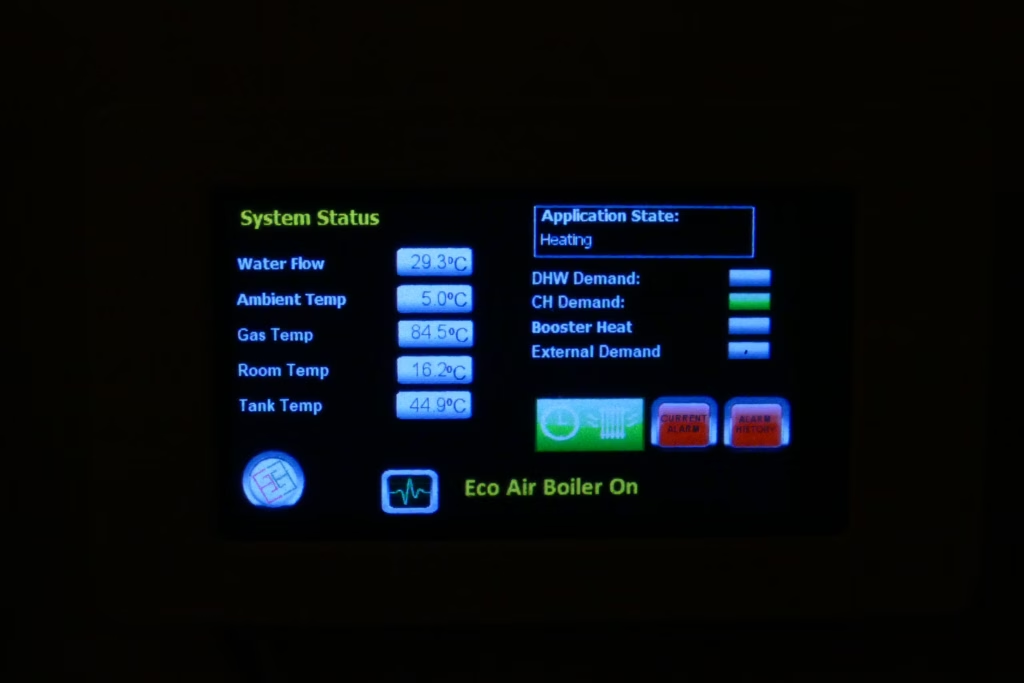
The data link to Global Energy’s web portal stopped recording data nearly two years ago and never resumed. They did not query the loss of data and ignored our request to fix it. They have done almost nothing for us. I would never recommend this company to anyone.
I make no criticism of World Heat. When I contacted them directly to ask about the internal layout of the tanks, they were extremely helpful.
I am also very grateful to Mars and his YouTube videos and website, from which I have learned a great deal, as well as from my own heat pump “journey”, though why this has to be a journey at all is beyond me. I now feel almost like a professional.
The big question is this: how does one find a reputable, reliable, competent and professional installer who will do the right thing, at a fair price? How do we choose the right heat pump to heat our home as we enter retirement? If this experience is typical, then any government policy encouraging heat pumps is doomed to failure.
I fear that 2026 into 2027 may be very costly indeed.
Review published on 3 January 2026. System installed almost seven years ago.

Wow! Reading this has brought back more than a few flashbacks (and not the pleasant kind)… 🤨
I have to say, Global Energy Systems appear to have rolled out the same approach across their installs, which is frankly horrifying. No heat loss calculation. Emitters not properly considered. Shambolic commissioning. Systems locked to a fixed 45C flow temperature. Utterly ridiculous, and almost a carbon copy of what they left us with on our Caernarfon system.
I’d just like to point out that you were paying for this service. In my view, you’d be well within your rights to demand a refund. This was one of the main reasons we never renewed the contract. The data connection never stayed live for longer than a week, and whenever I spoke to support, the advice was always the same: go outside, power the system off and restart it. That’s not exactly ideal for the internal electronics of a heat pump, just to get communications back online.
This was far more than “occasional” for us. It regularly shut the system down for no obvious reason, often in the early hours (typically around 2-3am) leaving us to wake up to a freezing cold house.
We were also in a similar situation with our emitters @outlawuk. Global Energy had never done a heat loss on our property or an emitter guide, yet our commissioning report was also just an exercise in ticking boxes for MCS… it took us two years to figure out something was wrong with rooms that weren’t heating up and when we dragged Global Energy Systems out they admitted to their “failings" and then “discovered" that 6 out of our 12 rads were undersized.
I’m sharing this so that homeowners can learn from us. Please get heat loss calcs done and also get installers to confirm that your emitters will work at design temperatures.
I suspect there are loads of other homeowners out there that have Global Energy Systems heat pumps installed, and I bet they’ve had the same corners cut and the same dreadful commissioning. If you have a system from Global Energy systems that you’re not happy with (or that you are happy with) please contact me: @Frank.co.uk">editor@Frank.co.uk
@Mars I rather feel that there may be just one thing to say in Global Energy Systems favour; they were instrumental in the creation of RHH! However, I feel very sorry for all those who may have suffered due to their ministrations – and all this has happened whilst MCS twiddle their fingers and moustaches. What hope has the average passenger on the Clapham Omnibus of making a wise investment whilst thinking they are ‘doing their bit’ towards NetZero?☹️ Regrets, Toodles.
@Toodles love the positive spin! 😂
I had to Google the Clapham Omnibus… amazing reference and must remember to use this in a future video 😂
Just remember not to travel on the other omnibus. Google that 🙂
@outlawuk sorry to hear of your woes. The above is a rather systematic approach across a lot of the ashp industry which I have personally found highly concerning as well.
Regarding your consumption figures- and don’t get me wrong, the rest of it is clearly a mess- aren’t too outrageous in principle, if of course it was reaching the desired indoor temp (which yours evidently isn’t). On the coldest days our consumption just for the ashp might be high 60s. In fact yesterday ours used 68kWh.
Great point Benson. In winter, on mild days, our 18kW was doing 40-60 kWh… I remember a few years ago we had a spell of -7C and we’re doing 100-110kWh/day… only thing that made it OK was the sub 15p we were on.
reading this has honestly made my stomach drop becuase this is EXACTLY our experiance too.
We had a system installed by Global Energy ssystems almost six years ago now. Same horrible green heat pump. Same story. No heat loss calc. they just turned up, eyeballed it and said it would be fine.. its not good.
Commissioning was done by a bloke called Adam. I’ll never forget it. Arrogent, dismissive, talked down to us like we were thick any question was met with a eye roll. Made us feel stupid
The system has basically limped along ever since. If it’s 5 outside, it’s kind of OK. Not great, but tolerable. As soon as temps drop to 2 or below, forget it. House won’t get past 18, no matter what we do. We’ve had to put electric heaters on and light fires just to be confortable. What’s the point a green heating system if you’re relying on fires and plug-in heaters?
Biggest mistake we ever made. now saved enough money and this summer we’re ripping this heat pump out. We still want to stay green but never again with this brand and never letting them anywhere near an install or commissioning.
terrible company
@gingervitis, sorry to hear that. It’s interesting because we’re starting to see more and more Global Energy Systems homeowners contacting us, and they royally bodged our system too.
Glad to hear you’re still keeping the faith in heat pumps despite this poor experience though. What brand are you considering as the replacement and will you get a proper heat loss and emitter guide done before your replacement? I strongly recommend that you do and if you want to email or DM me I can recommend an installer to you.
I will get heat loss dine & already have a installer lined up
they have recommeded vallant and Samsung
@gingervitis that’s great, and pleased you’ll get a proper heat loss calculation done. Out of the two choices, I’d opt for Vaillant if I was you. Let us know how you come along, and feel free to ask questions so that you get a decent install this time.
I’d choose Vaillant of the two too. We heard too many sorry tales locally from people who couldn’t control their Samsung well. You’ll find them on here too.
But Vaillant controls are excellent even if you need a bit of time to get used to them, the app has made it much easier too
@Judith thank you .
i will get quotes in Feb. I found installer that does vallant and one that likes mitsu. Just want to get this rubbish heat pump removed.
I met with a local Stiebel Eltron HP installer a year ago. He quoted me £10K for just a HP and cylinder, and he wanted me to do the heat loss survey. When I pressed him a little more he told me that he ‘usually dealt with the thick and rich of Cheshire who weren’t worried about running costs’.
@L8Again 😱 Fortunately, the readership of this forum are Nause and Savvy rich and care about consumption!😉 Toodles.
Having read your story about your Global Energy heat pump, it almost exactly mirrors the problems we’ve been dealing with since moving into our property in January 2025. We have rooms that simply won’t get warm and often end up relying on electric oil-filled heaters. The system also shuts down randomly in cold or damp weather — which, being in rural Cumbria, happens a lot.
We eventually brought in an expert to assess the installation, and the list of issues was shocking. None of the pipework had been lagged, and the system’s pressure gauge had been fitted outside the unit, giving completely inaccurate readings. And that’s just the start. We’ve spent thousands fixing mistakes made by the developer.
At this point, we’re seriously considering ripping the whole system out and replacing it with an oil-fired boiler.
Sorry to hear that Alexander. Was the system also installed by Global Energy Systems?
It was indeed – Although not by us. But the developer who renovated the property before we bought it. I believe the system is a 18kw Winchester unit.
It’s remarkable how many of these systems from Global Energy Systems are beginning to pop up. Can you please email me more photos as well as the commissioning report?
Following contact with Global Energy Systems they sent out one of their engineers to meet our expert to discuss our system. Multiple defects were found with the installation and engineering solutions were agreed between our expert and GES including a settings change that stopped the error alarms immediately. To clarify the installation was carried out by the original developer of our house along with their plumber, GES didn’t carry out design install or commissioning of this install they supplied the unit only direct to the developer. GES have supported us and our expert over the last couple of weeks and we feel much better equipped to improve our system going forward.
Thanks for the update Alexander, and I’m glad that you’re getting things sorted out. Hopefully your system will soon be performing the way it should. Keep tabs on it just make sure things are working and that you’re happy with the performance. Keep us updated.
It was reading about Mars’ woes with his Caenarfon pump that put me off ASHPs when I refurbed my bungalow. Between that and the, I think 2012?, report on ASHP real installation efficacy that has fuelled a lot of heatpumpaphobia. I think much of the current distrust stems from these older reports.
And probably rightly so. The industry as a whole was woefully inadequate but is improving.
I’ve recently re-evaluated what’s on offer and clearly the current generation are significantly better, especially with retrofits. Skills seem to be improving as the old 80c-26kw-and-done gang retire.
Mark, I can see why our saga would have put you off.
That said, with the benefit of hindsight, our system really wasn’t a fair reflection of what a heat pump can do. It was a textbook example of a boiler-style install with a heat pump bolted on top. That’s essentially what a lot of those earlier reports captured as well… systems designed and installed at a time when the industry simply wasn’t ready.
Things are better now. Not perfect, but better. The good installers are designing properly (accurate heat loss, correct pipe sizing, proper hydraulics, weather comp as standard) and when you get those fundamentals right, the systems perform very differently.
The problem is that the technology still gets judged by the worst installs, and there are unfortunately still enough of those around to keep the scepticism alive. I would argue the numbers of poor installs continue to increase.
So I’d agree with you on the direction of travel (it is improving) but I’d also say the risk hasn’t disappeared. It’s just shifted. It’s definitely less about “do heat pumps work?" and more about “have you got the right people designing and installing it?”
On the omnibus comment (for anyone scratching their head and not wanting to google it) it’s just an old expression meaning don’t jump from one extreme to the other. In this case, don’t go from “heat pumps are the answer to everything" to “they’re all useless", or the other way round. The truth sits somewhere in the middle.
Hello Outlaw UK,what a heart-breaking story; very sorry to hear so.It’s a while ago now that you posted, how are you proceeding?Thank you for providing a well-done problem description, which lets me think of a possible solution.
However, I would appreciate when @JamesPa and @Mars would give supervision here; I’m no way sure if my contribution can be helpful.When this was my own system, I would proceed as follows, taking single steps, approaching mostly isolated issues independently.
Any of these steps would provide the installer to an explicit, unequivocal mission without charging him unduly a design risk:As measure zero, I would never ever turn down the hall thermostat for a night setback or the like.
Especially the sandstone part of your house will take three days minimum to acclimatise, during which time you will suffer cold feet. When turning down temperature, the building will take again three days to cool down, providing a good feel of sitting in a dwelling done well, but the bad ending is that it will take three days again to get back to setting point (even with a proper heat pump).
The first thing to do for the installer from my point of view would be to take out that unspeakable combination tank from the heating cycle but, since I am stingy, mean and cheap, leave it as a domestic hot water (DHW) cylinder in place.
A manually (yes!) operated three-way valve would serve either DHW preparation or the heating circle with hot water from the heat pump; such concept normally would be automatically driven by the typical heating control system (which includes a weather compensation as well).
This would mean that, some ten minutes or half an hour before taking a shower, I would have to walk into the boiler room, turn that valve to ‘DHW’ and, later, back to ‘heating’ again. Since the heating and I are already thick as thieves, this would be no serious issue and, being a temporal solution, neither.
From this measure I would expect serious progress, in front assuming of course that the cylinder will comply with the pipework modification.
First of all I look forward to finally bring the given 45°C to the emitters, thus adding at least 50% more heating power to the house. When further it would turn out that, in the course, the insubordinate outdoor unit gave up its bucking, this would be a great success and spawn an investigation if the 45°C-ban can lifted from that device and if it can get paired with a third party controller, in which case I would seriously consider to keep the green monster in place.
Otherwise it would be time to give it a bullet and call in the knackerman, while putting an order for a new heat pump including a suitable controller and a motor for the manually driven three-way valve. Since the newish R290-pumps are said to be able to supply high flow temperatures without giving up too much COP, they seem the right choice.Next stage then would be to find out if now, with an employable heat pump at hand, the emitters will do a proper job heating the house on the one hand and not sacrificing too much efficiency on the other. When this, as can be expected, will not be the case, at least it will be easy now planning replacements along the visible deficiencies. And the last step would be to finally lay waste to the room decoration while replacing radiators as necessary.
As can be seen, the worst step is the last one and obsolete when the former moves came out well. These again would be either in the boiler room or outside, not much interfering with the use of the building. And none of that will exceed the complete replacement you seem to plan.
As a timeframe I would start immediately with step one and watch the system working during spring and summer, putting step two in place when autumn comes for to approach winter with a performing heat pump. When in January it turns out that further measures will be necessary, do them in 2027.
I think this is an important point to keep repeating, but perhaps with some context:
I looked around for independent Heat Pump CSAT reports and came across (for a second time) the Nesta one published in 2023, which seems to be the best available. In summary it says that people are broadly as satisfied with heat pumps as they are with gas boilers, albeit that satisfaction with heat pumps is a bit more polarised. However the satisfaction with boilers isnt particularly high, only about 70% being either very satisfied or fairly satisfied. So thats 30% who arent satisfied. There was no rating ‘neither satisfied nor dissatisfied, you had to be one side of the line or the other.
These people, if they have just had a heat pump installed, will attribute their dissatisfaction to the change in technology, not to the fact that this level of satisfaction is (apparently) representative of our heating industry as a whole!
Hello @outlawuk sorry, I forgot about this, important:if it’s not already done (you didn’t mention though), consider of insulating your cavity walls. This would be a step into the right direction anyway plus that it could save you from replacing radiators.