
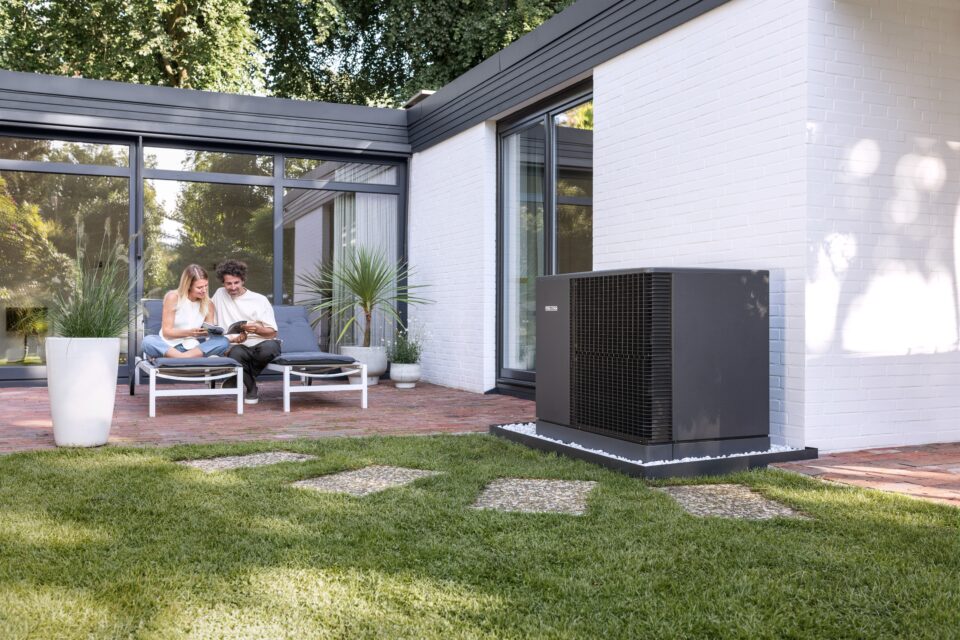
There is no shortage of heat pumps for British homeowners to choose from. The market has expanded at a remarkable pace, manufacturers are increasingly converging around propane refrigerants, high maximum flow temperatures and impressively low published sound levels, and almost every new generation of machine arrives accompanied by familiar promises of greater efficiency, smarter controls and easier installation. From a homeowner’s perspective, this abundance ought to make choosing a heat pump easier, yet in many respects it has done precisely the opposite, because once the headline specifications begin to look broadly similar, the harder question becomes what actually separates one manufacturer from another.
STIEBEL ELTRON is an interesting company through which to explore that question because 2026 marks 50 years since it began producing heat pumps. That longevity does not, in itself, guarantee that somebody will end up with a good heating system, and it certainly does not absolve an installer of the responsibility to calculate, design, install and commission it properly, but half a century of working with the technology does give the company a perspective extending well beyond the current UK heat pump boom.
The machines themselves have changed almost beyond recognition during that period. Early heat pumps relied much more heavily on direct electric backup as outdoor temperatures fell, helping to create the persistent myth that heat pumps somehow stop working when the weather drops below freezing, whereas STIEBEL ELTRON’s current HPA-O Plus air source range is designed to continue operating at outdoor temperatures down to -25C. Inverter-driven compressors have transformed the ability of heat pumps to vary their output, refrigerants have improved, controls have become vastly more sophisticated and the emergence of solar PV, batteries and connected energy systems is gradually shifting the heat pump from being viewed as an isolated heating appliance towards becoming one part of a much more integrated home energy system.
Yet perhaps the most interesting thing about STIEBEL ELTRON’s current position is not what has changed, but what the company says has remained constant. It has maintained a long-standing belief that electricity will increasingly become the energy carrier for domestic building services and sees heat pumps as uniquely capable of providing heating, hot water and, where appropriate, cooling from one technology. That is an engineering philosophy rather than a marketing slogan, and understanding it helps explain some of the decisions STIEBEL ELTRON has made with its latest generation of products.
The heat pump is only part of the heating system
One of the recurring themes on Renewable Heating Hub is that homeowners tend to spend far too much time choosing the heat pump and nowhere near enough time interrogating the system around it. A premium machine can be rendered inefficient, uncomfortable or troublesome by inadequate radiators, restrictive pipework, poor hydraulic design, inappropriate controls or simply by being the wrong size for the building, and STIEBEL ELTRON is unusually explicit about where it believes the line between manufacturer and installer responsibility should sit.
The manufacturer, it says, is responsible for producing equipment that performs according to its published specification, supplying the technical information required to install and commission it correctly and providing training and support to the people working with its products. The installer has a much broader responsibility for the finished heating system, including heat pump sizing, pipework, emitters, controls, hydraulic balancing, commissioning and the way all those components interact once the heating is switched on. A functioning heat pump therefore cannot automatically be equated with a functioning heating system; an appliance can be doing precisely what it was designed to do while the house remains uncomfortable or the electricity consumption disappointingly high because something elsewhere in the design is wrong.
That distinction becomes particularly important when looking at STIEBEL ELTRON’s current hpnext range because, like several of the latest R290 heat pumps, these machines are capable of producing very high water temperatures. The temptation with high-temperature heat pumps is to assume that they make careful retrofit design less important, because a machine capable of delivering water at 70C or 75C can simply replace a boiler while everything else is left alone. STIEBEL ELTRON does not endorse that approach.
Its recommendation for radiator systems is a maximum design flow temperature of 55C and it says it sees very little justification for deliberately designing above that figure. Because the systems operate with weather compensation, they should spend much of the heating season below their maximum design temperature anyway, increasing the water temperature only as outside conditions become progressively colder. The ability of certain STIEBEL ELTRON heat pumps to produce water at up to 75C should therefore be understood primarily as additional flexibility, particularly for domestic hot water production, rather than as permission to design a central heating system around permanently elevated temperatures.
This is an important position because the fundamental physics of heat pumps has not changed simply because refrigerants and compressors have improved. The greater the temperature lift between the air outside and the water circulating around the house, the harder the compressor generally has to work and the more electricity is required to move each unit of heat. A heat pump capable of reaching 75C may therefore provide useful resilience, but a well-designed system should still be trying to operate at the lowest practical temperature consistent with keeping the house comfortable.
Sizing introduces another layer of complexity. STIEBEL ELTRON says the current UK range, with outputs running from roughly 5kW to more than 17kW across its Trend and Plus models and with both single-phase and three-phase options, is capable of covering more than 80% of UK homes with a single unit, while cascaded machines extend that coverage considerably further. More interesting, however, is the emphasis the company places on minimum modulation and domestic hot water recovery, because these are issues that often disappear when homeowners are simply presented with a nominal kilowatt number on a quotation.
A heat pump that is correctly sized for a building’s heat loss still needs to recover a hot water cylinder. During winter most conventional single heat pump systems alternate between space heating and domestic hot water rather than performing both jobs simultaneously, so spending too long reheating a cylinder can interrupt space heating for a noticeable period. Specifying a larger heat pump can improve recovery time, but oversizing can create another problem when the property requires relatively little heat and the machine cannot reduce its output sufficiently. STIEBEL ELTRON’s answer is a wide modulation range, coupled with controls capable of changing the output used for hot water according to the season, recovering the cylinder more rapidly when space heating is important during winter, then allowing the process to take place more slowly and efficiently during warmer months.
It is a good illustration of why homeowners should look beyond nominal capacity when comparing machines. Two heat pumps carrying similar headline output figures may behave very differently at the lower end of their operating range, and it is often during milder weather, when a house requires comparatively little heat, that good modulation becomes particularly valuable.
Existing pipework presents another challenge and STIEBEL ELTRON takes a relatively cautious position on microbore. Heat pumps generally require comparatively high water flow rates, whereas traditional 8mm and 10mm microbore systems were often designed around lower flow requirements, and the company therefore generally recommends hydraulic separation between the heat pump and a microbore heating circuit, usually in the form of a buffer. The final decision remains with the system designer and installer.
Renewable Heating Hub would add an important qualification here: the presence of a buffer tank should never be regarded as evidence that a hydraulic problem has automatically been solved. Buffer configuration, pump control, flow rates and temperature mixing can themselves have a substantial influence on heat pump performance. What matters is that the designer understands why the component is present and can demonstrate that the proposed hydraulic arrangement will work, rather than installing additional hardware merely because it has become standard practice.
Controls, information and a heating system that can explain itself
Controls have become one of the less visible battlegrounds in modern heat pump design. At their simplest, weather-compensated systems adjust the required heating water temperature according to outdoor conditions, but STIEBEL ELTRON believes external temperature alone is not enough information for the most accurate control and recommends adding compatible room sensors so that the system also understands the difference between the temperature being requested inside the house and the temperature actually being achieved.
That’s important because the ideal heat pump is not repeatedly firing at full power and stopping in the manner homeowners may associate with older boilers. It is continuously adjusting its effort to match the building’s changing requirement, increasing output as the gap between target and actual room temperature grows and reducing it again as that gap narrows. STIEBEL ELTRON says its own room sensing can work alongside third-party controls, which is potentially useful in houses where zoning is required but where the homeowner still wants the heat pump to retain meaningful information about indoor conditions rather than simply responding to a succession of external on-off commands.
Homeowners increasingly want to know not merely that their heating is working, but how well it is working, and here STIEBEL ELTRON provides access to heat output, electrical consumption, COP and seasonal efficiency information through its controller, app or internet service portal. There is, however, an important piece of honesty in the company’s answer that deserves highlighting: these figures represent appliance-level performance and should not be confused with a complete measurement of whole-system efficiency.
External circulation pumps may consume electricity, cylinders lose heat, pipework loses heat and the wider hydraulic system can introduce inefficiencies that the heat pump itself cannot measure. The figures produced by the appliance are consequently a useful proxy and an excellent way of spotting trends or determining whether optimisation is improving performance, but rigorous whole-system measurement requires additional monitoring equipment.
That distinction may sound technical, but it matters when homeowners start comparing seasonal performance figures online. A number shown on the heat pump controller and a figure derived from independently metered total electrical input and delivered heat are not necessarily measuring precisely the same thing.
There is another aspect of modern controls that deserves more attention than it generally receives: what happens when the internet connection, cloud platform or manufacturer service is unavailable. Heating systems should remain in properties for many years, potentially much longer than the lifespan of the app through which they were originally commissioned, which makes complete dependence on a remote cloud service uncomfortable.
STIEBEL ELTRON says all control of its systems can remain local and that homeowners do not lose functionality if they choose not to connect their heat pump to the cloud. Connectivity provides benefits (notably remote monitoring and fault diagnosis) but the underlying heating system is not dependent on that connection to operate. The company also says it welcomes integration with wider home energy management as domestic generation becomes increasingly common.
That is likely to become progressively more important as heat pumps coexist with solar PV, batteries, electric vehicles and increasingly dynamic electricity tariffs, because the most efficient heating appliance in isolation is not necessarily the cheapest or most intelligent way to operate an entire electrically powered home.
STIEBEL ELTRON’s portfolio also challenges the assumption that a heat pump necessarily means an outdoor air source monobloc. Ground source systems remain part of its offering and, particularly for new-build properties, the company sees opportunities for combined technologies such as its LWZ concept, which integrates an internal air source heat pump with mechanical ventilation and heat recovery. These approaches receive far less attention in Britain because retrofit dominates the current market and external monoblocs have consequently become the default mental image of a heat pump, yet for a self-builder who has the freedom to consider heating, hot water and ventilation as one coordinated design rather than three separate purchases, an integrated system can be an altogether different proposition.
The question homeowners should ask before buying
For all the engineering discussion, the strongest argument for looking closely at any heat pump manufacturer may have remarkably little to do with the compressor, refrigerant or maximum flow temperature. The question that deserves to be asked is what happens after somebody has bought the machine.
Installer competence remains one of the most significant weaknesses in the British heat pump market. STIEBEL ELTRON requires installers on its public list to have attended in-person training covering its products and installation requirements, while its field technical management team continually reviews that network and assesses whether installers are applying the training and providing the standard of service expected.
This does not mean that a manufacturer-approved installer should escape scrutiny. Homeowners should still interrogate heat loss calculations, design temperatures, radiator outputs, pipework, hydraulic arrangements and expected performance before accepting a quotation. Manufacturer training is one part of installer competence, not a substitute for good design.
Where STIEBEL ELTRON’s proposition becomes more interesting is what sits behind that installer. The company says it has field engineers operating throughout the UK alongside telephone support staffed by technical specialists, with the intention that installers encountering an unfamiliar problem can access somebody who understands the equipment rather than leaving the homeowner caught between an installer blaming the manufacturer and a manufacturer blaming the installation.
There will inevitably still be boundaries. If the machine itself has failed, responsibility sits with the manufacturer under its warranty and service arrangements. If the problem lies with radiator sizing, pipework, hydraulic configuration, commissioning or another aspect of the system design, responsibility ultimately sits with the installer. The useful part is that STIEBEL ELTRON says its intention is not simply to identify whose fault something is, but to help diagnose the cause and work with the installer where appropriate.
Perhaps most importantly, it has an answer to one of the questions Renewable Heating Hub repeatedly encourages homeowners to ask before committing to any heat pump: what happens if the installer is no longer there?
Installers retire. Businesses fail. Relationships deteriorate and sometimes a homeowner simply loses confidence in the company that fitted the system. STIEBEL ELTRON says that where the original installer relationship has ended it will help identify an appropriately qualified installer partner who can take the problem forward, while its own field service engineers and telephone technical team remain available to assist installers with diagnosis. It cannot assume responsibility for somebody else’s system design, but there is at least a route back into a support network rather than the homeowner being left with an unfamiliar appliance and a search engine.
That, ultimately, may be the most useful way to assess STIEBEL ELTRON after 50 years of making heat pumps. There is plenty to interest technically minded buyers in the new generation of products, broad modulation, very low outdoor operating temperatures, high-temperature capability when required, detailed performance information and increasingly sophisticated controls, but specification sheets are no longer sufficient to distinguish the serious heat pump manufacturers from everybody else.
The better question is what kind of heating system the manufacturer expects its appliance to become part of, what standards it expects from the people installing it and whether somebody will still answer the phone when the installation is no longer new.
STIEBEL ELTRON’s answers suggest a company that understands something the UK market has sometimes been painfully slow to learn: a heat pump cannot be judged in isolation from the heating system around it and the relationship between homeowner, installer and manufacturer matters long after the outdoor unit has been bolted into place.
The company was also candid when asked what it would change about the British heat pump market. Its answer was not a new refrigerant, a higher flow temperature or another incremental improvement in efficiency. It was speed. STIEBEL ELTRON believes the industry needs enough installer capacity, readily available equipment and a planning environment that allows somebody whose boiler has failed to realistically choose a heat pump without facing weeks or months of design and delay, because every household forced into an emergency fossil-fuel replacement may then remain tied to that appliance for another decade or more.
There is a great deal contained in that answer. The next stage of the UK heat pump transition will not be won simply by producing better boxes. The technology is already extremely capable. It will be won by making good design easier to access, competent installation easier to find and long-term support something homeowners can reasonably expect rather than hope for.
For homeowners considering a STIEBEL ELTRON system, the manufacturer is inviting Renewable Heating Hub readers to speak to its team directly about their property, requirements and proposed project before committing to an installation.
Speak directly to STIEBEL ELTRON about your heat pump project:
https://www.stiebel-eltron.co.uk/en/forms/renewableheatinghub.html
This article was written by Renewable Heating Hub based on a series of questions put directly to STIEBEL ELTRON and the responses provided by the company. The final editorial structure, interpretation and wording are our own.
