
This is not a domestic heat pump launch and most Renewable Heating Hub readers are unlikely to encounter one of these systems in their own homes. It is nevertheless an interesting development because it illustrates how rapidly heat pump technology is spreading beyond the familiar outdoor unit and radiator system, and how buildings can increasingly reuse heat rather than simply throwing it away.
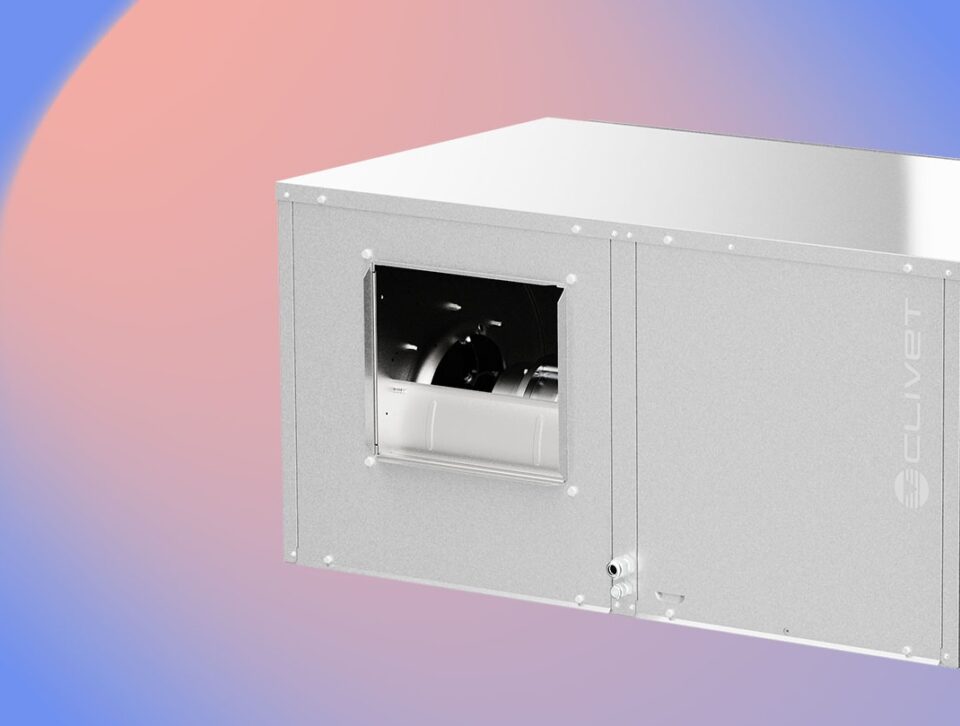
Clivet has launched a new generation of water-loop heat pumps aimed primarily at hotels, offices, shopping centres and other large buildings where different areas can require heating and cooling at the same time.
The new VERSATEMP range works quite differently from the air source heat pumps now appearing outside British homes. Instead of every unit extracting heat directly from outdoor air, individual heat pumps are connected to a shared closed water circuit running through the building. That water becomes the medium through which thermal energy can be moved from one part of the property to another.
The interesting part comes when different areas need opposite things.
A south-facing office exposed to strong sunlight might require cooling while a north-facing part of the same building still needs heating. Rather than simply throwing the heat removed from the warm office outside, a water-loop system can transfer it into the common water circuit. Heat pumps serving the colder areas can then recover and reuse it.
In effect, the building can move unwanted heat from somewhere that has too much of it to somewhere that needs it.
That principle has obvious attractions in hotels, offices and shopping centres where occupancy, solar gain and internal heat loads vary considerably throughout the day. It is a more sophisticated version of an idea that is becoming increasingly important throughout building design; stop treating heating and cooling as entirely separate problems and start managing heat as an energy resource.
Clivet’s new VERSATEMP range comes in two forms. VERSATEMP FLOOR covers smaller outputs from 1kW to 3kW and is intended for vertical installation within individual spaces, while VERSATEMP DUCT is a ceiling-mounted ducted system spanning outputs from 2kW to 28kW.
One of the more practical aspects of the system is its modularity. Because individual areas are served by separate units, parts of a building can potentially be upgraded independently. A hotel, for example, could refurbish a floor or group of rooms without replacing the entire heating and cooling system in one operation.
That could also make maintenance less disruptive. A fault or service requirement affecting one unit should not necessarily take heating or cooling away from the rest of the building.
The refrigerants are also noteworthy. VERSATEMP FLOOR uses R290, better known as propane, while the ducted range uses R454C. Clivet says the systems have been designed to meet the next stage of European F-Gas restrictions applying to equipment below 50kW from January 2027.
Homeowners following the domestic heat pump market will already be familiar with the rapid move towards R290. What is interesting here is seeing the same refrigerant transition spreading through much more specialist commercial equipment.
The units are also heavily connected. Individual systems can be controlled locally or remotely while larger installations can be managed centrally, giving building operators oversight of multiple zones and their energy demands.
None of this means water-loop heat pumps are about to start appearing in ordinary three-bedroom semis. They solve a very different problem.
But developments such as this are useful reminders of just how broad the heat pump sector has become. In the UK, the public conversation still tends to reduce heat pumps to an air source unit replacing a domestic gas boiler. In reality, electrified heating and cooling now encompasses air-to-water, air-to-air, ground source, shared-loop and water-loop systems serving everything from individual rooms to large commercial buildings.
There is also a principle here that could become increasingly important as buildings become smarter and more energy efficient. Generating heat while simultaneously throwing usable heat away elsewhere is inherently wasteful. Systems capable of recovering and redistributing that energy offer another route to lowering overall demand.
As ever, however, clever technology does not guarantee clever outcomes. Hydraulic design, controls, commissioning and installer competence will ultimately decide whether the theoretical efficiencies translate into lower energy consumption in real buildings.
That is exactly the same lesson we repeatedly see with domestic heat pumps. The machine is only one part of the system.
Clivet’s VERSATEMP therefore interests us less as another product launch and more as an indication of where heating and cooling technology is moving: towards lower-impact refrigerants, decentralised equipment, increasingly intelligent controls and buildings that move heat around rather than continually making it in one place and discarding it somewhere else.
It may not be coming to your living room, but the thinking behind it is worth watching.
